
Cost is a crucial consideration before purchasing or arranging something. Therefore, the cost to apply for Indonesia type approval is something you need to know in advance.
It is not free! The DJID certification process requires a fee. In fact, the cost to apply for Indonesia type approval is quite high in Southeast Asia.
In this case, the criteria are set by DJID or the Directorate General of Digital Infrastructure Resources. This is the agency that regulates the approval process for telecommunications devices entering and circulating in the country.
Also Read
Knowing the cost to apply for Indonesia type approval will help you plan your budget. That way, you can estimate your expenses accurately and allocate funds effectively.
Regulations in Indonesia
The cost to apply for Indonesia type approval is not without basis, as stipulated in Government Regulation (PP) Number 43 of 2023 concerning “Types and Rates of Non-Tax State Revenue.”
Article 1 of the regulation explains that the issuance of certificates and testing of telecommunications devices are included in the types of non-tax state revenue that apply. Thus, all of these costs will go to the state treasury and be calculated as Non-Tax State Revenue (PNPB).
This regulation also explains in detail all costs for testing telecommunications devices and issuing certificates. It should be noted that device testing and certificate issuance are two separate costs.
Therefore, to obtain the DJID certification, you need to pay for device testing and certificate issuance.
Different Testing Paths, Different Costs
Before finding out the cost to apply for Indonesia type approval, you need to know that there are several certification paths. These paths are divided into four parts, namely local testing, administrative documents, document evaluation based on the Radio Frequency (RF) module report, and partial paperwork.
Each application route for Indonesian type approval has a different fee. You can choose the route that suits your application needs.
Local testing
Local testing for Indonesian type approval is one of the routes that applicants can take. Taking this route means conducting all necessary tests in an accredited laboratory in Indonesia.
This is the most comprehensive route in the DJID certification process. Although optional, local testing for Indonesian type approval is the recommended option. In fact, it will become mandatory by 2026.
Local testing will be conducted at a DJID-accredited laboratory. Five technical tests must be passed.
- Radio Frequency (RF) Test
- Electromagnetic Compatibility (EMC) Test
- Electrical Safety Test (Only required for products directly powered by AC power)
- Laser Safety Test
- Specific Absorption Rate (SAR) Test (Only mandatory for tablets or phones)
By taking this path, you will need to prepare costs for device testing and certificate issuance. However, even though you have to pay for both, this path is still more cost-effective than just going through document evaluation.
Testing laboratories
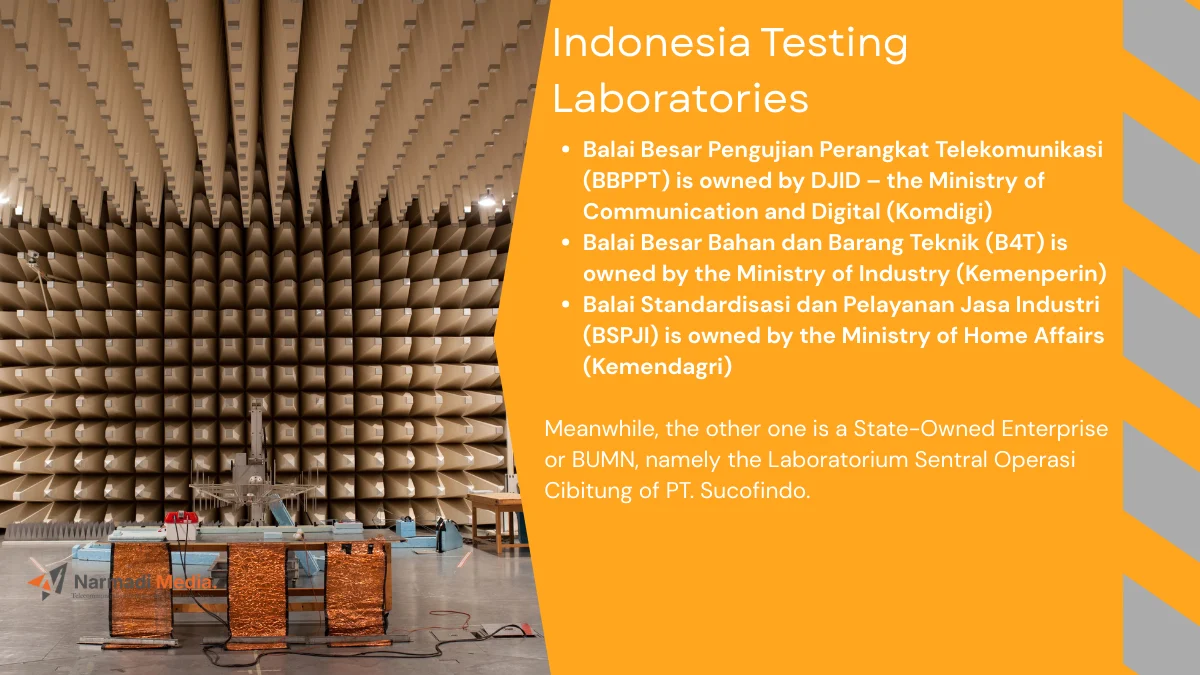
The establishment of testing laboratories in Indonesia is regulated by Ministerial Regulation No. 16 of 2018. There are 10 domestic laboratories recognized by DJID. Therefore, the testing process must be carried out in accordance with the provisions of these laboratories.
Each testing center has its own testing scope. Therefore, your device may not be tested at only one laboratory, depending on the features of the telecommunications device.
Of the 10 domestic testing centers, 3 are owned by the Indonesian government:
- Balai Besar Pengujian Perangkat Telekomunikasi (BBPPT) is owned by DJID – the Ministry of Communication and Digital (Komdigi)
- Balai Besar Bahan dan Barang Teknik (B4T) is owned by the Ministry of Industry (Kemenperin)
- Balai Standardisasi dan Pelayanan Jasa Industri (BSPJI) is owned by the Ministry of Home Affairs (Kemendagri)
Meanwhile, the other one is a State-Owned Enterprise or BUMN, namely the Laboratorium Sentral Operasi Cibitung of PT. Sucofindo.
Document evaluation
Document evaluation or file submission for Indonesian type approval is one alternative option that is still available at this time. By taking this route, you do not need to conduct testing in an Indonesian laboratory.
This means the cost to apply for Indonesia type approval is only the certification issuance. The requirement is that you must have a test report from an international laboratory that is registered and accredited by DJID and must comply with the technical testing standards applicable in Indonesia.
The required RF, EMC, and Electrical Safety test reports will be collected along with other document requirements for type approval in Indonesia. If Laser Safety and SAR testing is required, the testing must be conducted at a local laboratory in Indonesia. This means the cost to apply for Indonesia type approval will include additional testing and the certification issuance.
Document evaluation based on RF module reports
Document evaluation based on RF module reports is specifically intended for tools or devices whose radio frequency parameter test results do not meet or do not comply with DJID requirements. This is usually due to regulatory differences between other countries and Indonesia.
In this case, RF testing must be repeated. However, this only applies to modules within the product, not the final product. Testing can be conducted at an international laboratory registered and accredited by DJID or at a laboratory in Indonesia.
If you choose to conduct local testing, the cost to apply for Indonesia type approval will include the additional testing and certificate issuance. This route is often used for household appliances, including refrigerators, freezers, washing machines, and others.
Partial paperwork
Partial documents are intended for companies that have undergone international testing but do not yet fully meet Indonesian technical requirements. This is usually because one or more types of testing have not been carried out.
For example, telecommunications and wireless products that have undergone RF and EMC testing in overseas laboratories. However, according to technical regulations in Indonesia, these products are also required to undergo electrical safety testing.
In such cases, electrical safety testing must be carried out in Indonesia at the time the application is submitted. This means the cost to apply for Indonesia type approval will include additional testing and certificate issuance fees.
Cost to Apply for Indonesia Type Approval

Local testing fees
The first cost to apply for Indonesia type approval is the testing fee. Please note that the regulations for setting testing fees are only applicable and implemented by Indonesian government-owned testing institutions. Of the three government-owned laboratories, BBPPT is the most comprehensive. Here, all five types of testing can be carried out.
Therefore, we only list the testing fees for devices published by BBPPT. The following are the testing fees for the DJID certification at the Telecommunications Equipment Testing Center (BBPPT) owned by Komdigi.
| No | Cluster Name | Feature Name | Rate |
| 1 | All Types of Passive Antennas (All Range) | Inner transmitter antenna, broadcast transmitter antenna | IDR 6.000.000 |
| 2 | Gateways, Switches, Routers, Multiplexing, and Signaling | All Types of Features | IDR 8.000.000 |
| 3 | Gateways, Switches, Routers for Customer Premises Equipment (CPE) | Router (CPE) | IDR 3.000.000 |
| 4 | Optical Fiber/Optical Network Interfaces; Hybrid Fiber-Coaxial (HFC) Devices and Internet Protocol (IP) Interface Devices | All Types of Features | IDR 9.000.000 |
| 5 | Telecommunications Network Controllers | Telecommunications Network Controller | IDR 11.000.000 |
| 6 | Audio Broadcasting Transmitters | All Types of Features | IDR 7.000.000 |
| 7 | Television Broadcasting Transmitters | All Types of Features | IDR 9.000.000 |
| 8 | Public Switched Telephone Network (PSTN) and Power Line Network Devices | All Types of Features | IDR 7.000.000 |
| 9 | Mobile Phones and Mobile Modems | All Types of Features | IDR 5.500.000 |
| 10 | Radar | All Types of Features | IDR 9.000.000 |
| 11 | High Frequency (HF)/Very High Frequency (VHF)/Ultra High Frequency (UHF) Radio Communications | All Types of Features | IDR 5.000.000 |
| 12 | Maritime and Aeronautical Radio Communication | All Types of Features | IDR 7.000.000 |
| 13 | Point-to-Point/Multipoint Radio | All Types of Features | IDR 8.000.000 |
| 14 | Mobile System Centers and Broadband Wireless Access (BWA) | All Types of Features | IDR 7.000.000 |
| 15 | Set Top Box/Digital Standard Television | All Types of Features | IDR 6.500.000 |
| 16 | Short Range/Low Power Devices | All Types of Features | IDR 4.500.000 |
| 17 | Satellite-Based Telecommunications | All Types of Features | IDR 7.000.000 |
| 18 | Mobile Transceivers and Mobile Repeaters | All Types of Features | IDR 9.000.000 |
| 19 | Electrical Safety | Electrical Safety | IDR 1.500.000 |
| 20 | EMC | All Types of Features | IDR 5.000.000 |
| 21 | Specific Absorption Rate (SAR) | All Types of Features | IDR 7.000.000 |
Certificate issuance fees
The second cost to apply for Indonesia type approval is the issuance of a certificate. This will depend on the product you are applying to have certified and the certification path you are taking.
DJID certification is divided into two types of products:
- HKT: Mobile phones, handheld computers, and tablets
- Non-HKT: Outside of these categories
Certification pathways are also divided into two categories:
- Domestic laboratories
- Overseas laboratories (based on attached test reports)
Overseas laboratory test reports are also divided into two types:
- Mutual Recognition Arrangement (MRA): An agreement between Indonesia and other countries and/or laboratories to mutually recognize conformity assessment results.
- Non-MRA: Outside laboratories that collaborate with the Indonesian government.
The following are the complete DJID certificate issuance fees taken from the sertifikasi.postel.go.id website:
| Description | Cost |
| New Certificates of HKT & Non-HKT with Local Lab Test Report | IDR 12.000.000 |
| New Certificate Non-HKT – Overseas Lab Test Report with Non-MRA | IDR 60.000.000 |
| New Certificate Non-HKT – Overseas Lab Test Report with MRA & Non-MRA | IDR 60.000.000 |
| New Certificate Non-HKT- Overseas Lab Test Report with MRA | IDR 50.000.000 |
| New Certificate Non-HKT – Combination Test Report with Non-MRA | IDR 40.000.000 |
| New Certificate Non-HKT – Combination Test Report with MRA & Non-MRA | IDR 40.000.000 |
| New Certificate Non-HKT – Combination Test Report with MRA | IDR 30.000.000 |
| New Certificate HKT – Overseas Lab Test Report with Non-MRA | IDR 80.000.000 |
| New Certificate HKT – Overseas Lab Test Report with MRA & Non-MRA | IDR 80.000.000 |
| New Certificate HKT – Overseas Lab Test Report with MRA | IDR 60.000.000 |
| New Certificate HKT – Combination Test Report with Non-MRA | IDR 50.000.000 |
| New Certificate HKT – Combination Test Report with MRA & Non-MRA | IDR 50.000.000 |
| New Certificate HKT – Combination Test Report with MRA | IDR 40.000.000 |
Payment Process
The cost to apply for Indonesia type approval, including local testing fees and certificate issuance fees, will be paid in two separate stages. Local testing fees must be paid before testing can be carried out. Testing can only be carried out after payment has been made.
The certificate issuance fee must be paid after passing the document evaluation. DJID will issue a Certificate Payment Invoice (SP2). After the SP2 is issued, you must pay it within a maximum of 14 working days. The certificate can be obtained a maximum of 24 hours after the SP2 is paid.
What Should Be Done After the Certificate Is Issued?
The certificate will be issued after the cost to apply for Indonesia type approval is paid in full. If you have paid SP2, you can download the certificate from your e-certification account.
This means that your product has officially obtained permission to use telecommunications equipment/devices in Indonesia. However, certification is not the only requirement for selling telecommunications and wireless devices.
There are label requirements for Indonesia type approval that must be met. All devices that have been certified by DJID must be labeled. The label requirements consist of three components: identification (certificate number and PLG ID), QR code, and warning label. All three components must be affixed to the product and its packaging.
That is all you need to know about the cost to apply for Indonesia type approval. By knowing this from the outset, you can better plan your budget.
Basically, applying for the DJID certification requires a fee depending on the application route chosen. Broadly speaking, there are two things that need to be paid for, namely local testing and certificate issuance.
Problems with the cost of applying for Indonesian type approval can cause delays in marketing your product. To avoid this problem, you can consult with Narmadi Company.
Your RF type approval issues will be resolved effectively and efficiently. If you use our services, we will pay all certification application fees in advance. You can pay the entire fee once the certificate has been issued.
Additionally, our pre-testing services will reduce the risk of failure in the laboratory and the certification process can be monitored in real-time. We even have a team of professionals with over 15 years of experience and a network in various countries that can help you penetrate the global market.