
Manufacturers need to be aware of local testing for Malaysia type approval. Although not the main requirement, this will be one of the keys needed to access the market through the SIRIM certification process.
Testing is used to ensure that devices on the market meet the safety and quality standards set in Malaysia. SIRIM, or the Standard and Industrial Research Institute of Malaysia, is the agency that regulates local testing for Malaysia type approval as one of the approval processes for telecommunications equipment, if required.
Is local testing for Malaysia type approval mandatory? Is it permissible to conduct testing in international laboratories? We will answer these questions in detail in this article.
Also Read
What is Local Testing for RF Type Approval?
Each country has its own rules for the use of frequencies, power levels, and permitted emissions. This is where local testing for Radio Frequency (RF) type approval comes in. The process involves testing samples of telecommunications or wireless devices in the country of intended marketing.
Although some countries make local testing an option if needed. There are even countries that do not accept local testing, only evaluating test results from accredited international labs. However, the permitted frequency, power level, and emissions must still be met.
This is done to ensure that wireless products comply with the destination country’s spectrum rules, interference limits, and safety standards. Additionally, this ensures that the device can work safely and effectively in the environment of a particular country.
Local testing may be required as an alternative that can be chosen by the applicant for Malaysia type approval certification process.
Testing Process
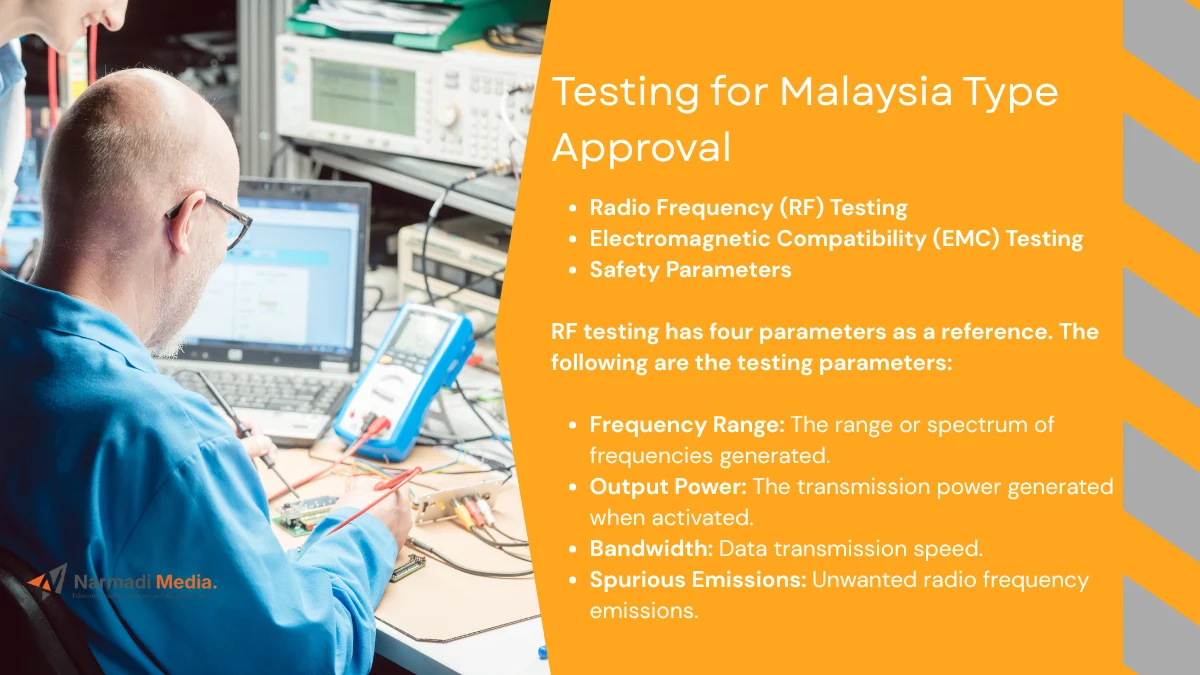
There are three types of testing processes required to apply for Malaysian type approval certification. These tests include:
- Radio Frequency (RF) Testing: This process is conducted on devices that use radio frequencies to evaluate wireless signal transmission.
- Electromagnetic Compatibility (EMC) Testing: A testing process for devices to ensure that they do not interfere with other devices.
- Safety Testing: Ensuring that the device is safe to use for equipment and power adapters.
RF testing has four parameters as a reference. The following are the testing parameters:
- Frequency Range: The range or spectrum of frequencies generated.
- Output Power: The transmission power generated when activated.
- Bandwidth: Data transmission speed.
- Spurious Emissions: Unwanted radio frequency emissions.
Local Testing for Malaysia Type Approval
Local testing for Malaysia type approval is one of the paths that applicants can take. Taking this path means conducting all necessary tests in an accredited laboratory in Malaysia.
This is not a recommended path and is uncommon in the SIRIM certification process. However, this path is often still required. Usually, this path is only required for mobile-based devices.
Additionally, IPv6 devices often undergo local testing in the field. Although testing for IPv6 devices can also be carried out in international laboratories, there is no obligation for local testing for these devices.
Test results from international laboratories that do not meet the technical specifications, frequency allocation, or requirements set must also undergo local testing. This refers to the Technical Code, Class Assignment (CA), Spectrum Plan, Standard Radio Spectrum Plan (SRSP), or Equipment Assignment (AA) applicable in Malaysia.
If local testing is conducted, SIRIM will request the sample unit. The number of samples to be submitted shall depend on the evaluation required. Generally, four units are required (for certification, communication testing, safety testing, and EMC testing.
The device has a cellular is still mandatory to pass the functionality. SIRIM will ask for one unit sample; most normal mode samples are sufficient for functional verification testing. SIRIM will not conduct full compliance testing.
Local testing is conducted fairly briefly. It is only done to confirm model and label checking parameters, confirm frequency bands, check output power, check connectivity, and conduct basic operation testing.
- Model and label check: A physical inspection will be conducted to verify that the model, brand, and rating label match the submission documents.
- Frequency band confirmation: The device will be verified to ensure that it operates within the permitted frequency band and is limited to channels approved in Malaysia.
- Output power check: ERP/EIRP will be randomly checked to ensure it is within the approved limits.
- Connectivity check: The test device will be checked to see if it can send and receive data normally.
- Basic operation test: The device will be powered on, transmission and reception behavior will be observed, and important functions will be ensured to be in accordance with the user manual.
Scope of Testing
| EMC Laboratory | RF Laboratory |
| 1. Information & Technology Equipment 2. Industrial, Scientific & Medical Product 3. Audio Video Product 4. Lighting Apparatus 5. Household AppliancesElectrical & Electronic 6. Sub-Assembly (Vehicle Component) 7. Electrical & Electronic Equipment in Military-related Applications 8. Radio & Telecommunication Product | 1. 3G/GSM Test System – Vehicle Tracking System- USB Modem- Mobile Station – Post Terminal 2. Anechoic Chamber (Semi & Fully) – Bluetooth Equipment- RFID- ISM 3. Security Device 4. Remote Control Device 5. Radio Test System (Shielded Room) – Land Mobile radio- Repeater- Base Station 6. Booster 7. Broadband Wireless Access 8. Broadband Over Powerline 9. Broadcasting Equipment 10. Aeronautical Communication System 11. VHF/UHF Transmitter 12. Telephony Test System – Facsimile Machine Modem- Post Terminal 13. Single Line Telephone 14. Private Automatic Branch Exchange (PABX) 15. Digital Enhanced Cordless Telecommunications (DECT) 16. FXO (Foreign Exchange Office) 17. Analogue Caller Line Identification Presentation (ACLIP) |
Malaysian Testing Laboratory
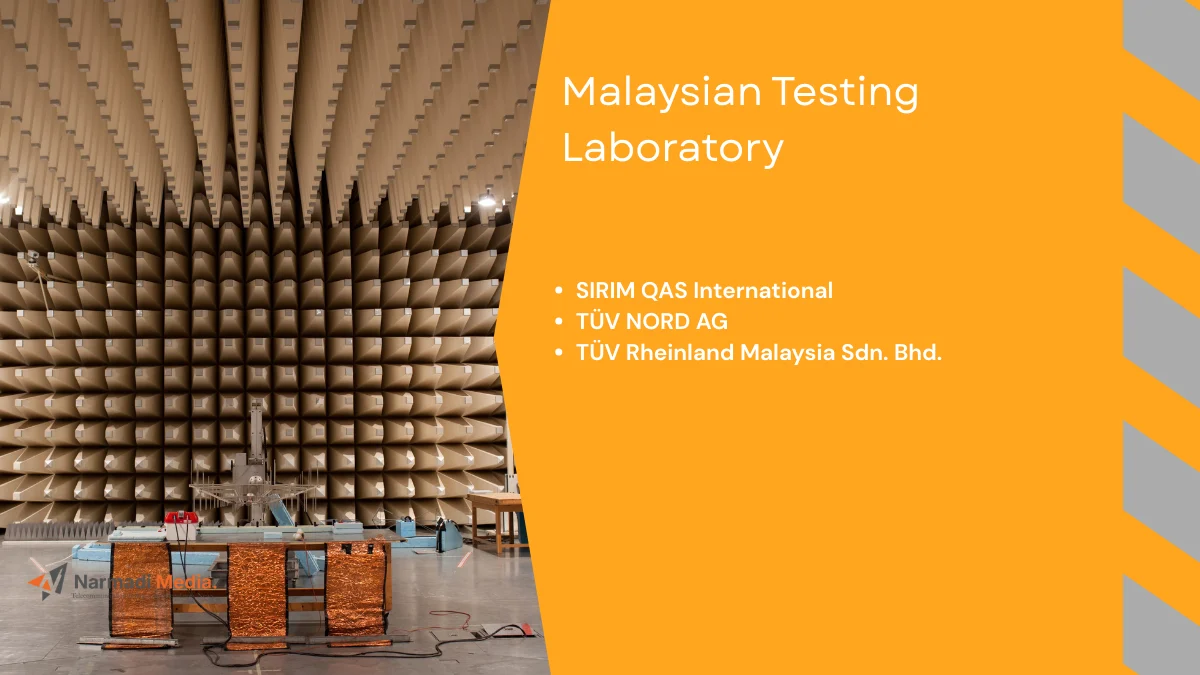
The following is a list of laboratories that can be used for local testing for Malaysia type approval:
| No | In-Country Lab Name | Address |
| 1 | SIRIM QAS International | SIRIM Complex, No. 1, Persiaran Dato’ Menteri, Section 2, P.O. Box 7035, 40700 Shah Alam, Selangor Darul Ehsan, Malaysia. |
| 2 | TÜV NORD AG | No. 9F-1A, 9th Floor, Tower 2 @ PFCC, Jalan Puteri, Bandar Puteri Puchong, 47100 Puchong, Selangor, MALAYSIA |
| 3 | TÜV Rheinland Malaysia Sdn. Bhd. | 27, Jln Para U8/103, Metropolitan Business Park, 40150 Shah Alam, Selangor, Malaysia |
For testing in international laboratories, ISO/IEC 17025 accreditation is required. Standards will refer to Conformité Européenne (CE) or Federal Communications Commission (FCC).
Finally, the question of whether local testing for Malaysia type approval has been answered. Local testing is not the recommended or common route in Malaysia.
However, this route is often still required. Usually, this route is only required for mobile-based devices, IPv6, and testing from international laboratories that do not meet SIRIM requirements.
Overseas laboratory testing is recommended with complete document requirements for Malaysia type approval. However, it must be ensured that the overseas laboratory meets technical standards and has the same testing coverage as SIRIM requirements.
Issues with local testing for Malaysia type approval can cause delays in the application process. To avoid these issues, you can consult with Narmadi Company.
We are ready to assist you in resolving RF type approval issues with a professional team that has over 15 years of experience. Your certification process will be effective and efficient with real-time monitored pre-testing services. Additionally, we have an international network that can help you penetrate global markets.