

Manufacturers need to know the lead time for Singapore type approval. Processing time is the most frequently asked question, especially when applying for IMDA certification for the first time.
Understanding the lead time for Singapore type approval will help you manage your business well. In this case, the criteria are set by the IMDA or Infocomm Media Development Authority, which is the institution that regulates the approval process for telecommunications devices entering and circulating in the country.
The lead time for Singapore type approval does not take long, as the most recommended route is the paperwork application. In this article, we will discuss in detail how long the process takes and why the local testing route is not recommended.
Also Read
Understanding the Lead Time Process for RF Type Approval
Applying for Radio Frequency (RF) type approval in several countries requires a series of steps before a certificate can be issued. Understanding the process and time frame will certainly allow you to measure many things.
First, you can plan your budget more accurately. By understanding the certification process, allocation can also be more effective.
Second, you can plan your business marketing strategy more smoothly. This is because the product release date and certification process are calculated accurately.
Finally, you can be better prepared for promotion. Marketing products with the waiting period in mind will prevent delays in marketing due to obstacles in the certification process.
IMDA Certification Process
Before finding out the lead time for Singapore type approval, you need to know the application process first. What is commonly known in the certification application process is the paperwork application and local testing.
The two certainly have different processing times. Usually, paperwork applications have a shorter lead time compared to local testing, which requires a fairly long testing process.
Document evaluation
Document evaluation or paperwork application for Singapore type approval is the recommended route for certification applications. Not only is the process short, but this pathway is also more cost-effective. Of course, this will affect your business calculations for the certification process in many countries.
The document evaluation process requires test reports from international laboratories that meet IMDA standards. In this case, international standards that meet IMDA standards, such as Conformité Européenne (CE) or Federal Communications Commission (FCC).
Testing laboratories must also be recognized by IMDA. This is based on Mutual Recognition Arrangements (MRAs), in this case, phase I mutual recognition. Other than that, the lab needs to have international ISO 17025 accreditation.
IMDA also accepts equipment certification from local or foreign certification bodies recognized under phase II mutual recognition arrangements.
Submitting paperwork means relying on strict document requirements for Singapore type approval. The document processing requires several documents to be submitted before the application is submitted via https://licensing.gobusiness.gov.sg/.
Before the certification is issued, there will be a payment process that you must complete. After that, the documents will be evaluated to determine whether they are accepted or rejected.
Local testing
Local testing for Singapore type approval is not the recommended route. Narmadi Company can say this not because the process is longer than the paperwork application, but because local testing in Singapore is expensive.
You certainly don’t want to waste a lot of money on the same process, right? However, you don’t need to worry if you don’t have the test reports for the certification process yet. We can still help you with the testing process.
Instead of using a Singapore lab, we can help with the process using a lab that also collaborates with IMDA. You can get the same process at a cost that is certainly more business-friendly.
Lead Time for Singapore Type Approval
The Singapore type approval application process does take time. However, by taking the recommended paperwork application route, you won’t need to wait long.
In fact, the lead time for Singapore type approval is the fastest compared to neighboring countries. The entire processing time, from submitting documents on the government portal to the issuance of the certificate, only takes about three working days. Very fast, isn’t it?
What Might Obstruct the Certification Process?
The lead time for Singapore type approval is indeed very fast. However, this is only if there are no obstacles in the process. If there are obstacles, the process will not run as smoothly.
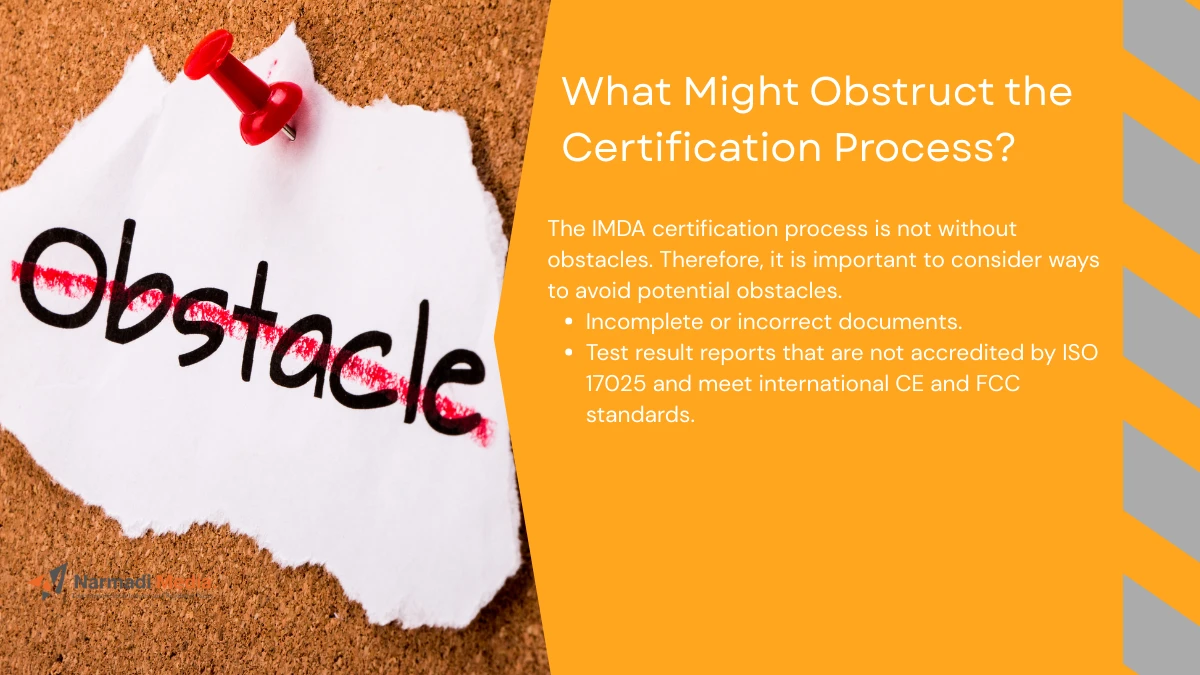
The IMDA certification process is not without obstacles. Therefore, it is important to consider ways to avoid potential obstacles.
Often, applicant for Singapore type approval submit incomplete or incorrect documents. This will certainly hinder the certification process, as it is not possible to submit complete documents on the submission portal. Therefore, it is important to complete them from the outset.
It has been stated that IMDA only accepts test reports from laboratories that have collaborated with or are accredited by ISO 17025 and meet international CE and FCC standards. Test reports that do not comply with the requirements will not be accepted. This will require you to conduct retesting.
That is the information regarding the lead time for Singapore type approval. Basically, the recommended process in Singapore to get fast results is through document evaluation.
Considering the time needed to apply for IMDA certification will greatly impact your business, from budget to market readiness. Additionally, considering the obstacles that may arise during the certification process will also make everything run smoothly.
Issues with the lead time for Singapore type approval can cause many problems. From cost overruns to missed product marketing schedules. Consulting with Narmadi Company for the certification process will help you avoid these problems.
With over 15 years of experience and a professional team, we will ensure all documents are submitted correctly. This ensures the RF type approval process runs effectively and efficiently, keeping the IMDA certification lead time within estimates.