
Manufacturers need to be aware of the importance of Thailand type approval. This is one of the key requirements for accessing the Thai market.
Thailand is one of the strongest countries in Southeast Asia, with the eighth largest economy in Asia and the second largest in Southeast Asia after Indonesia. This is due to its GDP increasing to US$505 billion (World Bank data 2018). Therefore, Thailand type approval guidelines are necessary to market these products.
Thailand type approval is commonly referred to as NBTC certification. It is a compliance instrument that must be fulfilled by manufacturers, importers, and distributors. By understanding the complete guidelines for this process, your products will be easier to market and use in Thailand.
Also Read
What is Thailand Type Approval?
Thailand type approval is regulated by the National Broadcasting and Telecommunications Commission (NBTC). This is an independent state regulatory body responsible for managing and regulating radio frequency spectrum, broadcasting, television, telecommunications, satellites, and radiocommunications business operations in Thailand.
Additionally, this authority also issues a certificate of compliance called the “NBTC Certificate.” The NBTC certification process is necessary to ensure that telecommunications and wireless devices meet technical, compatibility, and safety standards in accordance with applicable regulations in Thailand.
By obtaining NBTC certification, devices are guaranteed to be safe for users, and they are not expected to interfere with the functioning of other devices when used simultaneously.
Scope of Products Requiring Certification
Thailand type approval is divided into three classes. These classes are Class A, Class B, and Supplier’s Declaration of Conformity (SDoC). NBTC certification does not only apply to telecommunications products. However, this certification is also mandatory for all products that have telecommunications or radio frequency features.
Here are some examples of products that require Thailand type approval:
| Class Type | Products |
| Class A | – Drones – Wireless microphones – Vehicle radar – Satellite communication equipment |
| Class B | – Cellular land mobile radio – Mobile equipment |
| SDoC | – WiFi – Bluetooth – RFID – NFC – SRD equipment |
Who Can Apply for Certification?
Applicants for Thailand type approval certification are regulated in the Public Guide: Approval Certification of Radiocommunication Equipment and Devices in Broadcasting Business and Television Business. The regulation explains that NBTC certification applicants must be Thai citizens or legal entities established under Thai law.
For legal entities established under foreign law or domiciled abroad, they must have a representative in Thailand. Local Thai companies must be license holders related to the Broadcasting and Television Business Act.
Registered local companies must submit their applications to the NBTC Office. Subsequently, the company will be assigned a four-digit supplier code as an NBTC applicant for the certification application process.
NBTC Certification Process
The Thailand type approval certification process is divided into two methods, namely document evaluation and local testing. However, the local testing method is not mandatory, so the document evaluation method is more recommended when applying for certification. This is because the local testing method requires expensive testing costs and a longer waiting time.
In the document evaluation, applicants are expected to have conducted testing at an ISO/IEC 17025-accredited international laboratory. These standards refer to Conformité Européenne (CE) or the Federal Communications Commission (FCC) for Radio Frequency (RF) testing and Electromagnetic Compatibility (EMC) testing.
Alternatively, if necessary, other relevant test reports, such as safety test reports and Specific Absorption Rate (SAR) reports, should be attached.
Document evaluation
To apply for Thailand type approval, applicants must prepare and submit the required documents. The document requirements that must be submitted to the NBTC Office for Class A, Class B, or SDoC are essentially the same.
Here is a list of the required documents for NBTC certification under the paperwork method:
- Application form specified by the NBTC Office
- Company registration certificate of the applicants (less than 90 days old)
- ID card or passport of the authorized director issued by the Thai authority
- Applicant’s username and password issued by the Department of Business Development (DBD)
- Power of attorney authorization letter
- Catalogue or technical specifications
- Test reports, approval certificate, or certificate of conformity
- Laboratory accreditation certificate
- NBTC certificate (if any)
- Equipment photos show front, back, sides, logo, and type/model of the equipment
Please note that Thailand type approval applications cannot be submitted online. Therefore, all documents must be submitted directly to the NBTC office. All documents must be in Thai or English.
Next, documents received by the NBTC office will be evaluated. If they pass the evaluation, certification will be prepared for issuance and legalization. If not, the applicant will be required to complete the missing documents before re-evaluation.
Local testing
As previously informed, local testing is not a mandatory requirement for obtaining Thai type approval. This route is considered to be more costly and time-consuming.
However, NBTC still provides local testing services for applicants who choose this option. If local testing is conducted, NBTC will require samples for testing. The samples must be from the same model as those being manufactured or imported.
Applicants need to provide two samples of telecommunications equipment along with the following documents:
- Testing application form
- Business license of the applicants
- Catalog or technical specifications
- User manual
- Circuit diagram
Certificate issuance
The NBTC certificate will be issued after going through the above process. For document-based applications, the processing time is relatively short, although it varies depending on the product class.
For Class A or Class B types in Thailand, the lead time is approximately six weeks. However, if local testing is conducted, the lead time will be longer. Meanwhile, for SDoC, certification is typically completed within two to four working days.
The NBTC certificate is valid indefinitely, provided that there are no modifications to the RF specifications of the equipment. If there are modifications to the equipment, certification is required by following the same process as the initial certificate application.
Modifications that affect recertification include replacing the transmitting antenna, changing the transmission power or RF wave characteristics, replacing the existing interface card, or adding a new interface card.
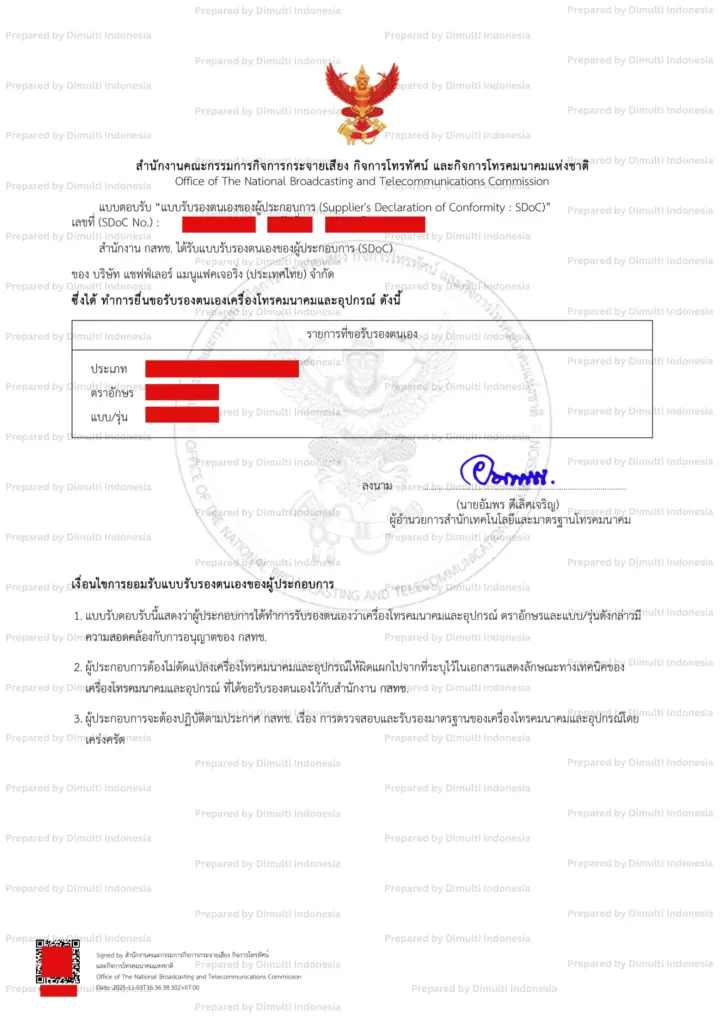
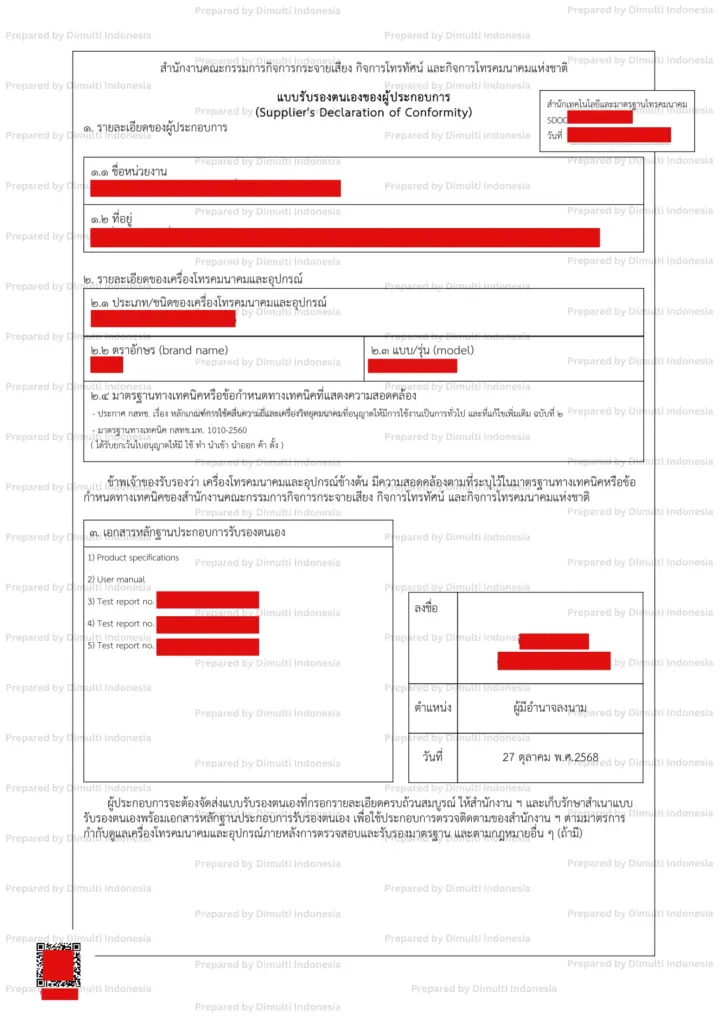
The following is an example of an NBTC certificate:
Labeling
All telecom and wireless devices certified by the Thailand type approval body must be labeled. This is stated in the National Broadcasting and Telecommunications Commission (NBTC) Announcement Volume 133, Special Chapter 178.
The labeling requirements for NBTC Thailand certification require the affixing of compliance labels on all registered products, user manuals, or packaging before the products are sold. Labels are not required at the import stage.
The NBTC label format is determined based on the equipment class, namely Class A, Class B, and Supplier’s Declaration of Conformity (SDoC). Each equipment class has its own label format.
For Class A and Class B, labels must be affixed to the surface of the product in a place that is easily visible and not easily removed. If the product is too small, it is permissible to affix the label to the packaging or user manual.
For the SDoC product, the statement must be attached to the user manual or other supporting documents accompanying the product. Examples include specification sheets or product compliance documents.
Class A
For class A equipment, here is the conformity mark format:
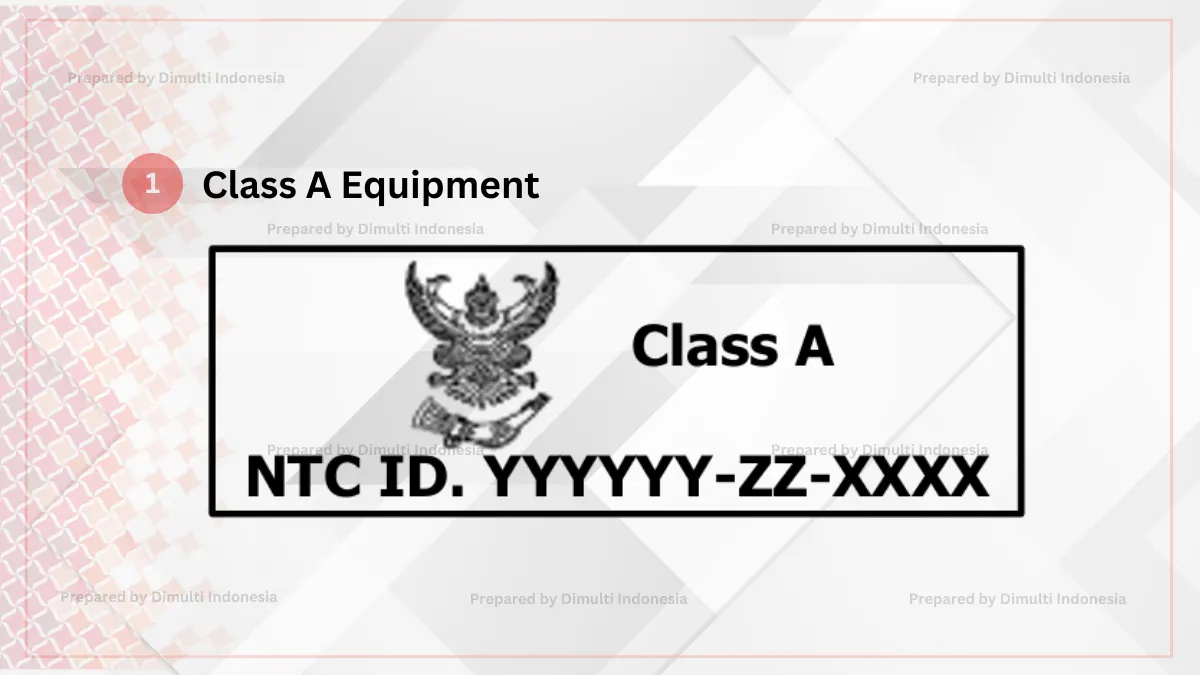
Where YYYYYY is the registration number (six digits), ZZ is the year of registration (last two digits of the year), and XXXX is the supplier code (four digits)
Class B Equipment
For class B equipment, here is the conformity mark format:
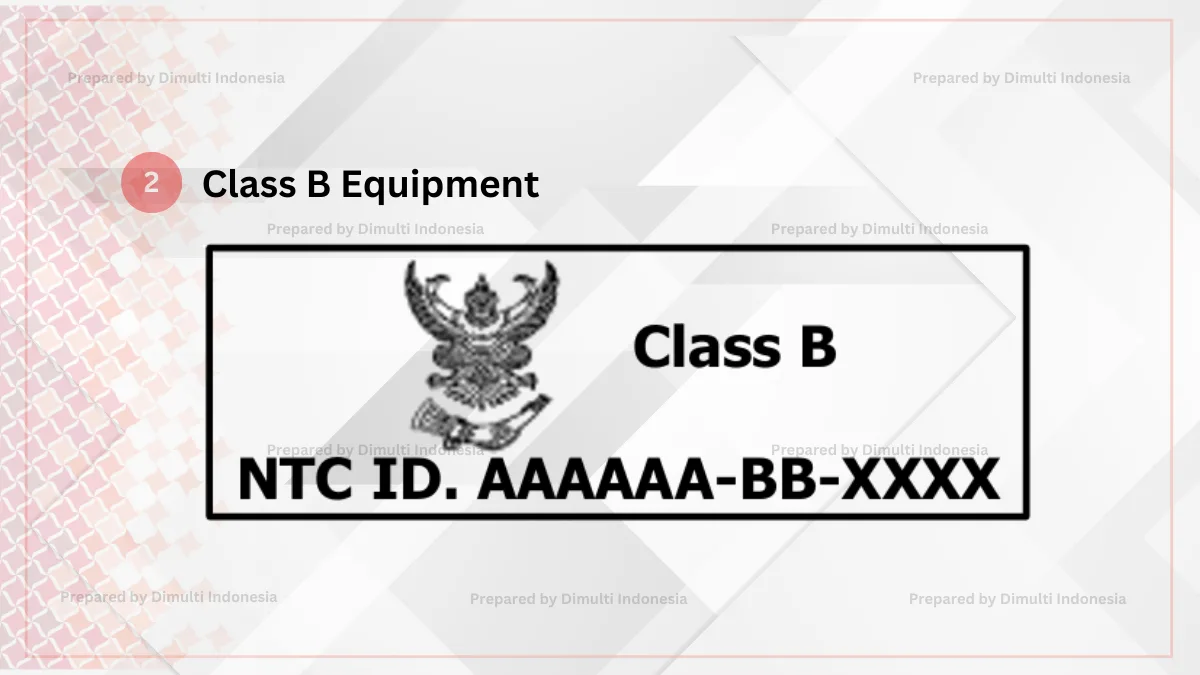
Where YYYYYY is the registration number (six digits), ZZ is the year of registration (last two digits of the year), and XXXX is the supplier code (four digits)
SDoC product
For the case of SDoC, the supplier is also mandatory to affix labels stating that the product has complied with certain Thai standards. The wording can follow the following format:
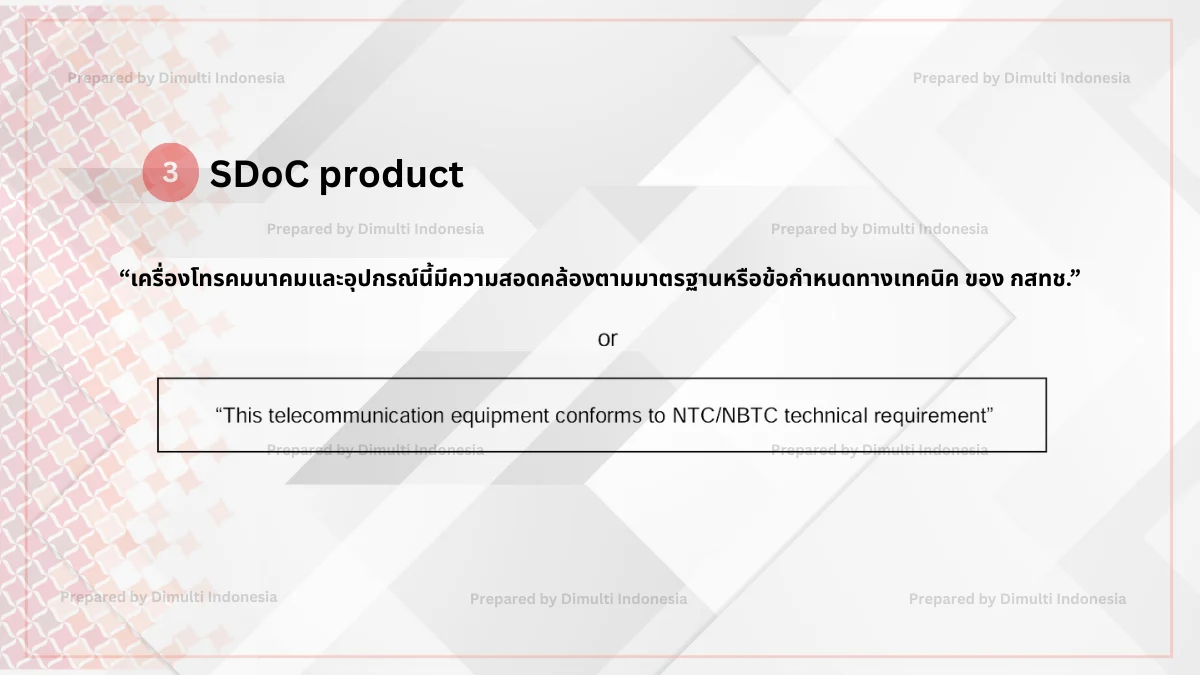
“เครื่องโทรคมนาคมและอุปกรณ์นี้มีความสอดคล้องตามมาตรฐานหรือข้อกำหนดทางเทคนิค ของ กสทช.”
Translation: This telecommunication equipment complies with NBTC’s standard or technical requirements.
NBTC Certification Management Services
Reviewing the entire NBTC certification process above may make you think that it will be difficult to manage. That may be the case, especially considering that three types of product classifications need to be taken into account.
You can simplify the entire Thailand type approval process by choosing the right certification management service. Narmadi Company, a provider of RF and telecommunications type approval certification services, is ready to help meet your needs.
We act as a reliable partner for manufacturers, importers, or distributors who are unfamiliar with the NBTC certification process. That way, any problems that may arise during the certification process will be handled correctly.
Since 2008, Narmadi has assisted hundreds of clients and thousands of RF type approval projects with efficient procedures. We are ready to help you manage all aspects of the compliance certification process with a team of experts who have more than 15 years of experience.
Here are our advantages:
- Certification process monitoring: You can monitor the certification process in real-time and transparently through the Project Management System (PMS).
- Pre-testing: For processes that require local testing, this is very helpful, as not many partners offer pre-testing services. Testing conducted in our internal laboratory before direct testing will prevent failure. This way, you will avoid costly losses.
- Global access: Not only in Thailand, but we also have a global partner network. For companies planning international market entry, Narmadi eliminates the need to find local partners independently, making the certification process more efficient and cost-effective.
The Thailand type approval certification process requires product classification, document collection, and direct submission of certification applications. To ensure efficiency and ease, feel free to contact us.