
Cost is the most important consideration before purchasing or arranging something. Therefore, the cost to apply for Thailand type approval is something you need to know in advance.
The certification process in Thailand certainly requires costs. In this case, the criteria are set by the NBTC or the National Broadcasting and Telecommunications Commission. This authority regulates the approval process for telecommunications devices entering and circulating in the country.
Knowing the cost to apply for Thailand type approval will help you plan your budget. That way, you can accurately estimate your expenses and allocate funds effectively.
Also Read
Different Testing Paths, Different Costs
Before looking at the cost to apply for Thailand type approval, it is important to understand that there are several certification paths available. These paths are divided into two parts, namely local testing and paperwork.
Each path for applying for a Thai type approval has different costs. You can choose the path that suits your application needs.
Local testing
Local testing for Thailand type approval is one of the paths that applicants can take. Taking this route means that you must conduct the required testing at a local laboratory in Thailand.
However, we do not recommend this route because it is expensive and time-consuming. The cost of Radio Frequency (RF) testing can be up to four times higher than the most expensive certification application (Class B). Meanwhile, the cost of Specific Absorption Rate (SAR) testing can be seven times higher.
Therefore, if you do not yet have test reports from overseas laboratories, the Narmadi team will assist you in finding a laboratory outside Thailand. The laboratories we select are, of course, those that meet Thai standards with ISO/IEC 17025 accreditation, and standards refer to Conformité Européenne (CE) or the Federal Communications Commission (FCC).
Paperwork
Paperwork for Thailand type approval is the route we recommend most. This method only evaluates all the documents you submit to the NBTC office. Of course, you must have obtained test results from a foreign laboratory in accordance with Thai standards.
RF test reports, Electromagnetic Compatibility (EMC), and SAR (if required) will be collected along with other document requirements for Thailand type approval. After that, all documents will be submitted directly to the NBTC office for evaluation.
Cost to Apply for Thailand Type Approval
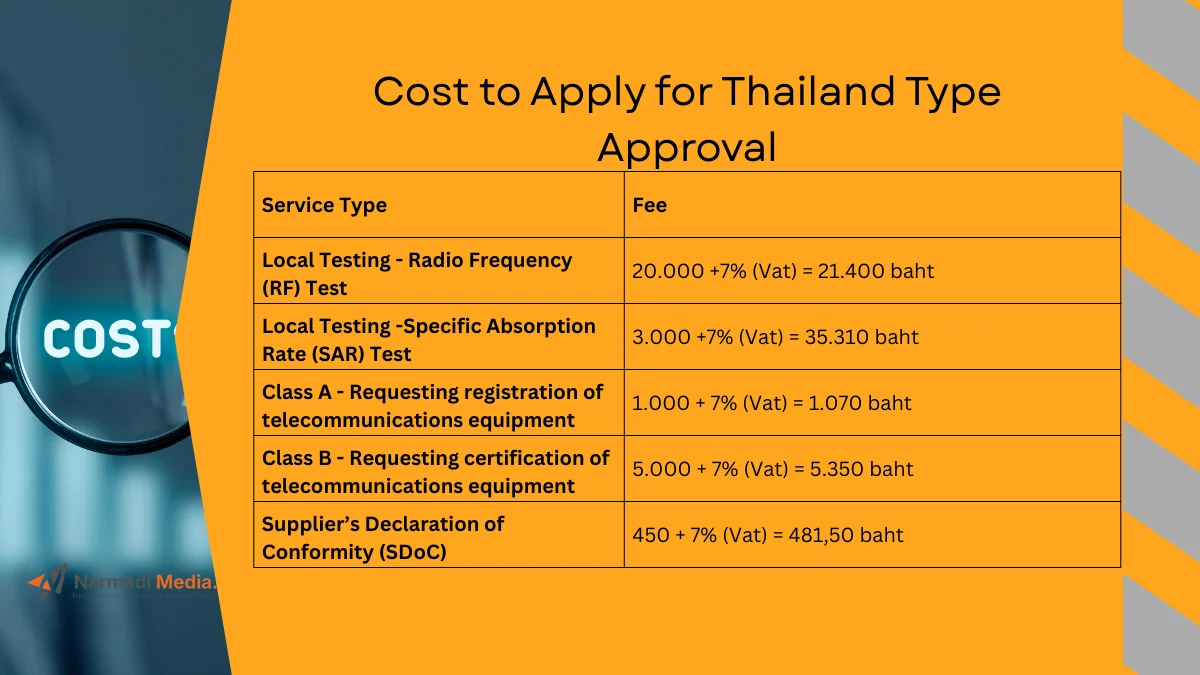
The cost to apply for Thailand type approval that we will display is the cost listed on the official website https://standard1.nbtc.go.th/. We checked this cost in February 2026. Once complete, all documents are submitted directly to the NBTC for evaluation.
| Service Type | Fee |
| Local Testing – Radio Frequency (RF) Test | 20.000 +7% (Vat) = 21.400 baht |
| Local Testing -Specific Absorption Rate (SAR) Test | 3.000 +7% (Vat) = 35.310 baht |
| Class A – Requesting registration of telecommunications equipment | 1.000 + 7% (Vat) = 1.070 baht |
| Class B – Requesting certification of telecommunications equipment | 5.000 + 7% (Vat) = 5.350 baht |
| Supplier’s Declaration of Conformity (SDoC) | 450 + 7% (Vat) = 481,50 baht |
Certificate Issued: Can the Product Be Marketed Immediately?
Once the evaluation process is completed, the certificate will be issued. This means that your product has officially obtained permission to use telecommunications equipment/devices in Thailand. However, certification is not the only requirement for selling telecommunications and wireless devices.
Thailand requires labeling for all certified telecommunications products. Every device approved by the NBTC must be labeled. Each type of certification—Class A, Class B, and SDoC—has different requirements.
For Class A and Class B, the label must be affixed to the surface of the product in a place that is easily visible and not easily removed. For SDoC products, the statement must be attached to the user manual or other supporting documents accompanying the product.
For more detailed requirements, you can refer to our previous article on label requirements for Thailand type approval.
That’s all you need to know about the cost to apply for Thailand type approval. Knowing this from the outset will certainly help you plan your certification budget better.
Basically, applying for NBTC certification requires a fee that depends on the type of application chosen. In general, there are three options: Class A, Class B, and SDoC. Local testing in Thailand is not recommended due to its high cost.
Issues related to the cost of applying for Thailand type approval can cause delays in marketing your product. Therefore, contact Narmadi Company first for consultation, so that all your RF type approval issues will be resolved.
If you use our services, we will cover all certification application costs upfront. You can pay the full amount only after the certificate is issued.
This way, you can focus on product development or other needs. Leave the certification process to us until the certification is issued. RF type approval issues will be resolved effectively and efficiently, right?