
Entering a country’s market to sell telecom and wireless devices requires compliance approval, and this also applies in Mexico. Therefore, understanding how to obtain Mexico type approval certification is essential.
The Mexican telecommunications market is a leading market in Latin America. This is due to the implementation of specific technologies such as fiber-to-the-home (FTTH), 5G adoption, and the prepaid market. Therefore, Mexico type approval guidelines are required to market these products.
Mexico type approval is known as NOM and CRT certification. Understanding the entire certification process is essential for all manufacturers, importers, and distributors before marketing and using their products in Mexico.
Also Read
What is Mexico Type Approval?
When discussing Mexico type approval, one cannot overlook the regulatory bodies involved. It is important to note that there are two types of certification for Information and Communication Technology (ICT) products in Mexico, each issued by a different authority based on specific requirements.
These certifications are NOM and CRT. NOM is the certification required for all types of telecommunications and ICT devices to be imported and marketed in Mexico. Meanwhile, CRT is an additional certification required for products with Radio Frequency (RF) features.
1. About NOM
Normas Oficiales Mexicanas (NOM) is the name of a series of mandatory technical regulations and standards issued by government agencies in Mexico. This certification is not administered directly by the government, but rather by several organizations designated as accredited Certification Bodies (CBs).
Obtaining NOM certification is mandatory for manufacturers wishing to import and market their telecommunications and ICT devices in Mexico.
2. About CRT
The Comisión Reguladora de Telecomunicaciones (CRT) is an additional certification for telecommunications products with RF features. The CRT is an agency under the Official Gazette of the Federation (DOF). It was formed from the National Antimonopoly Commission (CNA) and the Agency for Digital Transformation and Telecommunications (ATDT).
This certification is a new name officially adopted on October 21, 2025. Previously, it was known as the Federal Institute of Telecommunications (IFT).
Products Requiring Certification
There are two types of Mexico type approval: NOM and CRT. Both have specific product scopes that require certification.
There are various types of products covered by NOM standards that must be certified, as follows:
| Product | Detail Product |
| Electronic products | – Home appliances- Lighting equipment- Electronic components |
| Health products | – Pharmaceuticals- Medical devices |
| Telecommunications equipment | – Devices related to radiocommunication- Telecommunication technologies |
| Automotive parts | – Tires- Brakes- Airbags- Car seats |
| Toys | All children’s toys |
In addition to the telecommunications products listed above, NOM also sets standards for food and beverages, textiles and footwear, chemicals, and hazardous materials.
Meanwhile, all telecommunications products with RF features require CRT certification. This means that before applying for CRT certification, products must first complete the NOM certification process.
Who Should Be an Applicant for Certification?
Applicants for Mexico type approval for NOM and CRT certification must be registered local companies. They may be local manufacturers or importers.
Foreign companies cannot directly apply for the certification process. They must appoint a registered company to act as their local representative.
Mexico type approval certification is closely linked to the import process. The certification document will be required by customs for the import clearance process.
For companies that choose a local representative who is not an importer, the issued certificate cannot be used for importation. The certificate can only be used for marketing purposes.
Certification Process
The Mexico type approval process consists of two stages: NOM certification and CRT certification. Both require local testing as the only way to apply for certification.
Local testing means that the testing must meet the standards of laboratories in Mexico. Local testing requires the submission of samples. The number and type of samples will depend on the device’s features and the type of testing required.
1. Local testing
Local testing for Mexico type approval is a mandatory method. This method requires the applicant to submit samples for testing at a local laboratory in Mexico.
This process involves two types of testing: Radio Frequency (RF) Testing and Safety Testing. At least two samples are typically required, depending on the product’s features.
If the product features are more complex, additional samples are usually required. For example, an access point product with DFS features requires that the DFS be tested in a separate sample. This necessitates one additional sample for DFS testing.
In addition to samples, obtaining Mexico type approval also requires several documents to be submitted. The following documents are required:
- Mexican HS Code
- User manual in Spanish / including the following legend:
- La operación de este equipo está sujeta a las siguientes dos condiciones:
- Es posible que este equipo o dispositivo no cause interferencia perjudicial.
- Este equipo o dispositivo debe aceptar cualquier interferencia. Incluyendo la que pueda causar su operación no deseada
- La operación de este equipo está sujeta a las siguientes dos condiciones:
- Local rep PoA
- Contract signed by Local Rep, Lab, and CB
- Electrical ratings (safety only)
- Internal/external Pictures
- Test Instructions for RF and DFS (telecom only)
- Antenna details (for telecom approval only). Some information that needs to be provided:
- How many antennas
- Antenna gain
- Antenna type
- Block diagram
- Labelling artwork
- Datasheet of the product
2. Certificate issuance
Once all documents have been submitted, they will be evaluated. For telecommunications products without RF features, after passing local testing and ensuring all documentation requirements are met, the NOM certificate will be issued immediately by the Certification Body (CB).
For telecommunications products with RF features, after the NOM certificate is issued, the product must still undergo the CRT certification process. Only then can the CRT certificate be issued.
The entire NOM certification process, from testing to obtaining the certificate, takes approximately four to five weeks. Meanwhile, the CRT certification process has a relatively longer waiting period. This is because the NOM certification process must be completed first.
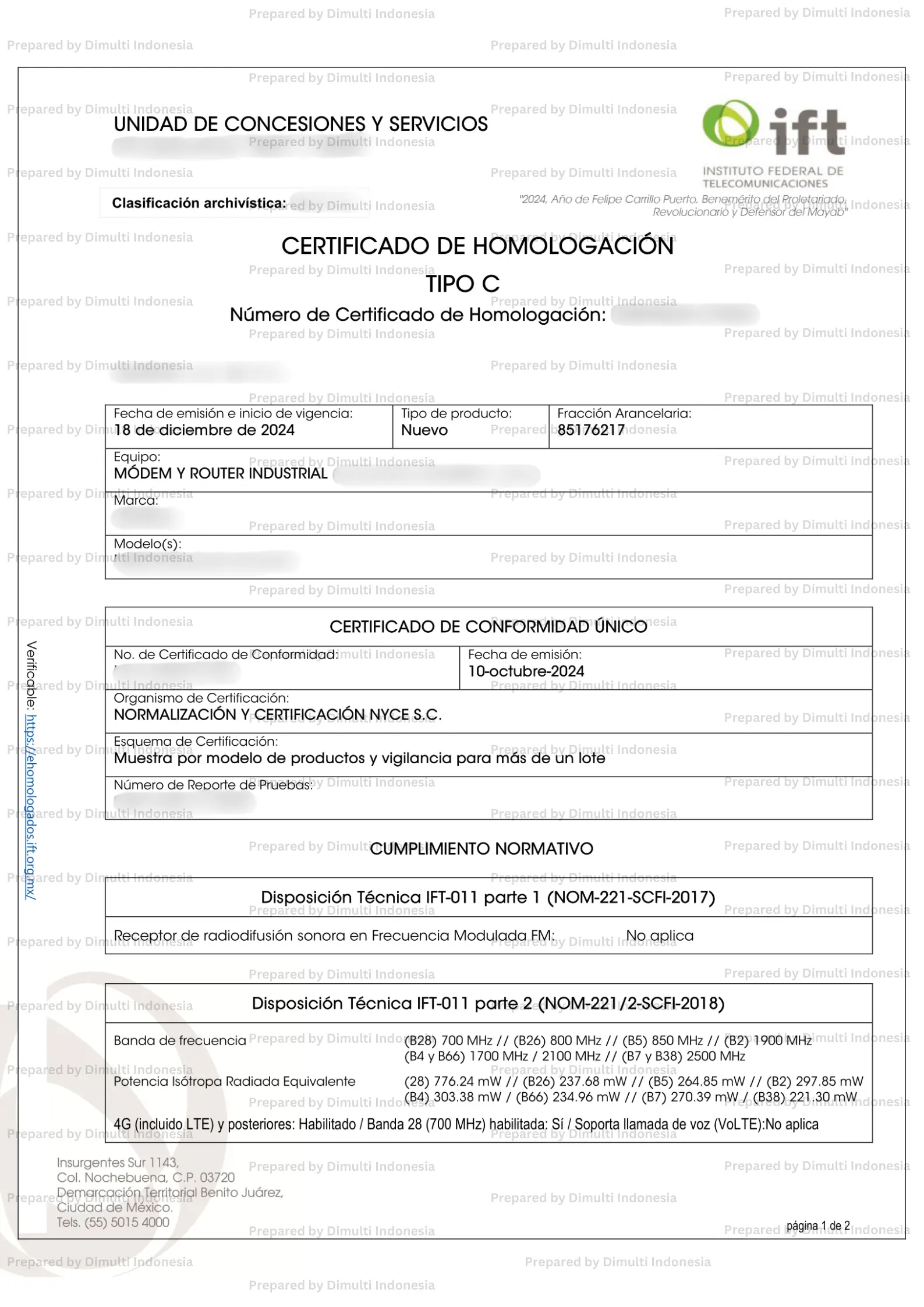
After the NOM certificate is issued, the process proceeds to CRT (IFT) certification with a processing time of approximately 20 business days. The total lead time for NOM and CRT certification is approximately 45 business days.
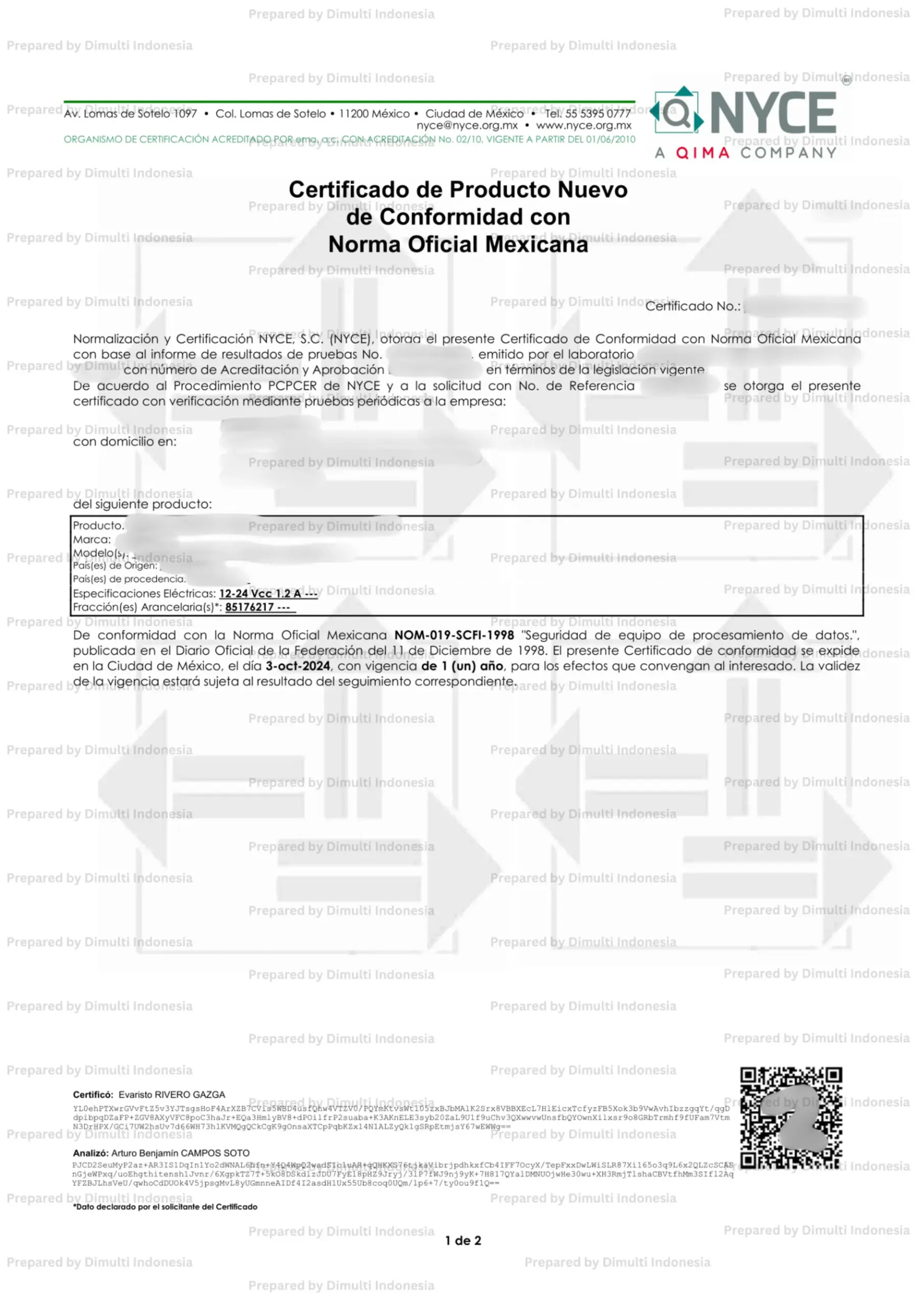
The NOM certificate is valid for one year, with an option for annual renewal six to nine months after the initial certification. Meanwhile, the CRT certificate has no expiration date.
The following is an example of a NOM certificate:
The following is an example of a CRT certificate:
3. Labeling requirements for Mexico type approval
All telecommunications devices certified by a Mexico type approval body must be labeled. The NOM label may be affixed directly to the product or applied as a sticker. There are no specific requirements regarding size, provided that the required information is clearly visible.
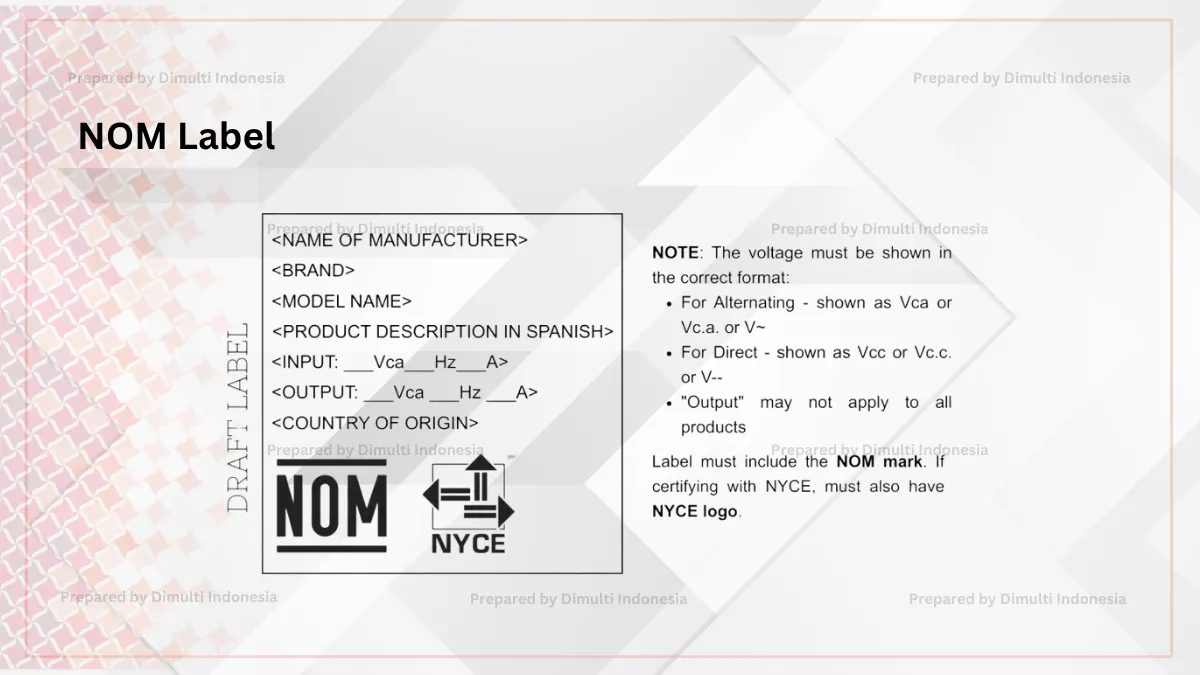
The following information must be included on the NOM label:
- Manufacturer information
- Brand
- Model name
- Product description in Spanish
- Electrical rating
- Country of origin
- NOM mark (NYCE logo required if certified by NYCE)
Here is an example of a NOM label:
Official information regarding the CRT label has not yet been released, as it is still in transition from the IFT. However, if based on existing IFT labels, the label must include the same information as the NOM label.
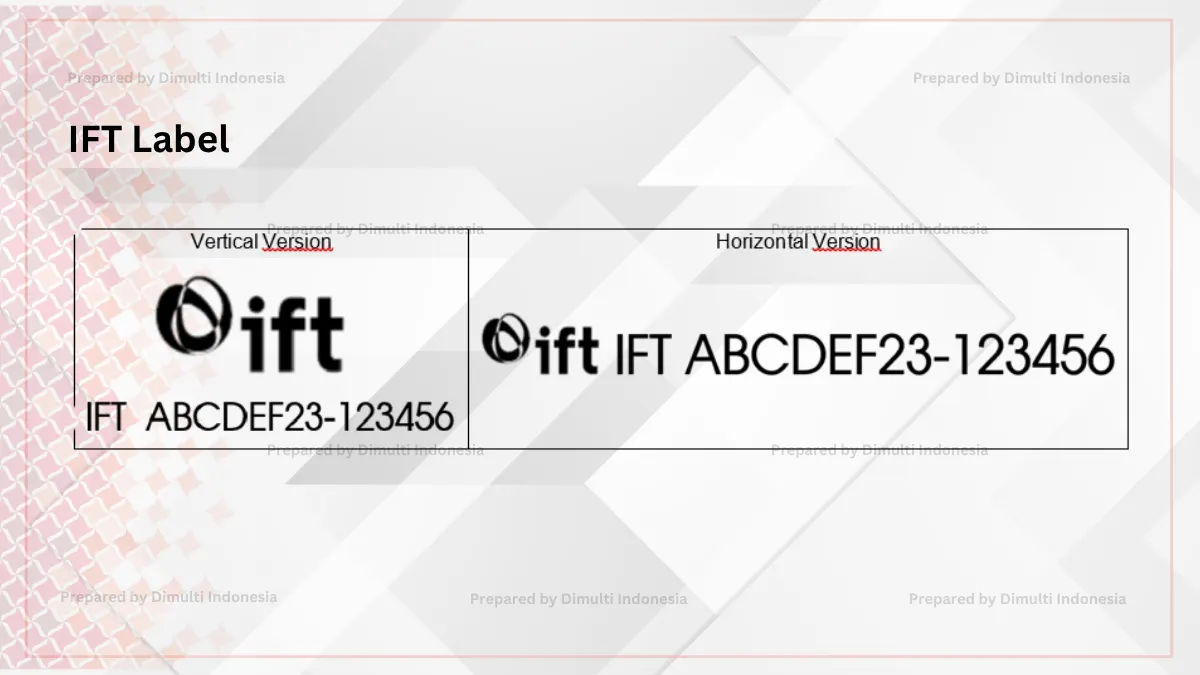
Two components must be included: the IFT symbol, the text “IFT”, and the certificate number. The IFT label can be displayed in either a vertical or horizontal orientation.
Here is an example of an IFT label:
NOM and CRT Certification Management Services
Do you find NOM and CRT certifications difficult to manage? It’s possible, especially given the lengthy processes involved in both certifications.
This can be simplified by choosing the right Mexico type approval certification management service. At Narmadi Company, as a provider of RF and telecommunications type approval certification services, we are ready to help meet your needs.
We are ready to partner with companies unfamiliar with the NOM and CRT certification processes. Your certification process will be handled by our team of experts with over 15 years of experience, ensuring everything proceeds smoothly.
We will help you manage all aspects of the compliance certification process. Since 2008, we have assisted hundreds of clients and thousands of RF type approval projects with efficient procedures.
Here are our key advantages:
- Certification process monitoring: You can monitor the certification process in real-time and transparently through our Project Management System (PMS).
- Pre-testing: Few partners offer pre-testing services. Our internal laboratory testing process prevents direct testing failures that could result in significant losses.
- Global access: Not only in Mexico, but we also have a network of partners worldwide. For those looking to market globally, through Narmadi, you don’t have to go through the hassle of finding partners in your target country. The certification process becomes more efficient and cost-effective.
The Mexico type approval certification process requires a thorough understanding. This includes understanding the two types of certification available, document collection, local testing, and submitting the certification application. To make it efficient and easy, don’t hesitate to consult with us!