

Manufacturers need to be aware of Indonesia type approval. This is one of the keys to accessing the market of this country of a thousand islands.
Indonesia has undoubtedly become a marketing destination for telecom and wireless products for manufacturers, importers, and distributors. Therefore, an Indonesia type approval guide is needed to market these products.
Indonesian approval is referred to as DJID certification, a compliance instrument that manufacturers, importers, and distributors must adhere to. By understanding the complete guidelines for this process, your products will be easier to market and use in Indonesia.
Also Read
What is Indonesia Type Approval?
Indonesia type approval is regulated by the Ministry of Communication and Digital, or KOMDIGI for short, which is called the Ministry of Communication and Digital in English. This ministry is responsible for setting communication technology standards, testing products through its local laboratories, and monitoring products on the market.
In addition, the ministry also issues a compliance certificate called the “DJID Certificate”. DJID stands for “Directorate General of Digital Infrastructure”.
The DJID certification process is necessary to ensure that telecommunications and wireless devices meet technical, compatibility, and security standards in accordance with applicable regulations in Indonesia.
Devices that have obtained DJID certification are guaranteed to be safe for use by users and will not interfere with the functioning of other devices when used together.
Scope of Products Requiring Certification
The scope of products requiring Indonesia type approval certification is listed in Permen Kominfo No. 3 of 2024. The regulation explains that telecommunications devices are any devices that transmit, send, and/or receive information in various forms through wire, optical, radio, or other electromagnetic systems.
Most recently, the list of products subject to certification is also listed in the Decree of the Minister of Communication and Digital Affairs (Kepmen Komdigi) No. 469 of 2025. The regulation explains that DJID certification is not limited to telecommunications products. However, this certification is also mandatory for all products that have telecommunications or radio frequency features.
The following are some examples of products that require Indonesia type approval:
| Home Appliances: Smart Dishwasher Smart Oven Smart Washing Machine Smart Refrigerator Smart Air Conditioner Smart Wine Chiller Smart Coffee maker Smart Fan Electronic Water Meter Sensor Smart Lighting system Smart water closet Robot vacuum cleaner Smart locker Etc. | Automotive: Tire Pressure Monitoring Sensor Head Unit/Car Audio Telematic Unit Body Control Module Immobilizer Keyless Wireless Charging Unit Vehicle Radar Dashboard Camera Seat-belt Sensor Door-Lock Sensor Vehicle Dashcam Etc. |
| Audio-Video Devices: Wireless Speaker Smart Television or Digital Television Monitor Wireless Microphone Microphone Receiver In-ear monitoring device Headset/headphone True Wireless Earbuds Projector Speakerphone Etc. | Telecommunication Products: Smartphone Line/wired telephone Tablet PC Handy Talkie/Walkie Talkie Switch Router Access Point Video Conference Cordless telephone IP Phone Etc. |
| Medical and Healthcare products: Blood Glucose Monitoring System Blood pressure monitoring system MRI system Smart Operating Table Digital Radiography Smart syringe pump Body Height measurement Body weight measurement Bluetooth Oximeter Etc. | Wearable: Smartwatch Smart Ring Smart tag Running shoes tracker Smart eyeglasses Etc. |
| Environmental Monitoring Product: Wildfire Sensor Whether Sensor Etc. | Mining: Smart detonator system Tunnel light signal Etc. |
Who Can Apply for Certification?
Applicants for Indonesia type approval certification are specified in Articles 2 and 10 of Regulation of the Minister of Communication and Digital Affairs (PERMEN) No. 3 of 2024. Article 2 explains that applicants for certification can be Indonesian citizens or foreign nationals who manufacture, assemble, or import telecommunications equipment for trade or use in Indonesia.
Meanwhile, Article 10 further explains the entities that can apply for and hold certificates. They must be local companies registered in Indonesia. These companies can be distributors, importers, or brand representatives. In addition, telecommunications devices used for personal needs also need to apply for certification.
If the certification application uses a third party, the certification application is submitted by the importer or distributor, also known as the Local Representative (LR). The third party will then become an official partner responsible for the sale and/or use of the product in Indonesia.
This is reinforced by attaching a copy of the distribution agreement or MoU between the certificate holder and the brand holder.
DJID Certification Process
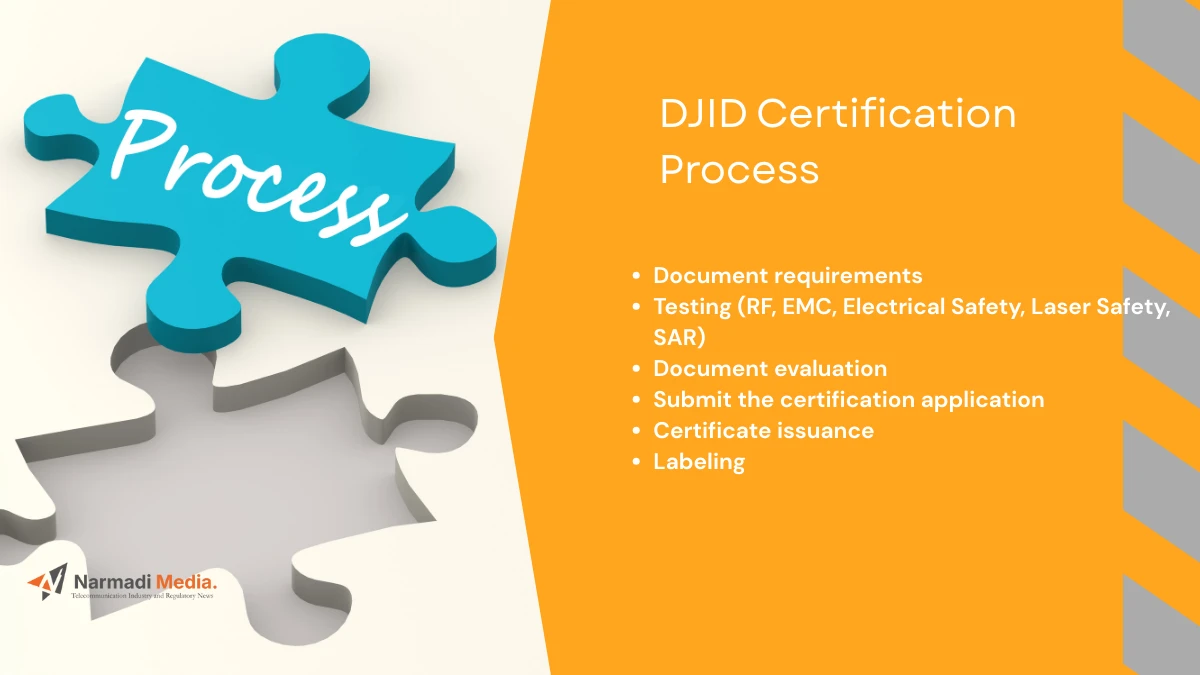
Obtaining an Indonesia type approval certificate involves a lengthy process. The process includes document compliance, testing for document requirements (test report), and certification application.
Document requirements
The following is a list of documents required for the DJID certification application:
- Product specifications that include the model name
- Product photos
- Test Report (RF, EMC, Electrical Safety, Laser Safety, SAR)
- PM5 Application Form
- Declaration of Conformity signed by LR
- MoU/Distributor Agreement between Brand Holder and LR
- LR Information (company name and address, contact person’s name and number, company email address)
Testing
Testing for the DJID certification can be done through two processes, namely local testing or international testing. In this case, local testing is more recommended because it is cheaper than applying through document evaluation only.
The testing includes:
- Radio Frequency (RF) Test
- Electromagnetic Compatibility (EMC) Test
- Electrical Safety Test (Only required for products powered directly by AC power)
- Laser Safety Test
- Specific Absorption Rate (SAR) Test (Only mandatory for tablets or mobile phones)
For valid test reports from international laboratories, only RF, EMC, and Electrical Safety testing is required. For Laser Safety and SAR testing, testing must be conducted at a local laboratory in Indonesia.
Document evaluation
Document evaluation is a process that is carried out if local testing is not performed, provided that RF, EMC, and Electrical Safety test reports from an international laboratory have been obtained.
Required documents:
- Required documents for the document requirements
- RF, EMC, and Electrical Safety test reports
- Product specifications
- Product photos
- Self-declaration letter
- MOU or distributor agreement (between the certificate holder or applicant and the brand owner)
Submit the certification application
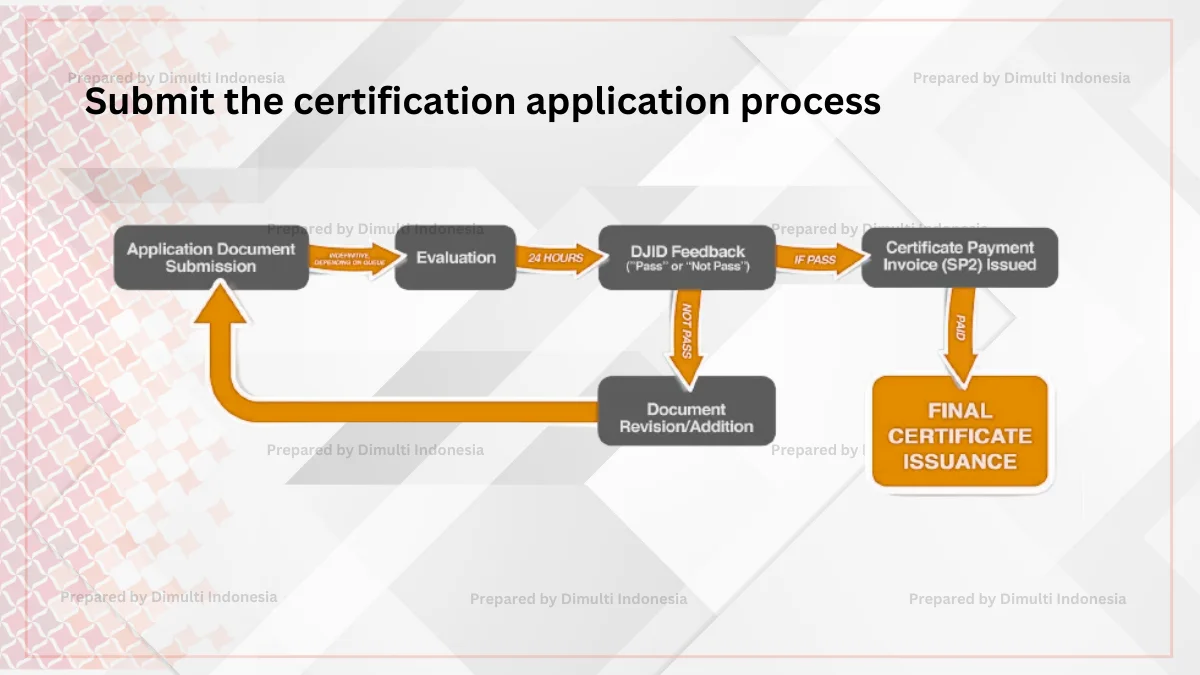
Once all documents are complete, the next step is to submit the Indonesia type approval certification application. The application will be submitted through the DJID e-certification website.
The authorities will evaluate all documents within 24 hours. After that, feedback will be provided by DJID. If the certification is approved, a Certificate Payment Invoice (SP2) will be sent, and the certificate will be issued.
If the evaluation is not passed, the documents will be returned to the applicant for revision or to add missing documents. The revised and completed documents can then be resubmitted.
Certificate issuance
DJID certificates will be issued after going through the above process. The processing time for applications through the Local Testing Approach is approximately five to six weeks. On the other hand, the processing time through administrative channels is approximately three to five working days.
DJID certificates are valid for three years from the date of issuance. After three years, if the goods are still being manufactured, assembled, or imported for use or sale in Indonesia, the certificate must be renewed.
If the goods are no longer being manufactured, assembled, or imported for use or sale in Indonesia, certificate renewal is not required. Existing stock in Indonesia can still use the old certificate until it runs out.
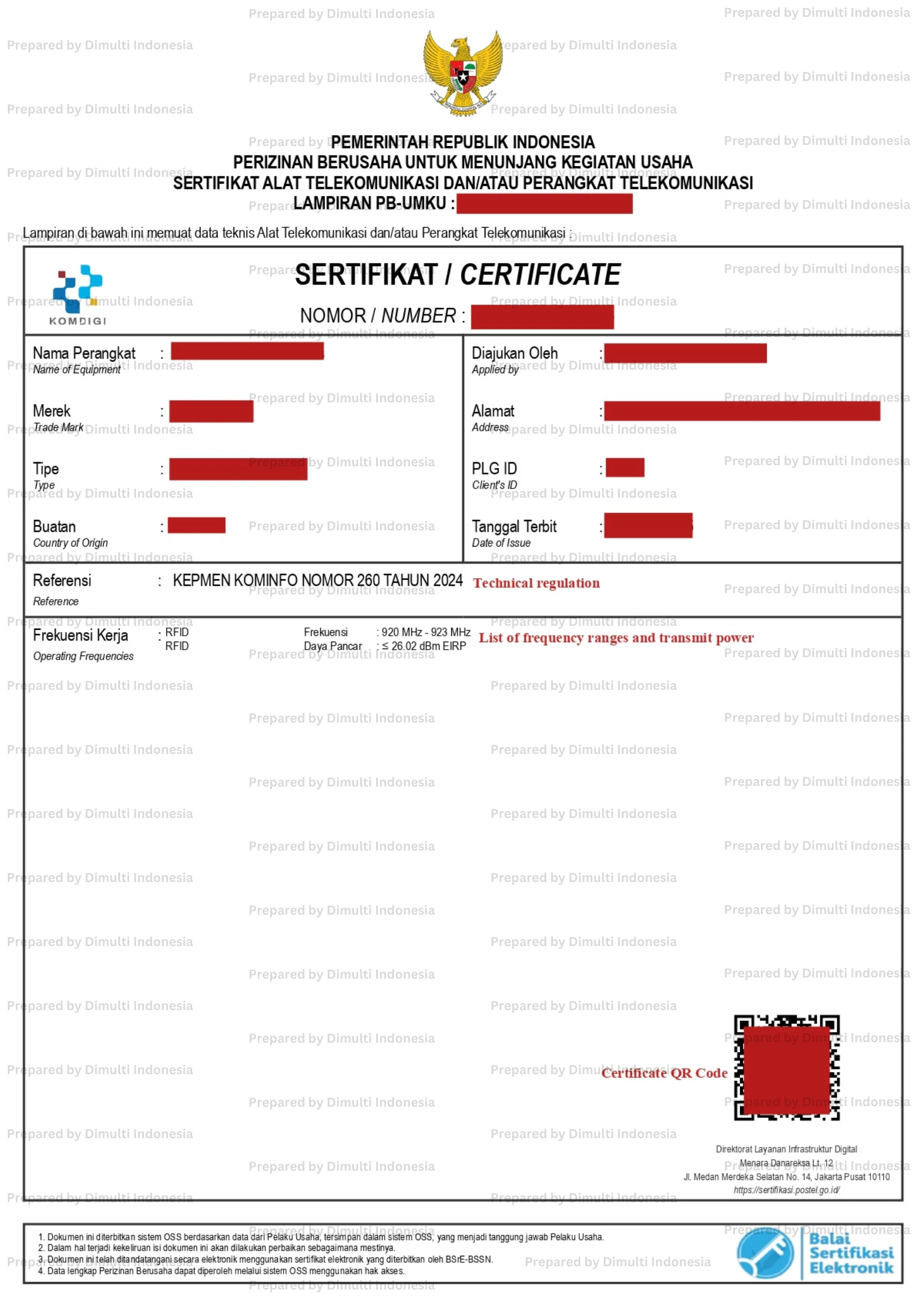
The following is an example of a DJID certificate:
Labeling
All telecom and wireless devices that have been certified by Indonesia type approval must be labeled. This is confirmed in Permen Kominfo Number 3 of 2024, Article 25.
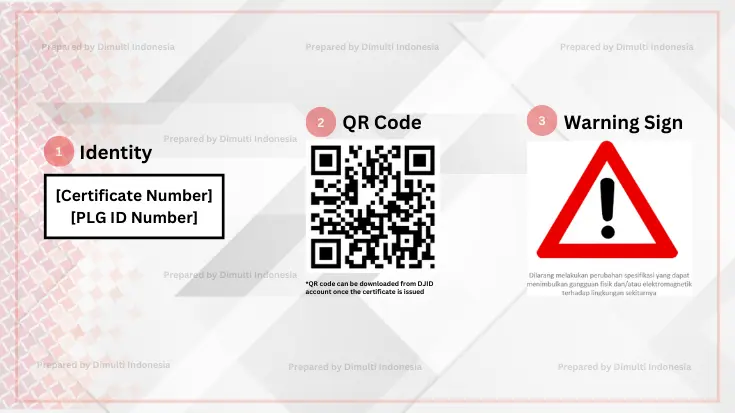
Label requirements consist of three components: identification (certificate number and PLG ID), QR code, and warning label. All three components must be affixed to the product and its packaging.
If the product is too small to affix the label to the product itself, it is permissible to affix the label only to the packaging.
Here is an example of the label:
DJID Certification Management Services
Do you find the DJID certification difficult to manage? It may seem that way, especially considering the lengthy process involved. However, this can be simplified by choosing the right Indonesia type approval certification management services.
Dimulti, as a provider of RF and telecom type approval certification services, is ready to help meet your needs. We are ready to be a partner for manufacturers, importers, or distributors who are unfamiliar with the DJID certification process.
Thus, all issues in the certification process will be handled by our team of experts who have more than 15 years of experience. We will help you manage all aspects of the compliance certification process.
Since 2008, we have assisted hundreds of clients and thousands of RF type approval projects with efficient procedures.
Here are our advantages:
- Certification process monitoring: You can monitor the certification process in real-time and transparently through the Project Management System (PMS).
- Pre-testing: Not many partners offer pre-testing services. The testing process in our internal laboratory will prevent direct testing failures that can cause cost losses.
- Global access: Not only in Indonesia, but we also have a network of partners around the world. For those of you who want to do global marketing, through Dimulti, you don’t need to bother looking for partners in your destination country. The certification process becomes more efficient and cost-effective.
The Indonesia type approval certification process takes a considerable amount of time, from document collection, testing for document requirements (test reports), to submitting the certification application. To make it efficient and easy, don’t hesitate to consult with us!










Hi, this is a comment.
To get started with moderating, editing, and deleting comments, please visit the Comments screen in the dashboard.
Commenter avatars come from Gravatar.