

Manufacturers need to know who should be the applicant for Indonesia type approval. The applicant is a key party in the DJID certification process for accessing the Indonesian market.
DJID, or the Directorate General of Digital Infrastructure, is the institution that regulates Radio Frequency (RF) type approval for telecommunications equipment entering and circulating in Indonesia. The applicant for Indonesia type approval will act as a guarantor that the devices in circulation meet the established safety and quality standards.
“Who should be the applicant for Indonesia type approval?” is a question often asked by companies outside Indonesia that want to market their products. This article will provide a detailed explanation, enabling you to legally market your products in Indonesia.
Also Read
The Regulation in Indonesia
Understanding who is eligible to apply for Indonesian type approval is inseparable from the regulations that govern it. Applicants for DJID certification are regulated in Ministerial Regulation No. 3 of 2024, Article 10. The content is as follows:
Article 10
1. The certificate as intended in Article 7 paragraph (1) is submitted by an applicant who is:
a. Business Actors who:
- Is a registered trademark holder in Indonesia.
- Is appointed as a representative and/or distributor of the brand holder.
- Manufacture and/or assemble Telecommunications tools and/or telecommunications devices for brand holders.
- Manufacture and/or assemble Telecommunications tools and/or telecommunications devices; or
- Use telecommunications tools and/or telecommunications devices for their purposes.
b. State Administrative Agencies.
c. International organizations; or
d. Individual person.
2. Applications for Certificates by State Organizing Agencies, international organizations, or individuals as intended in paragraph (1) letters b, c, and d can only be submitted for Telecommunications tools and/or telecommunications devices used for their own purposes.
Applicant for Indonesia Type Approval
If you read Regulation No. 3 of 2024, Article 10 above, it is clear that the parties are allowed to become applicant for Indonesia type approval. They are divided into two categories, namely business actors and non-business actors.
For business actors themselves, they must be local companies or local business entities registered in Indonesia. These can be distributors, importers, local brand representatives, or even local buyers in Indonesia.
For non-business entities, examples include state agencies, international organizations, or individuals. To avoid misunderstandings, let’s discuss one by one who can be an applicant for Indonesia type approval.
Business entities
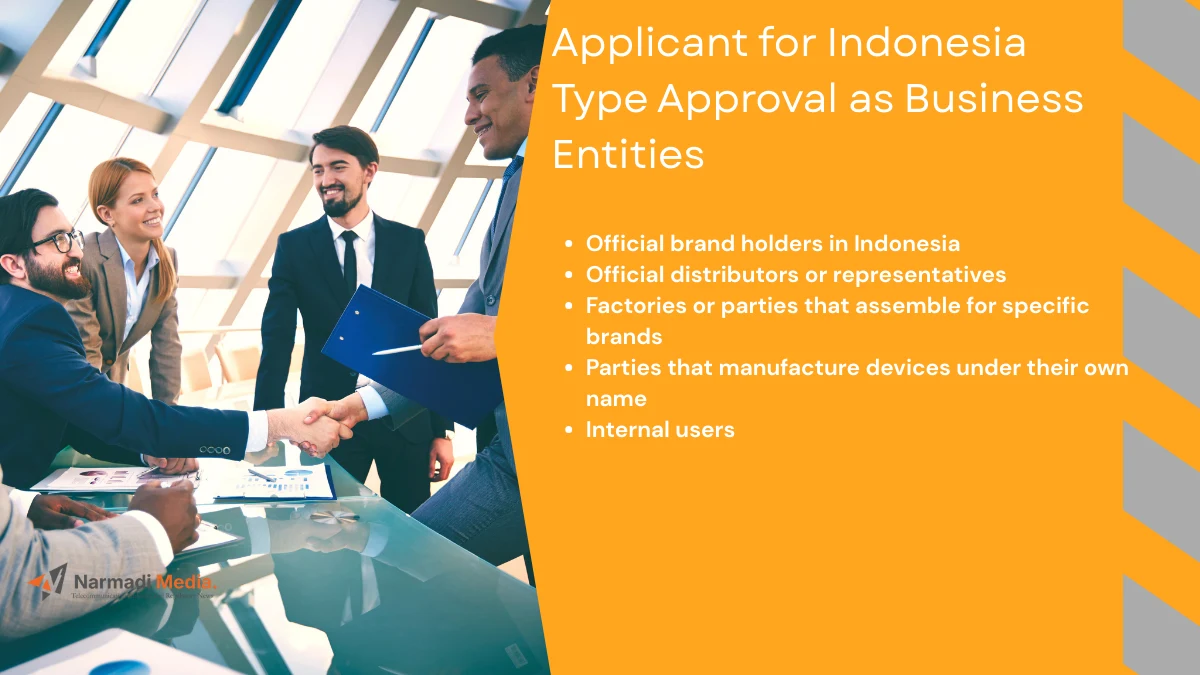
The majority of applicant for Indonesia type approval are submitted as business entities. However, this term can have a fairly broad scope. In regulations, business entities are divided into several subcategories:
- Official brand holders in Indonesia: Original manufacturers registered in Indonesia.
- Official distributors or representatives: Companies appointed by global brands as distributors or local representatives with valid appointment documents.
- Factories or parties that assemble for specific brands: For example, factories that assemble wireless devices for a brand.
- Parties that manufacture devices under their own name: Local business operators with their own labeled products.
- Internal users: Companies or institutions that purchase communication devices for their own operational needs.
Non-business entities
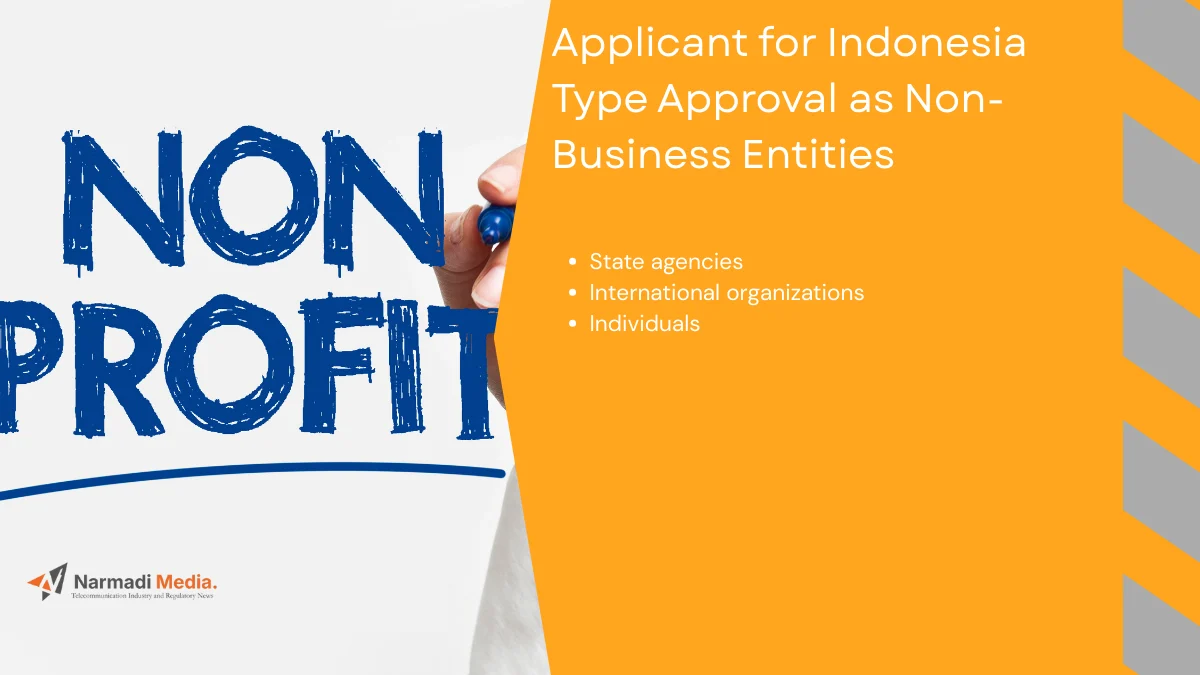
Certification applications are not only intended for devices that are sold. Some are used for internal organizational needs. The following are included in the regulations:
- State agencies: Government agencies or state institutions that require communication devices in their duties.
- International organizations: International organizations operating in Indonesia that require devices to support their activities. Typically, these devices are specific or not widely available, but they must still comply with technical and administrative regulations.
- Individuals: Although rare, individuals may also submit applications, for example, in the case of amateur radio devices, research equipment, or imported devices.
Why is the Applicant Status Important?
The examination of applicant for Indonesia type approval is carried out at an early stage, even before entering the laboratory testing stage. This should not be overlooked, as many applications are rejected because the applicant’s status is not appropriate or supporting documents, such as letters of appointment, are not attached.
The applicant’s name on technical and administrative documents for DJID certification applications must be consistent. If the test report lists name A, while the letter of appointment uses name B, the application may be rejected.
Businesses are advised to consolidate all document requirements for Indonesia type approval from the outset. If you do not yet understand the entire process, you can start by understanding the basics of Indonesia type approval to get a sense of the broader context.
Applicant Rules
We already know that applicant for Indonesia type approval are divided into several categories. Each category has different rules for applying for the DJID certification process.
The rules for non-business applicants will certainly differ from those for business applicants. Even the rules for business applicants who are brand owners and those who are not brand owners are different.
Essentially, applying for DJID certification requires the submission of numerous documents. Each applicant category has different document requirements. To avoid mistakes, let’s discuss each of these requirements.
Brand holders
As a trademark holder, applicant for Indonesia type approval must attach a certificate or statement of trademark ownership. This letter contains a statement that the trademark or company name of the certification applicant is officially registered with the Ministry of Law.
The letter must be signed by the company’s president or director and stamped with the company seal. This is an official letter that can be obtained from the Directorate General of Intellectual Property (DJKI), under the Ministry of Law (Kemenhum) of the Republic of Indonesia.
Not a brand owner
Not being a brand owner means that the company acts as a Local Representative (LR). Additionally, to be a legal entity in Indonesia, the LR must have a letter of agreement or Memorandum of Understanding (MoU) with the brand owner.
This MoU serves as proof of the LR’s validity as an applicant for Indonesia type approval and as an official partner of the brand owner. The LR will also be responsible for the sale and/or use of telecommunications products in Indonesia.
The most important aspect of this MoU is the inclusion of a clause stating that the first party (the brand owner) authorizes the second party (the applicant or certificate holder) to become a distributor or representative. Their duties include being responsible for product warranties, sales, and/or use in Indonesia.
The MoU is not drafted in the form of a power of attorney or certificate of authority and is signed by both parties.
Non-commercial use
There are also rules governing the use of telecommunications equipment for non-commercial purposes. Equipment used for internal company needs that is not sold must be accompanied by a Statement Letter.
There are no specific rules or regulations governing this statement letter. What is clear is that the letter must explain that the items submitted for certification are only used internally by the company and are not for sale. The document must be completed with the signature of the company’s leadership, a stamp, and the company seal.
For applicants from state institutions, international organizations, or individuals, there are different requirements. In this case, the certification application must be submitted directly to the Ministry of Communication and Digital Affairs, not through the OSS system.
The question of who should be the applicant for Indonesia type approval and what the rules are has been answered. In essence, DJID certification can be applied for commercial or non-commercial purposes.
Applicants can be brand owners, domestic manufacturers or assemblers of foreign brands, distributors, or importers. For non-commercial purposes, applicants can be state agencies, international organizations, individuals, or companies for internal needs.
Each party wishing to apply must understand its position. Different positions will require different certification process documents.
Issues with the certification applicant can lead to delays in the application process. To avoid this problem, you can contact Dimulti for a consultation.
Rest assured that your RF type approval issues will be handled well by a team of professionals with more than 15 years of experience. We are ready to help you access the global market with a certification process that can be monitored in real time.