
Manufacturers need to be aware of the paperwork application for Indonesia type approval. This is one of the channels that is still permitted to date for applying for the DJID certification.
Paperwork application for Indonesia type approval is permitted with several requirements that must be met. In this case, the criteria are set by DJID or the Directorate General of Digital Infrastructure Resources, which is the agency that regulates the approval process for telecommunications devices entering and circulating in the country.
The ease and speed of the paperwork application for Indonesia type approval is one of the reasons why this route is favored by companies. However, it is important to note that there are several conditions that still make local testing unavoidable. We will discuss this in detail in this article.
Also Read
What is the Paperwork Application for RF Type Approval?
A paperwork application or evaluation document for Radio Frequency (RF) type approval is a step in evaluating the test report of international laboratory testing. Each country has its own rules for submitting this step.
This step usually applies in countries that do not require local testing. That way, the authorities only evaluate the test report document. Of course, this is done in accordance with applicable international standards, such as the International Electrotechnical Commission (IEC) and the European Telecommunications Standards Institute (ETSI).
Additionally, the test report must also comply with the frequency usage, power levels, and emissions permitted in the destination country. Therefore, it is best to have this process carried out in an international laboratory that is registered and accredited by the authorities of that country. In Indonesia, paperwork application is one of the channels that can be taken in the DJID certification process.
Foreign Laboratory Testing Requirements
Local testing is not the only process that must be carried out to apply for the DJID certification. Therefore, the paperwork application for Indonesia type approval can be carried out.
Testing in international laboratories is permitted, provided that they are registered and accredited by DJID. Additionally, test reports and summaries must be attached to the certification application process.
The designation of Indonesian and foreign testing laboratories is regulated in Ministerial Regulation No. 16 of 2018. This regulation includes a list of Indonesian and foreign laboratories that are registered and accredited by DJID.
The list of foreign laboratories recognized by DJID is regulated in Ministerial Decree No. 13 of 2025. This regulation lists 103 foreign testing centers that can be used for sample testing.
For a list of international laboratories registered and accredited by DJID, please check the following link: https://sertifikasi.postel.go.id/balai-uji/balai-uji-ln.
Things to note
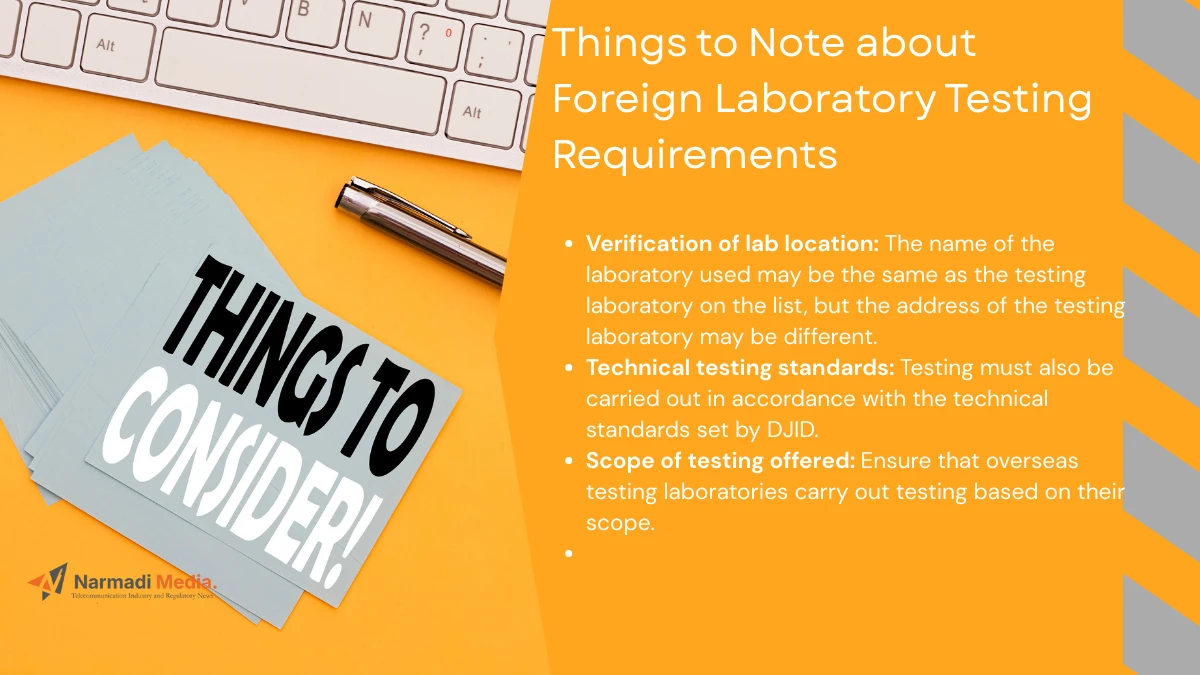
It should be noted that test report from laboratories that are not registered or accredited by DJID are invalid. Therefore, there are several things that need to be considered when completing the paperwork application for Indonesia type approval.
- Verification of lab location: The name of the laboratory used may be the same as the testing laboratory on the list, but the address of the testing laboratory may be different.
- Technical testing standards: Testing must also be carried out in accordance with the technical standards set by DJID.
- Scope of testing offered: Ensure that overseas testing laboratories carry out testing based on their scope.
Test report from the wrong lab, non-compliant testing standards, and non-compliant testing scope must be retested through local testing channels.
Test Reports from International Laboratories That Allowed
Paperwork application for Indonesia type approval is permitted by attaching test report from overseas laboratories. This process will determine whether the device meets the specified parameters. Test parameters include frequency range, output power, bandwidth, and spurious emissions. The tests include:
- Radio Frequency Test (RF)
- Electromagnetic Compatibility (EMC) Test
- Electrical Safety Test (Only required for products directly powered by AC power)
Testing will result in an RF test report being issued if the telecommunications and wireless product passes the testing process. Test reports from international laboratories are only valid for RF, EMC, and Electrical Safety testing. If necessary, Laser Safety and Specific Absorption Rate (SAR) testing must be conducted at a local laboratory in Indonesia.
The Process of Paperwork Type Approval
Submitting paperwork means relying on strict document requirements for Indonesia type approval. Besides the general document requirements for DJID certification applications, there are additional documents that need to be attached.
When choosing the paperwork application for Indonesia type approval, you must also attach two additional documents. These are a summary of the test report and a letter of authorization from the owner of the report to the applicant/local representative to use their report.
Once everything is complete, the document requirements for Indonesian type approval will be submitted through the DJID e-certification website. All documents will then be evaluated by the authorities within 24 hours.
After the evaluation is complete, DJID will respond as to whether the certification application has been approved or rejected. If the certification is approved, a Certificate Payment Invoice (SP2) will be sent, and the certificate will be issued.
If the evaluation is not passed, the documents will be returned to the applicant for revision or to add missing documents. The revised and complete documents can then be resubmitted.
Conditions that Require Local Testing to be Performed
Test report from DJID-registered and accredited international laboratories are mandatory in the process of paperwork application for Indonesia type approval. However, some conditions require local testing to be performed even if test report from international laboratories have been obtained.
Therefore, DJID has an alternative route for this, namely, document evaluation based on RF module reports and partial documents. This alternative route means that applicants have no choice but to undergo local testing. Therefore, sample requirements for Indonesia type approval are necessary.
Parameters that do not meet requirements
RF testing on final products only for spurious emission parameters may be acceptable in other countries. Meanwhile, in Indonesia, all parameters must be met, namely frequency range, output power, bandwidth, and spurious emissions.
These parameter requirements are what make RF testing necessary. However, this only applies to the modules within the product, not the final product itself. This additional testing can be conducted at an international laboratory registered and accredited by DJID or at an Indonesian laboratory.
However, to save time, it is usually recommended to conduct testing locally. This way, the process becomes an evaluation of documents based on RF module reports. This method is often used for household appliances, such as refrigerators, freezers, washing machines, and others.
Technical requirements not fully met
Some companies have conducted testing in international laboratories, but there are one or more types of testing that have not been carried out. This means that the technical requirements have not been fully met.
For example, telecommunications and wireless products that have undergone RF and EMC testing in overseas laboratories. However, according to technical regulations in Indonesia, these products are also required to undergo electrical safety testing.
In this case, electrical safety testing must be carried out in Indonesia when the application is submitted. This means that the path taken is partial documentation.
Plan to Eliminate Paperwork Application Pathway
Currently, paperwork application for Indonesia type approval is still an option. However, the Indonesian government, through the Minister of Communication and Digital Affairs (KOMDIGI), Meutya Hafid, has stated that it plans to conduct all local testing on telecommunications and wireless devices for DJID certification.
The plan to conduct all local testing for Indonesia type approval will certainly have an impact on manufacturers. You must be prepared to face changes in compliance procedures.
Gradually, by the end of 2026, all local testing for DJID certification will be mandatory. It is expected that by 2027, local testing for Indonesian type approval will become mandatory.
This is being done to strengthen and encourage the independence of the domestic Information and Communication Technology (ICT) industry. In addition, this will reduce dependence on foreign testing laboratories.
Basically, paperwork application for Indonesia type approval are still permitted at this time. Although recommended, local testing is not currently the only route that can be taken.
Overseas laboratory testing can be carried out through document evaluation by attaching the test report and summary. However, several additional documents must be fulfilled.
Additionally, overseas laboratory testing must ensure that the location complies with the DJID list, meets technical standards, and has the same scope of testing. It should be noted that not all overseas testing is valid in Indonesia.
This means that there is still a possibility that DJID certification applications must still go through local testing. For example, when necessary, SAR Laser Safety testing parameters do not yet or do not meet the requirements, and do not yet fully meet the technical requirements.
Issues with paperwork application for Indonesia type approval can cause delays in the application process. To avoid these issues, you can consult with Dimulti.
With over 15 years of experience, we are ready to help you overcome RF type approval issues with our team of professionals. Your certification process will be effective and efficient with real-time monitoring and an international network to penetrate the global market.