
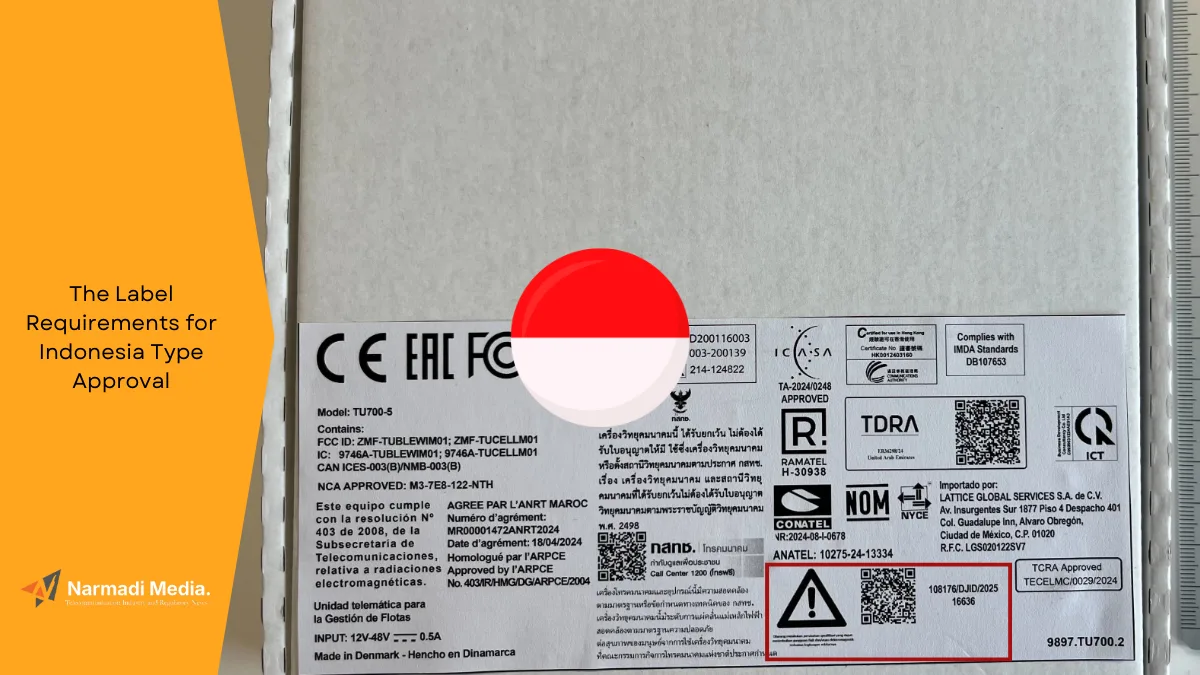
Manufacturers need to be aware of the label requirements for Indonesia type approval. This is something that must be done after the DJID certificate is issued. Failure to do so will result in legal consequences.
The label requirements for Indonesia type approval are intended for consumers. The purpose is to prove that the device has obtained DJID certification.
In this case, the criteria are set by DJID or the Directorate General of Digital Infrastructure Resources. This is the agency that regulates the approval process for telecommunications devices entering and circulating in the country.
Also Read
The existence label requirements for Indonesia type approval will increase consumer confidence in your products. That way, consumers will choose your legal and safe products over others.
The Regulation in Indonesia
Understanding the label requirements for Indonesia type approval is closely tied to the regulations that govern it. These are regulated in the Communication and Digital Ministry Regulation (PERMEN) No. 3 Tahun 2024 in Articles 25 to 28. The content is as follows:
Article 25
- The Certificate Holder is obliged to put a label on the Telecommunications tools and/or telecommunications devices for which the Certificate has been issued as intended in Article 15.
- The label as intended in paragraph (1) displays:
- a. Certificate number and PLG ID;
- b. QR Code; And
- c. warning signs.
- The QR Code as intended in paragraph (2) letter b contains at least the following information:
- a. certificate number;
- b. PLG ID;
- c. brand of Telecommunications tools and/or telecommunications devices;
- d. Type of Telecommunications tools and/or telecommunications devices; And
- e. other data elements listed in the Certificate.
- The warning sign as intended in paragraph (2) letter c contains information regarding the prohibition on making changes to specifications that could cause physical and/or electromagnetic disturbances to the surrounding environment.
Article 26
- Installation of labels as intended in Article 25 paragraph (1) is carried out on every:
- a. Telecommunications tools and/or telecommunications devices; And
- b. packaging or wrapping of Telecommunications tools and/or telecommunications devices.
- If the size of the Telecommunications tools and/or telecommunications devices is too small so that it is not possible to attach a label as intended in paragraph (1) letter a, the label can be installed only on the packaging or wrapping of the Telecommunications tools and/or telecommunications devices.
- Installation of labels as intended in paragraph (1) by:
- a. embossed, debossed, or printed;
- b. affixed or attached; or
- c. digital on Telecommunications tools and/or telecommunications devices.
Article 27
The label as intended in Article 25 paragraph (2) is made in accordance with the format as stated in the Attachment which is an inseparable part of this Ministerial Regulation.
Article 28
- The Certificate Owner is obliged to report proof of making the label as intended in Article 25 paragraph (2) to the Director General no later than 30 (thirty) days after the Certificate is issued.
- The report as intended in paragraph (1) is submitted through the Directorate General’s Certification Service Facility by uploading a photo of the Telecommunications tools and/or telecommunications devices that have been labeled.
The Label Requirements of Indonesia Type Approval
If you read PERMEN No. 3 of 2024 in Articles 25 to 28 above, it is clear that the label requirements for Indonesia type approval have certain provisions. These range from components, placement, installation methods, and proof of label installation.
Therefore, it is important to understand each of these provisions. Let’s discuss them so that there are no mistakes in label installation.
Label components
The components of label requirements for Indonesia type approval refer to PERMEN No. 3 of 2024 in Article 25, paragraph 2. It is explained that the label must display the certificate number and PLG ID, QR code, and warning sign.
The following is a detailed explanation of the DJID label components:
- Certificate Number: A unique code or number that differs from each certificate issued by DJID.
- PLG ID: Stands for Customer ID, which is a unique code to identify products in the DJID system.
- QR Code: This will take customers to information related to device certification.
- Warning Sign: A label containing signs and information that the telecommunications specifications in the product may be harmful to users.
The following are examples of label component requirements for Indonesian type approval:
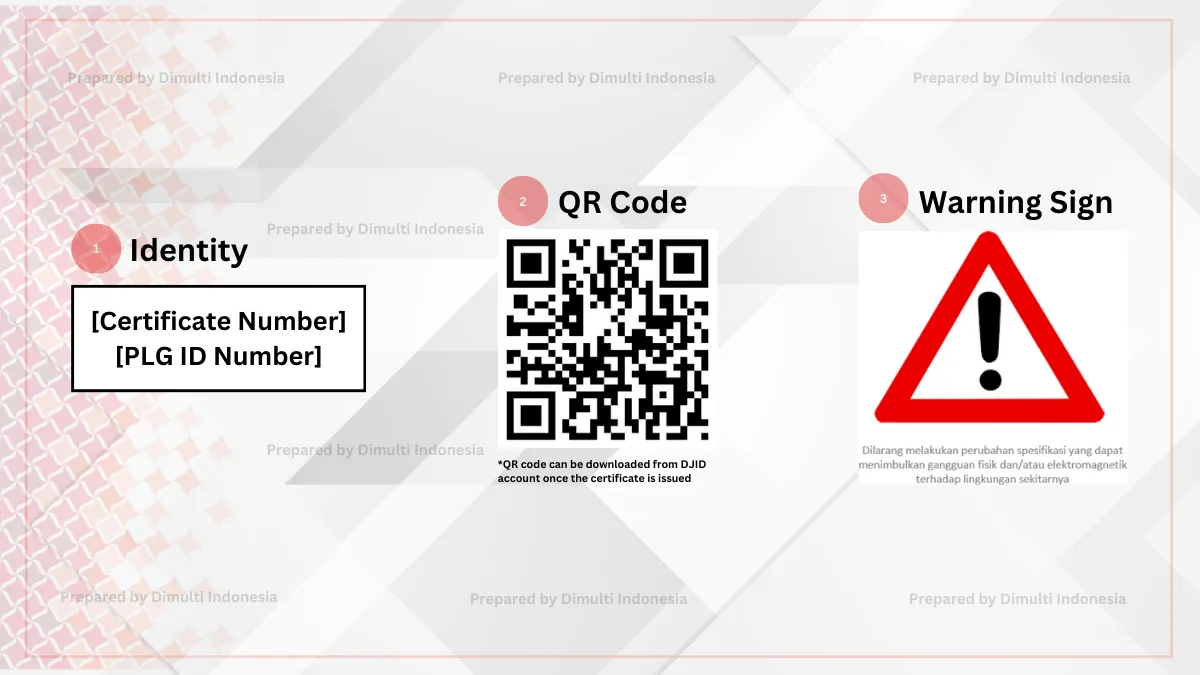
All label components can be downloaded through the e-certification account used by the applicant. Regarding warning signs, DJID does not provide high-resolution, AI-based, or vector warning sign images. Therefore, warning signs can be cut from existing regulations.
Label placement
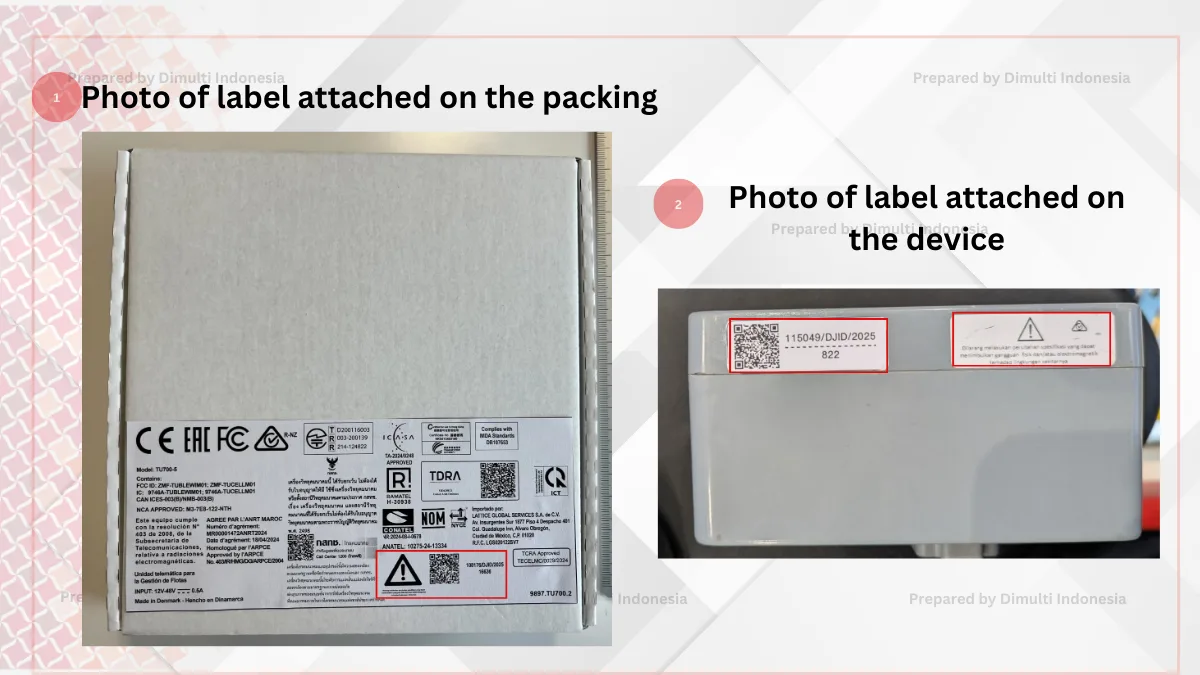
The placement of label requirements for Indonesia type approval refers to PERMEN No. 3 of 2024 in Article 26, paragraph 1. It is explained that labels must be placed on the device and product packaging. The location of placement on the product and product packaging is unrestricted.
Similarly, the size of the label is also not specified. What is clear is that the placement and size of the label must be easily visible and clearly legible.
If the device is too small to accommodate a label, it is permissible to place the label only on the product packaging. For devices that do not have product packaging, the label may be affixed to the manual.
Label attachment method
The attachment method of label requirements for Indonesia type approval refers to PERMEN No. 3 of 2024 in Article 26, paragraph 3. It explains that labels must be attached using the emboss, deboss, or print method.
For telecom devices that have screens, such as cell phones, tablets, and laptops, it is permissible to embed the label in digital form. So you don’t need to stick it on the device; just enter it as a file in the device software to be accessible.
Label attachment report
The report of label requirements for Indonesia type approval refers to PERMEN No. 3 of 2024 in Article 26. It explains that labels that have been attached to devices and product packaging must be reported.
Attached labels must be photographed and uploaded to the e-certification page as a report of compliance. Two photos are required to upload the label application report.
The first photo is a close-up photo of the label showing the details of the label image. The second photo is a photo of the packaging or device showing the location of the label application.
The following is an example of a label installation report photo:
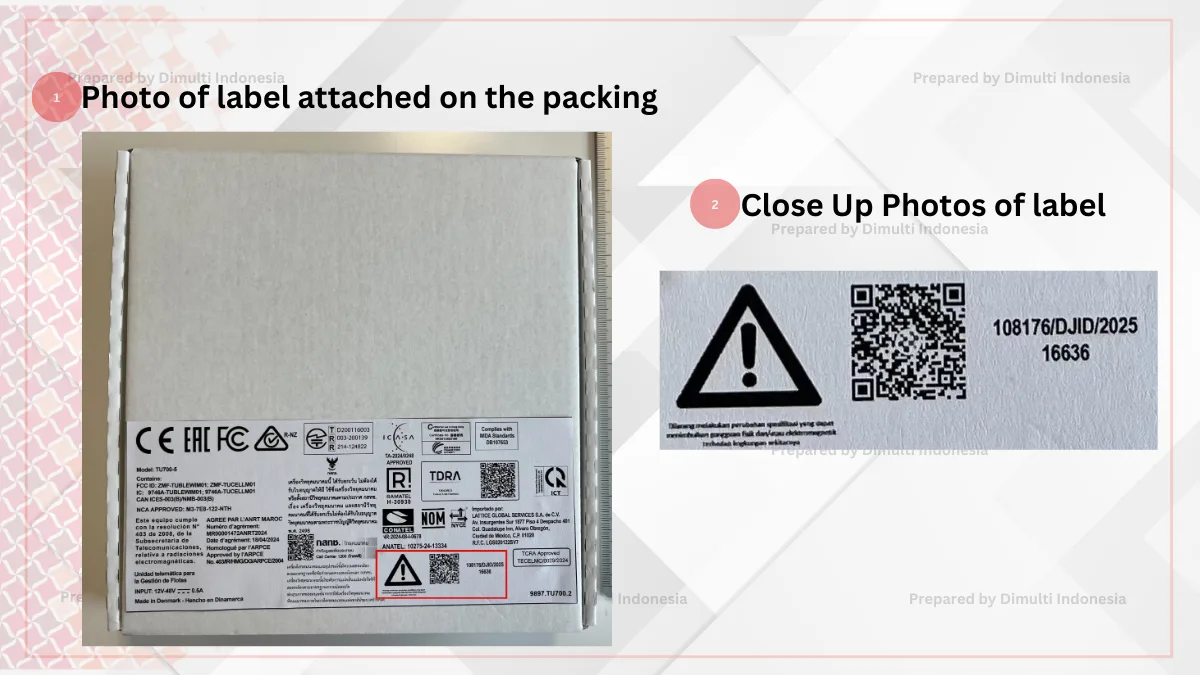
Label requirements for Indonesia type approval must be reported by uploading photos to the DJID website within 30 working days from the date of certificate issuance.
Sanction
Applicants who have not uploaded photos of their label application reports to the DJID website after 30 working days will be subject to sanctions for non-compliance. The sanction of label requirements for Indonesia type approval refers to PERMEN No. 3 of 2024 in Article 58.
It is explained that after 30 days, applicants will receive a first notification letter. This letter is valid for up to 14 working days. If, within that period, there is still no proof of label installation, the applicant will receive a second notification letter. The second letter is also valid for up to 14 working days.
If, after this period, there is still no proof of label installation, the applicant will receive a final notification letter. This means that the applicant will be subject to sanctions prohibiting them from applying for certification, for new or renewal applications, for a period of six months.
Consequences of being sanctioned
When sanctioned for violating the label requirements for Indonesia type approval, your company will be unable to carry out any processes related to the certification of all products. Six months is certainly not a short period of time. This can cause you significant losses.
- Disruption to business operations in Indonesia: You cannot produce new types of telecommunications products that you want to market.
- Marketing ban on products: Unlabeled products and/or newly manufactured products cannot be marketed.
- Possibility of recertification: Labels may be attached after the sanction period ends, but often, DJID requires recertification.
- Unable to renew certificates: During the sanction period, other devices requiring certificate renewal cannot be processed.
- Placed on DJID’s watchlist: This may create obstacles in applying for future certification processes.
What Happens to Products That Have Already Been Labeled Upon Renewal?
The validity period of an Indonesia type approval certificate is indefinite. However, this is on the condition that the product is not reproduced and imported after three years from the date of issuance of the certificate.
For devices that are still being manufactured, assembled, or imported for use or sale in Indonesia after three years, they must be recertified. The recertification process will issue a certificate number that is different from the first certificate number that was previously issued.
As a result, after the re-certification certificate is issued, the label on the product needs to be modified to match the latest certificate number. The label modification process only needs to be done for products that are still in production and have not been imported into Indonesia.
As for products that have been imported, stored in warehouses, or distributed in the Indonesian market, no label changes are necessary. The DJID label from the initial certification process can still be used.
That is the information regarding label requirements for Indonesia type approval. By installing the label and reporting it to DJID, you will avoid sanctions. To avoid this problem, you can consult with Dimulti.
Our team will assist you with device labeling. So you don’t need to worry about validity periods, certification renewals, and regulatory updates.
We will also help process label reporting and submit it to the official DJID e-certification portal. This way, your RF type approval issues will be resolved effectively and efficiently by our professional team with over 15 years of experience.
We provide a certification process that can be monitored in real-time. Additionally, we have a network in various countries that can help you penetrate the global market.