
Manufacturers need to recognize the importance of Malaysia type approval. This is one of the keys to accessing the Land of Indigenous Malay market.
Malaysia is a promising market for marketing telecommunications and wireless products. This is due to its status as the 34th largest economy in the world, with the fastest economic growth in Southeast Asia. Therefore, Malaysia type approval guidelines are required to market these products.
Malaysia type approval is known as SIRIM certification, a compliance instrument that must be adhered to by manufacturers, importers, and distributors. By understanding the complete guidelines for this process, your products will be easier to market and use in Malaysia.
Also Read
What is Malaysia Type Approval?
Malaysia type approval is regulated by the Standard and Industrial Research Institute of Malaysia (SIRIM). This is an organization under the Malaysian Communications and Multimedia Commission (MCMC) responsible for the development of standards and quality of technology in Malaysia.
The ministry issues a certificate of compliance called the “SIRIM Certificate.” The SIRIM certification process is necessary to ensure that telecommunications and wireless devices meet technical, compatibility, and safety standards in accordance with applicable regulations in Malaysia.
Devices that have obtained SIRIM certification are guaranteed to be safe for users and will not interfere with the functioning of other devices when used simultaneously.
Products Requiring Certification
Products requiring Malaysia type approval certification are listed in another official document issued by SIRIM called eTAC/DOC/01-2. This regulation explains what is included in the scope of Malaysia type approval, which covers wired, wireless, or combined wired and wireless equipment.
The following are some examples of products that require Malaysia type approval:
| Categories | Products |
| Wired Equipment | – Public Switched Telephone Network (PSTN) – Integrated Subscriber Digital Network (ISDN) – Private Automatic Branch Exchange (PABX) / Key Telephone – Asymmetric digital subscriber line (ADSL) 300.00 – Broadband over Power Line (BPL) – IPv6 – Facsimile (inclusive PSTN) 1,000.00 – Analogue Calling Line Identity Presentation (ACLIP) |
| Wireless Equipment | – Land Mobile Radio (LMR) / Digital Trunking (e.g., TETRA, GoTA, iDEN) – Bluetooth – Microwave – Radar – Alarm system / In-house paging – Digital Terrestrial Television Broadcast Service Receiver (DVB-T2) (RF/OAD/PSI) – HbbTV – Wireless Charger – Repeater – Digital Enhanced Cordless Telecommunications (DECT) – Caller ID – VoLTE / VoNR / other similar technology – Radio Frequency Identification Device (RFID) – ANT+ – GSM / 3G / LTE / 5G / other similar technology – WLAN 2.4GHz – WLAN 5.0Hz – WLAN 802.11ad Wireless LAN [Support 2.4GHz] (For product integrated with GSM/LTE/5G feature only) Wireless LAN [Support 5.0 GHz] (For product integrated with GSM/LTE/5G feature only) Wi-Fi 6E Wi-Fi 7 LoRa ZigBee (IEEE 802.15.4) Ultra-wide Band (UWB) Near Field Communication (NFC) |
| Free-space optical | – |
Who Can Apply for Certification?
Applicants for Malaysia type approval certification are regulated in eTAC/DOC/01-1.1. Article 3.3 of this document explains that SIRIM certification applicants must be entities registered in Malaysia.
They must already have a valid Registration of Company (ROC) or Registration of Business (ROB) number from the Companies Commission of Malaysia (SSM). These companies can be manufacturers, assemblers, importers, network operators/service providers, and authorized consultants.
The application process will be represented by a management representative who will be responsible for the application. This responsibility includes registering the company with the e-ComM online registration system, becoming the company account administrator, and acting as the liaison between the applicant and SIRIM.
Additionally, local entities are required to have a SIRIM account and a Dagangnet account. This is because the name of the importer (Dagangnet label applicant) and the name of the Certificate Holder (SIRIM certificate applicant) must be the same. The purpose of this is to streamline the import process.
SIRIM Certification Process
Basically, the Malaysia type approval certification process is focused on document evaluation. Therefore, applicants are expected to have conducted testing at an ISO/IEC 17025-accredited international laboratory.
The standards refer to Conformité Européenne (CE) or Federal Communications Commission (FCC) for Radio Frequency (RF) testing, Electromagnetic Compatibility (EMC) testing, and safety testing.
Local testing is usually only required for mobile-based devices. What often happens in the field is that IPv6 devices often pass local testing. Although there is basically no obligation for local testing for IPv6 devices. Testing can also be carried out in international laboratories.
Local testing
In addition to mobile-based devices, test reports from international laboratories that do not meet the technical specifications, frequency allocation, or requirements set forth must also undergo local testing. This refers to the Technical Codes, Class Assignments (CA), Spectrum Plan, Standard Radio Spectrum Plan (SRSP), or Apparatus Assignment (AA) applicable in Malaysia.
If local testing is conducted, SIRIM will request 1 sample unit, and in most cases, a normal mode sample is sufficient for functional verification testing. SIRIM will not conduct full compliance testing.
Local testing is conducted fairly briefly. It is only done to confirm model and label checking parameters, confirm frequency bands, check output power, check connectivity, and test basic operation.
Document evaluation
To apply for Malaysia type approval, applicants must complete the following processes on e-ComM: laboratory registration, test report registration, trademark/brand declaration, and compliance approval submission.
Laboratory registration: Each applicant can register a laboratory to become an Accredited Laboratory if the laboratory is not yet registered in Malaysia. Laboratory registration can be submitted by the applicant, consultant, or the laboratory itself.
Test report registration: Each applicant must upload all required test reprots. Valid test reports are those that are no more than five years old from the date of issue.
Brand statement: This is a statement from the applicant regarding the brand for which type approval is being sought.
Document requirements:
- Product Specifications
- Product Photos
- Product Photos with Brand Name and Model as Labels
- Complete CE or FCC Test Reports
- EMC and Safety Test Reports for mobile products and drones only
- Trademark Statement
After that, all submitted documents will be evaluated by SIRIM on the scheduled date. If it passes the evaluation, the certification will be immediately prepared for issuance and legalization. However, if it does not pass the evaluation, the missing documents must be completed and then re-evaluated by SIRIM.
Certificate issuance
SIRIM certificates will be issued after going through the above process. The processing time for Malaysia type approval applications, which are generally document-based, is relatively short. The lead time is approximately two weeks after all required documents have been received.
For equipment that ultimately has to undergo local testing, such as mobile and IPv6-based devices, it will take approximately four to six weeks from the date the samples and documents are received.
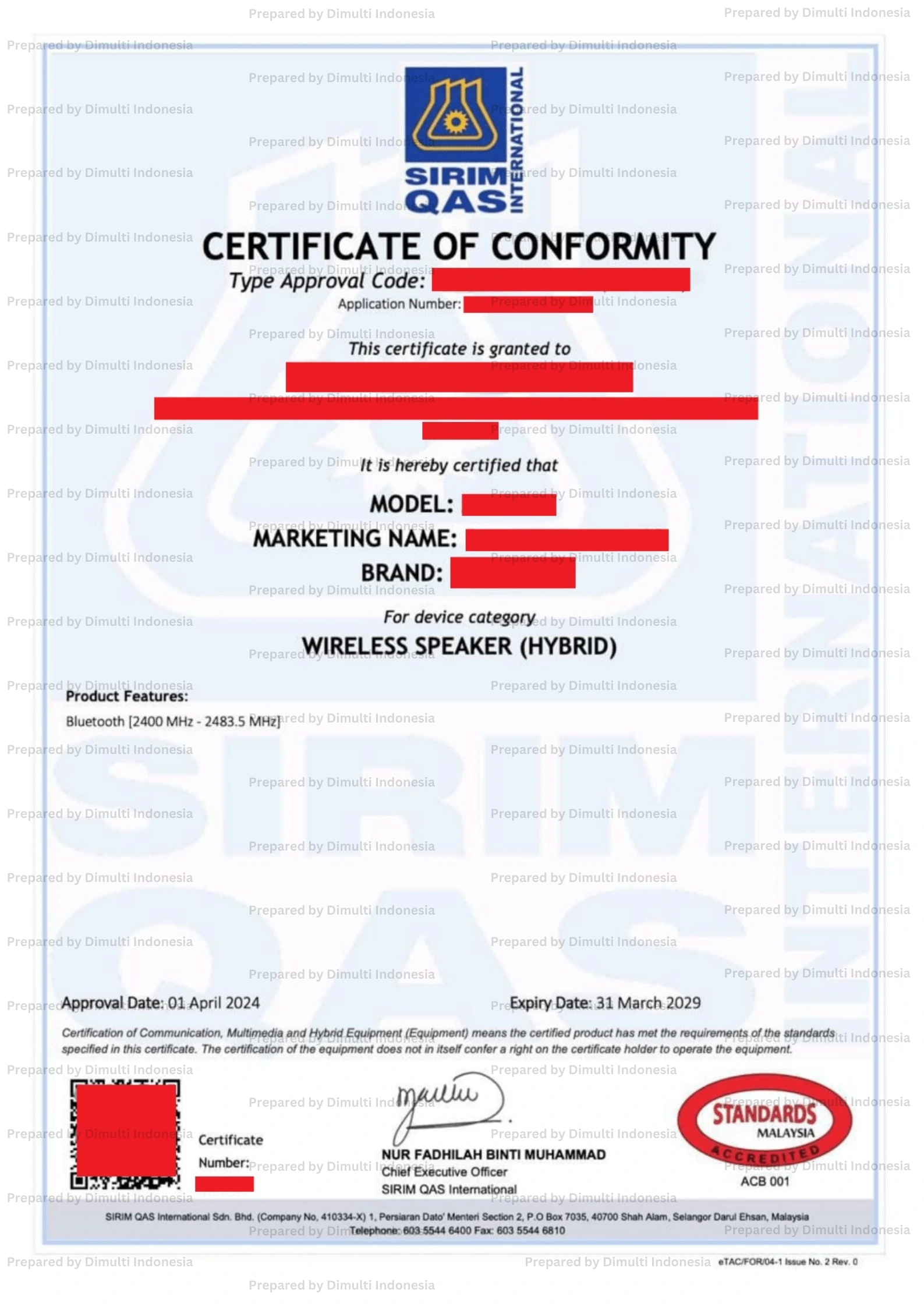
SIRIM certificates are valid for five years from the date of issue. After five years, renewals can use the same documents as long as there are no changes to the product specifications and follow the same process as the initial certificate application.
The following is an example of an SIRIM certificate:
Labeling
All telecommunications and wireless devices that have been certified by the Malaysia type approval must be labeled. This is confirmed in document eCMC/DOC/04-1
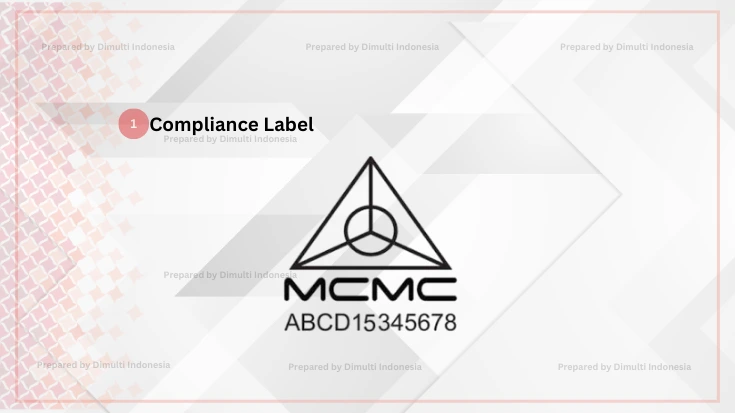
The labeling requirements for SIRIM Malaysia certification require the affixing of a Malaysian Communications and Multimedia Commission (MCMC) label. This label consists of three components: a triangle with the letters MCMC and the certificate holder’s manufacturer identification ID underneath.
The label can be affixed to the surface of the device or used with an electronic labeling method (e-labeling). Certification marks or labels must not be placed arbitrarily on communication equipment to indicate that the equipment complies with standards, unless the communication equipment has been certified.
Here is an example of the label:
SIRIM Type Approval and Management Services
Do you find SIRIM certification difficult to manage? Perhaps you do, especially considering the lengthy process involved. However, this can be simplified by choosing the right Malaysia type approval certification management service.
Dimulti, as a provider of RF and telecommunications type approval certification services, is ready to help meet your needs. We are ready to be a partner for manufacturers, importers, or distributors who are unfamiliar with the SIRIM certification process.
Thus, all issues in the certification process will be handled by our team of experts who have more than 15 years of experience. We will help you manage all aspects of the compliance certification process.
Since 2008, we have assisted hundreds of clients and thousands of RF type approval projects with efficient procedures.
Here are our advantages:
- Certification process monitoring: You can monitor the certification process in real-time and transparently through the Project Management System (PMS).
- Pre-testing: Not many partners offer pre-testing services. The testing process in our internal laboratory will prevent direct testing failures that can result in cost losses.
- Global access: Not only in Malaysia, but we also have a network of partners around the world. For those of you who want to do global marketing, through Dimulti, you don’t need to bother looking for partners in your destination country. The certification process becomes more efficient and cost-effective.
The type approval certification process in Malaysia takes a considerable amount of time, from document collection, document requirement testing (test reports), to certification application submission. To make it efficient and easy, don’t hesitate to consult with us!