
Manufacturers need to be aware of the document requirements for Singapore type approval. This is one of the key requirements for accessing the market through the IMDA certification process.
This certification ensures that devices on the market meet the safety and quality standards set in Singapore. IMDA, or Infocomm Media Development Authority, is the authority that regulates the document requirements for Singapore type approval, as telecommunications compliance to enter and circulate in the country.
The document requirements for Singapore type approval are regulated in the Guide for Registration of Telecommunication Equipment. However, the content is very long. Hence, we will try to summarize it for your convenience.
Also Read
Different Types of Applications, Different Document Requirements
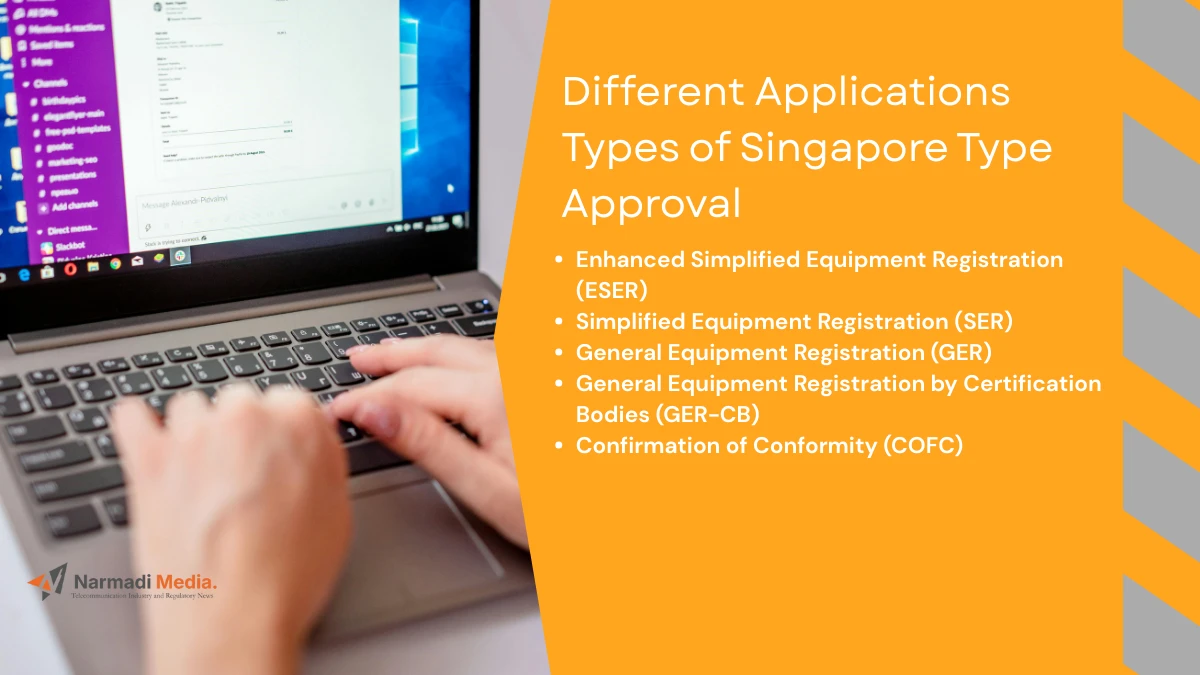
Before learning about the document requirements for Singapore type approval, it is important to know that there are several certification application types. These types are divided into five, namely Enhanced Simplified Equipment Registration (ESER), Simplified Equipment Registration (SER), General Equipment Registration (GER), General Equipment Registration by Certification Bodies (GER-CB), and Confirmation of Conformity (COFC).
Each application type for Singapore type approval has different document requirements. You must choose the type that suits your application needs. By understanding the differences between these types, the IMDA certification application process will run smoothly and effectively.
Enhanced Simplified Equipment Registration (ESER)
Enhanced Simplified Equipment Registration (ESER) is a type of application for conducting self-assessment and making self-declarations. The ESER application applies to certain types of equipment.
The following equipment is included in the ESER application type:
- Short-range/low-power devices (SRD/LPD) such as alarms, RFID, radio detection, on-site paging systems, vehicle radar, remote control, telecommands, telemetry, wireless microphone and video transmitters, wireless LAN, and Bluetooth.
- DECT cordless phones, portable mobile radios (PMR446), and multi-channel portable radios (MCR446) with a power of less than 500 mW
- Integrated DVB-T2 Receiver Decoders (e.g., DVB-T2 set-top boxes, integrated digital TVs, in-vehicle receivers)
- Complex multi-channel equipment (e.g., PABX, KTS, ISDN, PSTN, PLC)
The ESER application is an automated approval process. If you want IMDA to evaluate your test report, you can submit a GER-type application.
Simplified Equipment Registration (SER)
Simplified Equipment Registration (SER) is a type of application that requires you to submit a declaration of conformity with the IMDA Technical Specifications and the relevant European Union Type Examination Certificate (EU-TEC). The SER application applies to certain types of equipment.
The following equipment is included in the SER application type:
- Mobile Terminals, such as 3G/LTE/GMPCS mobile phones.
- Broadband Access Equipment, such as ADSL, Cable Modems, and CCHN equipment.
If the EU-TEC is not available or if you want IMDA to evaluate your laboratory test report, you can submit a GER application.
General Equipment Registration (GER)
General Equipment Registration (GER) is a mandatory application type for Mobile/IoT Base Station/Repeater Systems, Landmobile Radio/walkie-talkies, TV White Space devices, UWB, DSRC, IoT User Equipment, and Short Range Devices.
Of course, the operation of these types of equipment requires IMDA approval. GER applications are optional for equipment categories included in the SER/ESER scheme, but are subject to registration fees based on the GER scheme.
General Equipment Registration by Certification Bodies (GER-CB)
General Equipment Registration by Certification Bodies (GER-CB) is a type of application that only applies to official CB applicants based on MRA Phase II. This process applies to equipment that requires mandatory registration but allows for a more efficient certification route, rather than going through the standard General Equipment Registration (GER) process.
GER-CB is used for equipment that requires a more stringent level of testing or certification. This is because test reports and technical documentation are evaluated by a recognized third-party CB, rather than directly by IMDA.
Confirmation of Conformity (COFC)
Confirmation of Conformity (COFC) is a voluntary type of application. It is intended for telecommunications equipment that does not require sales approval (equipment exempt from registration).
Although exempt, such equipment still requires legal compliance. The following equipment is exempt from equipment registration:
- Telephone (standard, multi-feature, image, data, or switching).
- Line interface – cordless phone.
- Telephone ancillary.
- Auto-dialler.
- Auto answering or recording set.
- Caller identification equipment.
- Security alarm system.
- Facsimile transceiver or fax modem.
- Voice band modem.
- EFTPOS or CCAT.
- Digital leased circuit equipment.
If you are not sure whether you should apply for COFC, you may contact Dimulti Indonesia for consultation.
What are the Document Requirements for Singapore Type Approval?
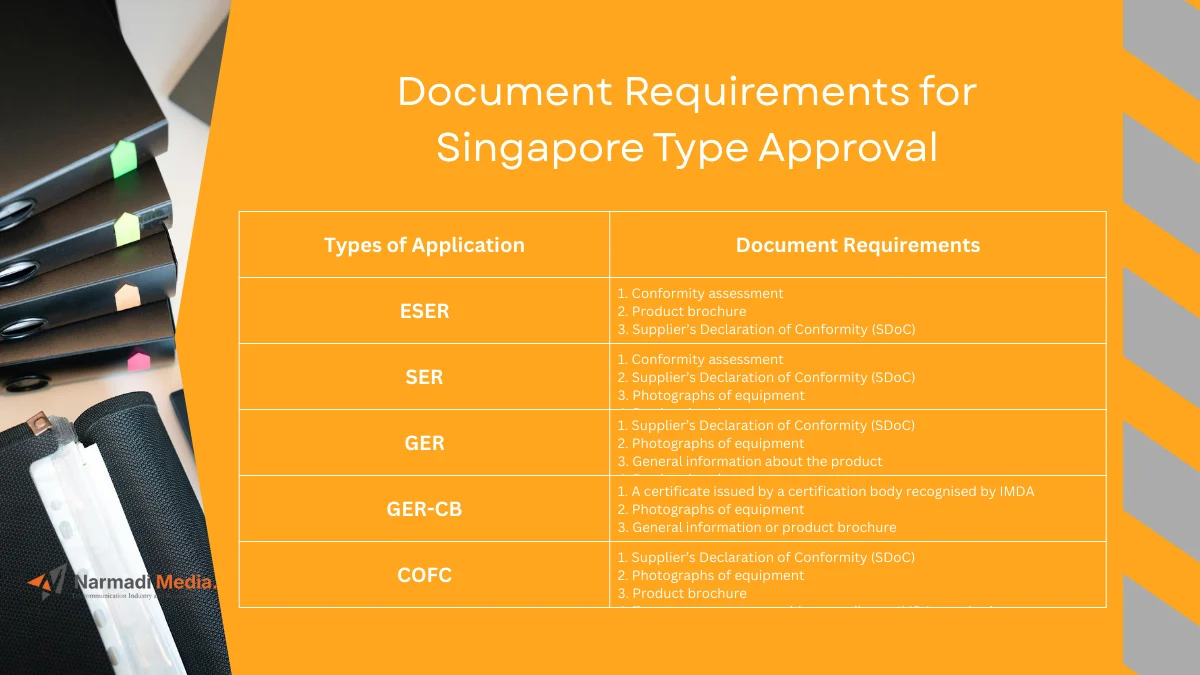
After determining which application type you will choose, it is time to find out the document requirements for Singapore type approval. The following are the documents required for each application type.
Document requirements for ESER
Here are the documents that you must prepare for ESER:
- Conformity assessment
- Product brochure
- Supplier’s Declaration of Conformity (SDoC)
Document requirements for SER
Here are the documents that you must prepare for SER:
- Conformity assessment
- Supplier’s Declaration of Conformity (SDoC)
- Photographs of equipment
- Product brochure
- EU-Type Examination Certificate (EU-TEC)
- User manual
- Safety information
Document requirements for GER
Here are the documents that you must prepare for GER:
- Supplier’s Declaration of Conformity (SDoC)
- Photographs of equipment
- General information about the product
- Product brochure
- Test reports
- User Guide
Document requirements for GER-CB
Here are the documents that you must prepare for GER-CB:
- A certificate issued by a certification body recognised by IMDA
- Photographs of equipment
- General information or product brochure
Document requirements for COFC
Here are the documents that you must prepare for COFC:
- Supplier’s Declaration of Conformity (SDoC)
- Photographs of equipment
- Product brochure
- Test reports are acceptable according to IMDA standards
Document Evaluation Process
The document evaluation process is the standard and recommended process for submitting a Singapore type approval application, because local testing in Singapore is more expensive. In other words, applicants must already have test results from an ISO/IEC 17025-accredited international laboratory.
The standards refer to Conformité Européenne (CE) or Federal Communications Commission (FCC) for Radio Frequency (RF) testing and Electromagnetic Compatibility (EMC) testing.
Once the above document requirements for Singapore type approval have been collected and prepared, they will be submitted via https://licensing.gobusiness.gov.sg/. The submitted documents will be evaluated by IMDA after you have made the payment.
The certificate will be issued immediately if the evaluation is successful. However, if it is unsuccessful, the missing documents must be completed, and then they will be re-evaluated by IMDA.
Those are the document requirements for Singapore type approval that you must prepare. Incomplete documents or ignorance of the testing route scheme will cause your IMDA certification application to be delayed or rejected.
Therefore, it is important to know and prepare all documents in accordance with the selected type from the initial product planning stage. That way, you can easily and efficiently access the Singapore market.