
Manufacturers need to be aware of the document requirements for Thailand type approval. This is one of the main requirements for accessing the market through the NBTC certification process.
This certification ensures that devices on the market meet the safety and quality standards set in Thailand. The NBTC, or National Broadcasting and Telecommunications Commission, is the authority that regulates the document requirements for Thailand type approval, as telecommunications compliance for entry and circulation in the country.
The document requirements for Thailand type approval are divided into three different classes. This article provides comprehensive information about the three classes of NBTC certification and all required documents.
Also Read
Different Types of Application
Before learning about the document requirements for Thailand type approval, it is important to know that there are several types of certification applications. These types are divided into three, namely Class A, Class B, and Supplier’s Declaration of Conformity (SDoC).
Each type of Thai type approval application actually has the same document requirements. The only difference is that for Class B, if you already have an NBTC Certificate, you can include it as an additional document.
You must choose the type that suits your application needs. By understanding the differences between these types, the NBTC certification application process will run smoothly and effectively.
Class A
Class A devices refer to telecommunications devices and their accessories that must be proven to comply with technical standards or technical specifications. Proof is provided through testing by an accredited testing laboratory and certification.
Furthermore, telecommunications devices and their accessories must be registered with the Ministry of Communication and Information Technology. Class A equipment must meet the standards by registering with the NBTC Office. Class A equipment includes drones, wireless microphones, vehicle radars, and satellite communication equipment.
Class B
Class B devices refer to telecommunications devices and tools that manufacturers must prove comply with technical standards or technical requirements. Proof is provided through testing by an accredited testing laboratory and certification.
These telecommunications devices and tools must be certified by an engineer in accordance with established criteria. Equipment under Class B must meet NBTC Class B standards by undergoing certification at the NBTC Office. Class B equipment includes mobile equipment.
Supplier’s Declaration of Conformity (SDoC)
Telecommunications devices and accessories subject to the Supplier’s Declaration of Conformity (SDoC) are those that have been certified by the competent authority. Although these devices have been declared compliant, they are still subject to inspection to ensure compliance with applicable standards.
Suppliers must provide a written statement declaring that the telecommunications equipment and accessories comply with the standards or requirements. Products categorized under SDoC must comply with NBTC standards, but are not required to undergo full certification or registration.
Suppliers or operators must submit a declaration of conformity to the NBTC Office. SDoC products include Wi-Fi, Bluetooth, RFID, NFC, and SRD equipment.
What are the Document Requirements for Thailand Type Approval?
After determining the type of application you will choose, it is time to find out the document requirements for Thailand type approval. Here are the documents required for each type of application.
Document requirements for Class A
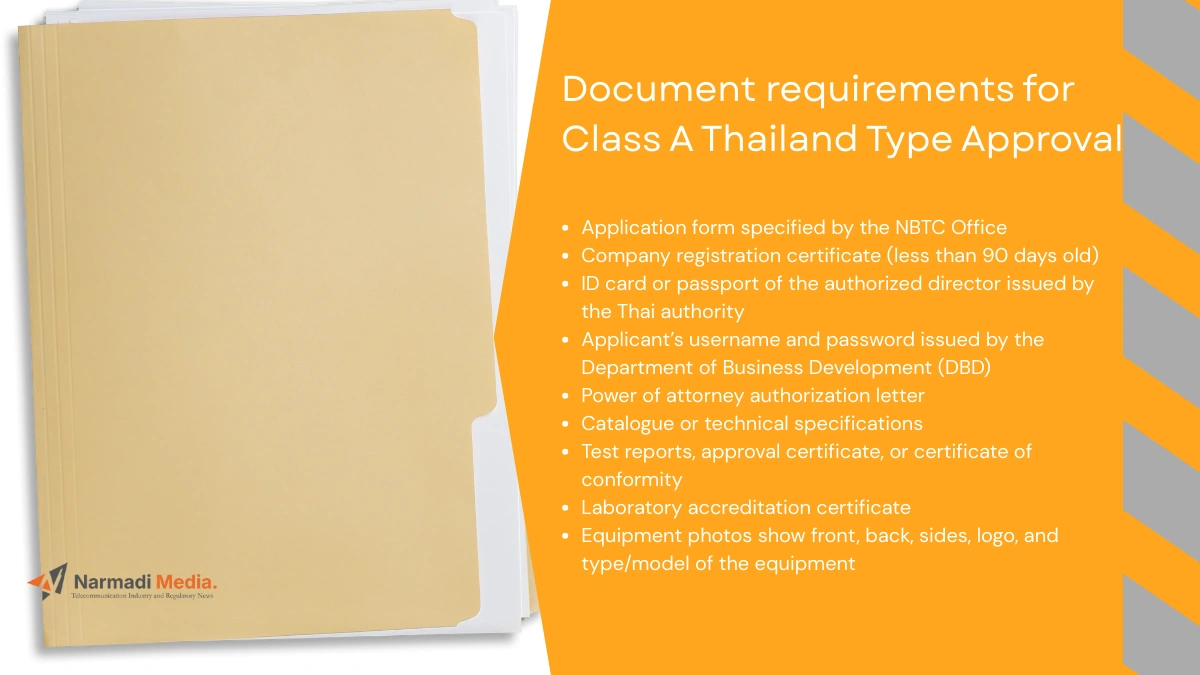
Here are the documents that you must prepare for Class A:
- Application form specified by the NBTC Office
- Company registration certificate (less than 90 days old)
- ID card or passport of the authorized director issued by the Thai authority
- Applicant’s username and password issued by the Department of Business Development (DBD)
- Power of attorney authorization letter
- Catalogue or technical specifications
- Test reports, approval certificate, or certificate of conformity
- Laboratory accreditation certificate
- Equipment photos show front, back, sides, logo, and type/model of the equipment
Document requirements for Class B
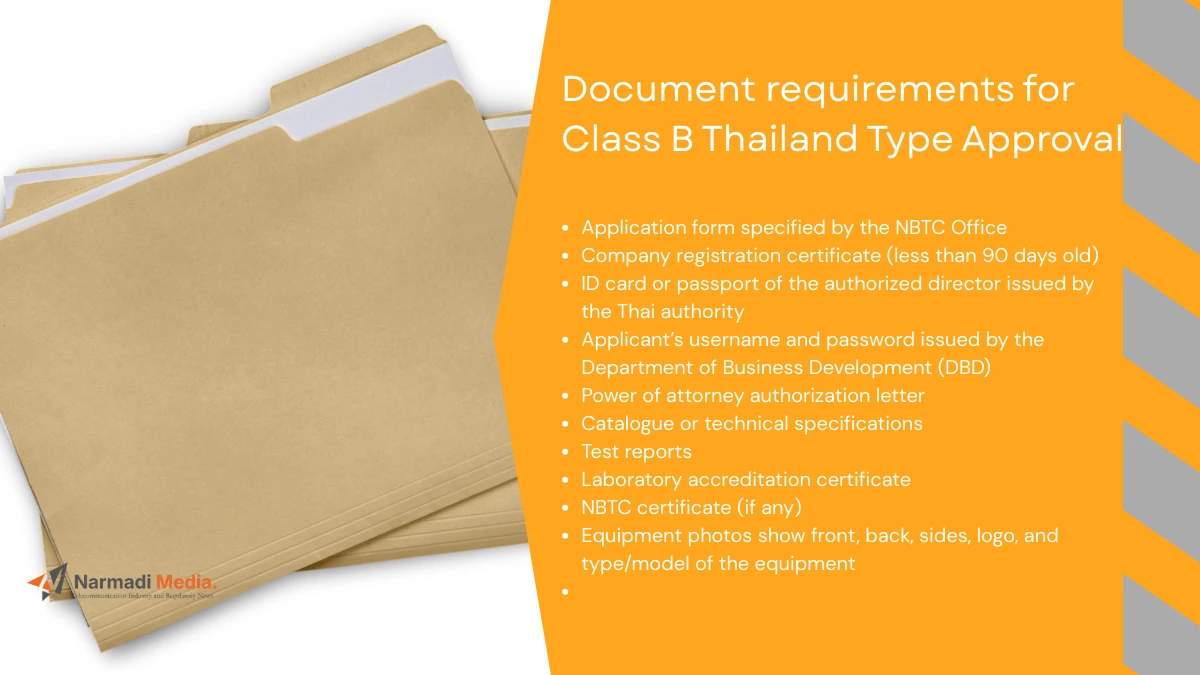
Here are the documents that you must prepare for Class B:
- Application form specified by the NBTC Office
- Company registration certificate (less than 90 days old)
- ID card or passport of the authorized director issued by the Thai authority
- Applicant’s username and password issued by the Department of Business Development (DBD)
- Power of attorney authorization letter
- Catalogue or technical specifications
- Test reports
- Laboratory accreditation certificate
- NBTC certificate (if any)
- Equipment photos show front, back, sides, logo, and type/model of the equipment
Document requirements for SDoC
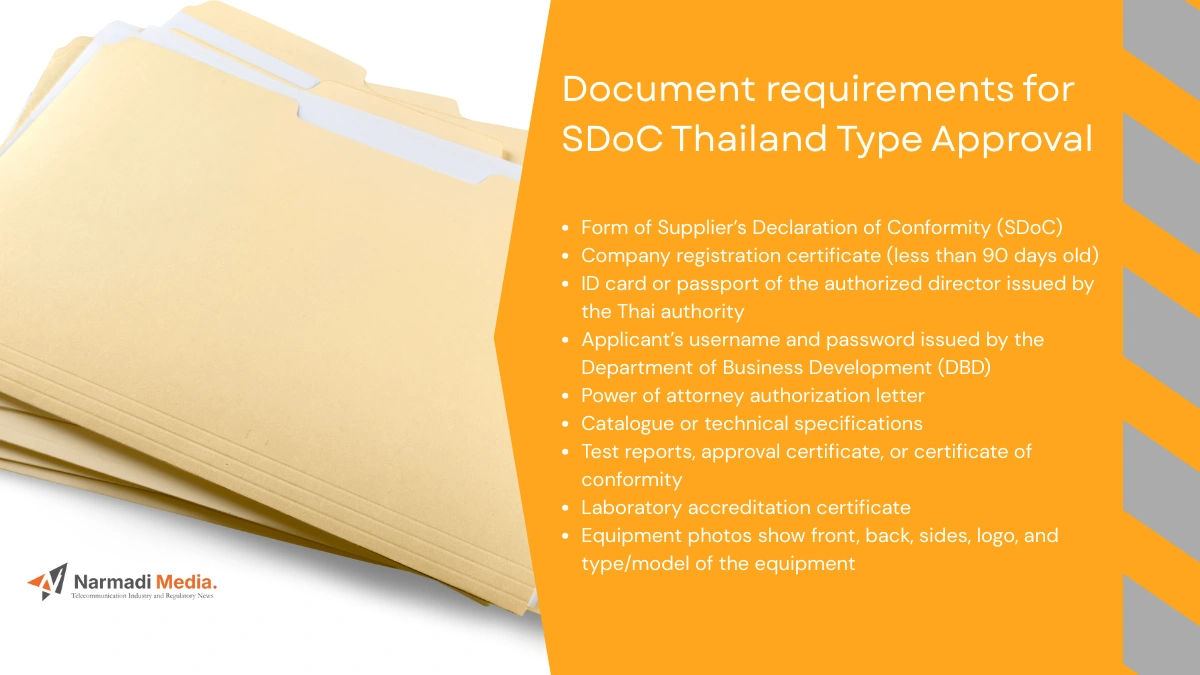
Here are the documents that you must prepare for SdoC:
- Form of Supplier’s Declaration of Conformity (SDoC)
- Company registration certificate (less than 90 days old)
- ID card or passport of the authorized director issued by the Thai authority
- Applicant’s username and password issued by the Department of Business Development (DBD)
- Power of attorney authorization letter
- Catalogue or technical specifications
- Test reports, approval certificate, or certificate of conformity
- Laboratory accreditation certificate
- Equipment photos show front, back, sides, logo, and type/model of the equipment
Document Evaluation Process
The document evaluation process is a standard and recommended approach for submitting a Thai type approval application, as local testing in Thailand is more expensive and takes longer. In other words, applicants must already have test results from an ISO/IEC 17025-accredited international laboratory.
These standards refer to Conformité Européenne (CE) or Federal Communications Commission (FCC) for Radio Frequency (RF) testing and Electromagnetic Compatibility (EMC) testing. If the device requires additional testing, applicants must also submit other relevant test reports, such as safety test reports and Specific Absorption Rate (SAR) reports.
Once all the above document requirements for Thailand type approval have been collected and prepared, the documents will be sent directly to the NBTC Office. Currently, the NBTC certification process does not support online submission. All submitted documents will be reviewed and evaluated by the authorities.
If the evaluation is successful, the certificate will be issued immediately. However, if it is unsuccessful, the applicant must complete the missing documents for re-evaluation by the NBTC.
Those are the document requirements for Thailand type approval that you must prepare. Incomplete documents or ignorance of the testing scheme will cause your NBTC certification application to be delayed or rejected.
Therefore, it is important to know and prepare all documents according to the selected type from the initial product planning stage. This preparation will help ensure smoother and more efficient access to the Thai market.