
Manufacturers must be aware of the label requirements for Thailand type approval. This must be done after the NBTC certificate is issued. Do not let the import and marketing of your products be delayed due to failure to affix the label.
The label requirements for Thailand type approval are intended to indicate that the device has undergone the certification process. In this case, the criteria are set by the NBTC, namely the National Broadcasting and Telecommunications Commission. This authority regulates the approval process for telecommunications devices entering and circulating in the country.
The existence of label requirements for Thailand type approval will increase consumer confidence in your product. Thus, consumers will choose your legal and safe product over other products.
Also Read
Regulation in Thailand
Understanding the label requirements for Thailand type approval is closely related to the regulations that govern it. These regulations are stipulated in Announcement of the National Broadcasting and Telecommunications Commission (NBTC) Volume 133, Special Chapter 178. The contents of these provisions are as follows.
Section 26. The supplier shall have the duty to provide written assurance of conformity with technical standards or technical requirements to demonstrate to the concerned stakeholders that suchtelecommunication equipment conforms to the prescribed standards or requirements by publishing the wording in the user’s manual, package, or providing supplementary documents contained in the product package. Such wording shall at least state the followings:
“This telecommunication equipment conforms to the technical standards no…”
or “This telecommunication equipment conforms to the requirements of the National Telecommunications Commission.”
Section 27. The supplier shall have the duty to display the conformity mark on the telecommunication equipment as follows:
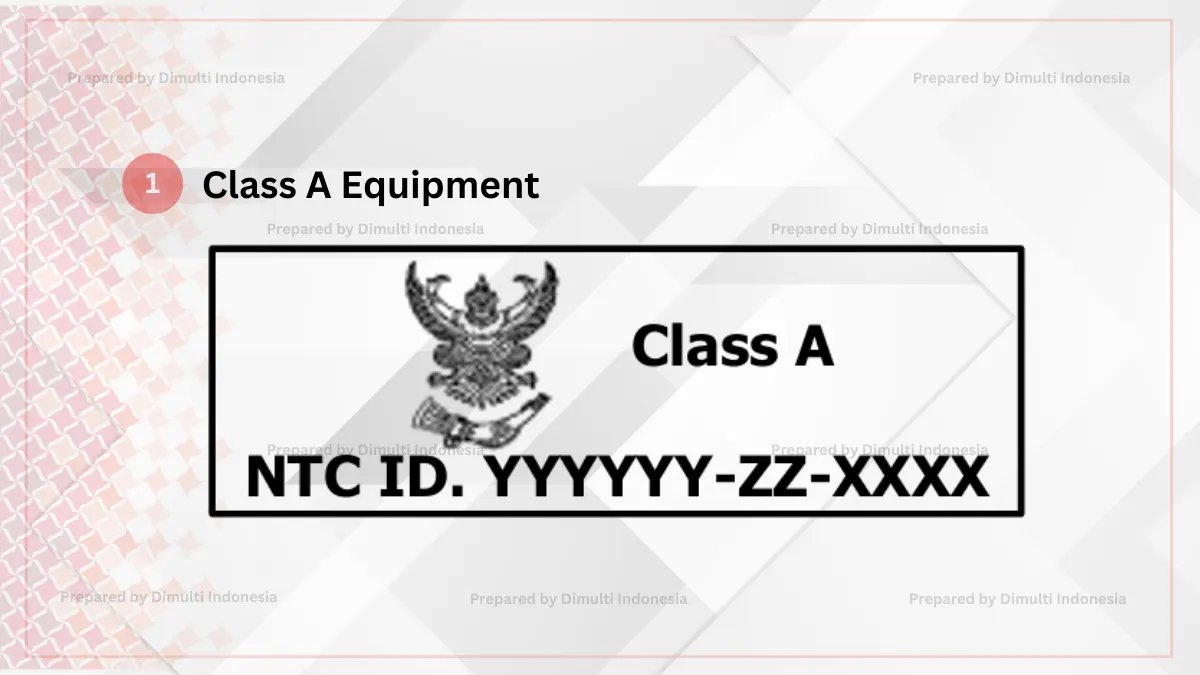
(1) Class A telecommunication equipment shall have the symbol depicted below.
CLASS A
NTC ID. YYYYYY-ZZ-XXXXWhere YYYYYY means the registration number (6 digits)
ZZ means the AC year of registration (the last 2 digits)
XXXX means the supplier code (4 digits)
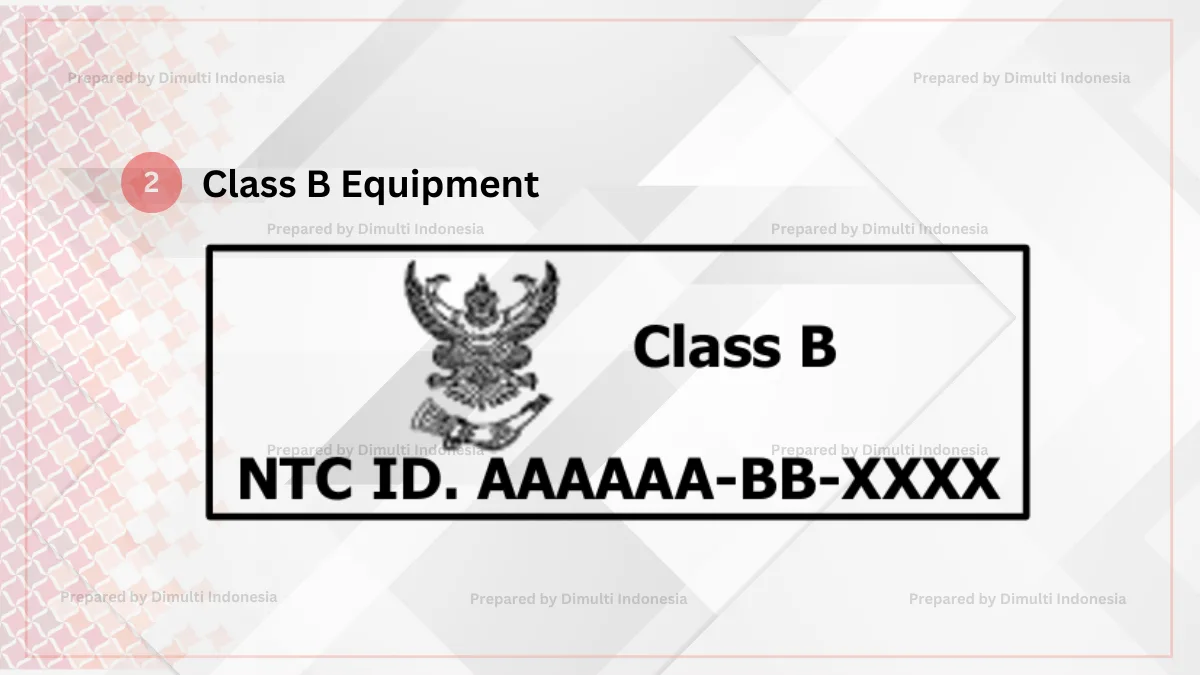
(2) Class B telecommunication equipment shall have the symbol depicted below.
CLASS B
NTC ID. AAAAAA-BB-XXXXWhere AAAAAA means the certification number (6 digits)
BB means the AC year of certification (the last 2 digits)
XXXX means the supplier code (4 digits)
The supplier shall display the mark legibly, visibly, and permanently on the telecommunication equipment. If the size of any telecommunication equipment is unsuitable for the display of such mark, the supplier shall have it displayed on materials used together with the equipment, such as package or user’s manual.
Section 28. The supplier shall have the duty to act upon the Commission’s stipulation in the case where certain category or type of telecommunication equipment are subject to specific written assurance of conformity with the technical standards or technical requirements.
Label Requirements for Thailand Type Approval
If you read the Announcement of the National Broadcasting and Telecommunications Commission (NBTC) Volume 133, Special Chapter 178 above, it is clear that the label requirements for Thailand type approval have certain provisions. Class A, Class B, and Supplier’s Declaration of Conformity (SDoC) have different provisions.
These provisions cover components and placement. To understand each requirement and avoid mistakes in affixing labels, let’s discuss them one by one.
Label components
Class A and Class B labels consist of three components, namely the NBTC Logo, Class Type, and NTC ID.
- NBTC Logo: Indicates that the NBTC has officially verified the product.
- Class Type: Indicates that the product falls under Class A or Class B.
- NTC ID: Consists of a six-digit registration number, two digits for the year of registration, and four digits for the supplier or operator code.
The following is an example of the label component requirements for Class A and Class B for type approval in Thailand:
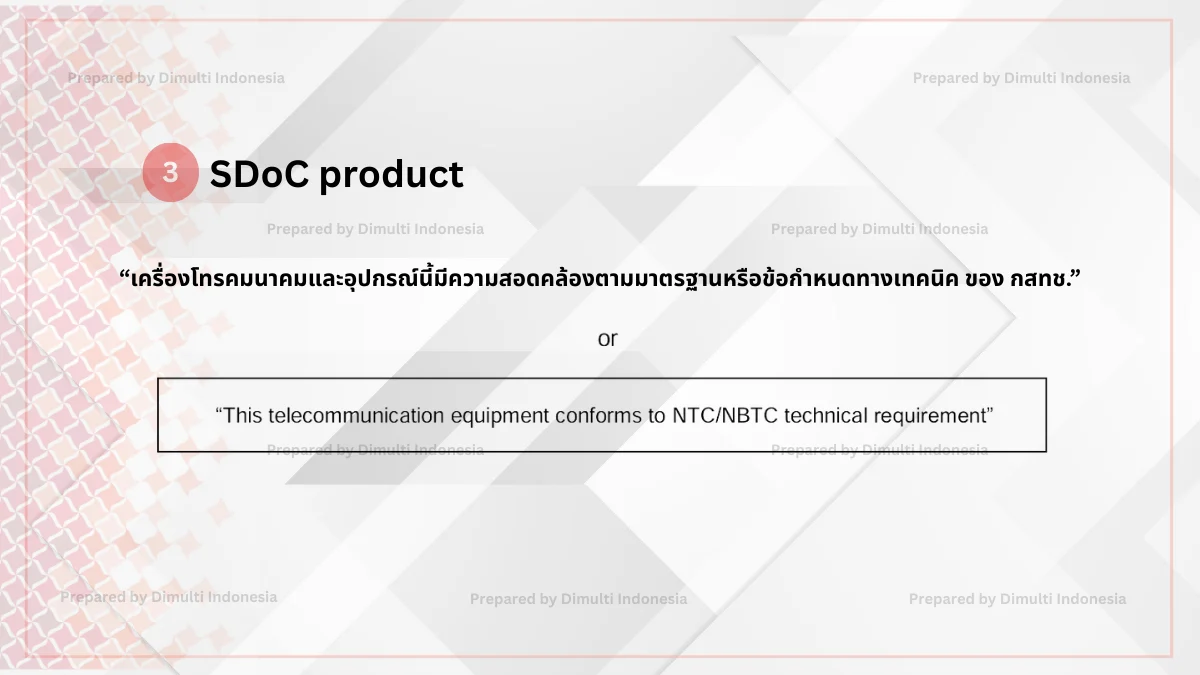
Meanwhile, for SDoC, it is only a statement that the product has met Thai standards.
Statement content: “เครื่องโทรคมนาคมและอุปกรณ์นี้มีความสอดคล้องตามมาตรฐานหรือข้อกำหนดทางเทคนิค ของ กสทช.”
This statement can also be translated into English as “This telecommunication equipment complies with NBTC’s standard or technical requirements.”
The following is an example of SDOC label component requirements for type approval in Thailand:
Label placement
Thailand’s NBTC certification labeling requirements mandate that compliance labels be affixed to all registered products, user manuals, or packaging before the product is sold.
Certification marks or labels must not be placed arbitrarily on communication equipment. For Class A and Class B, the label must be affixed to the product surface in a place that is easily visible and not easily removed. For SDoC products, the statement must be attached to the user manual or other supporting documents accompanying the product.
Notice Label
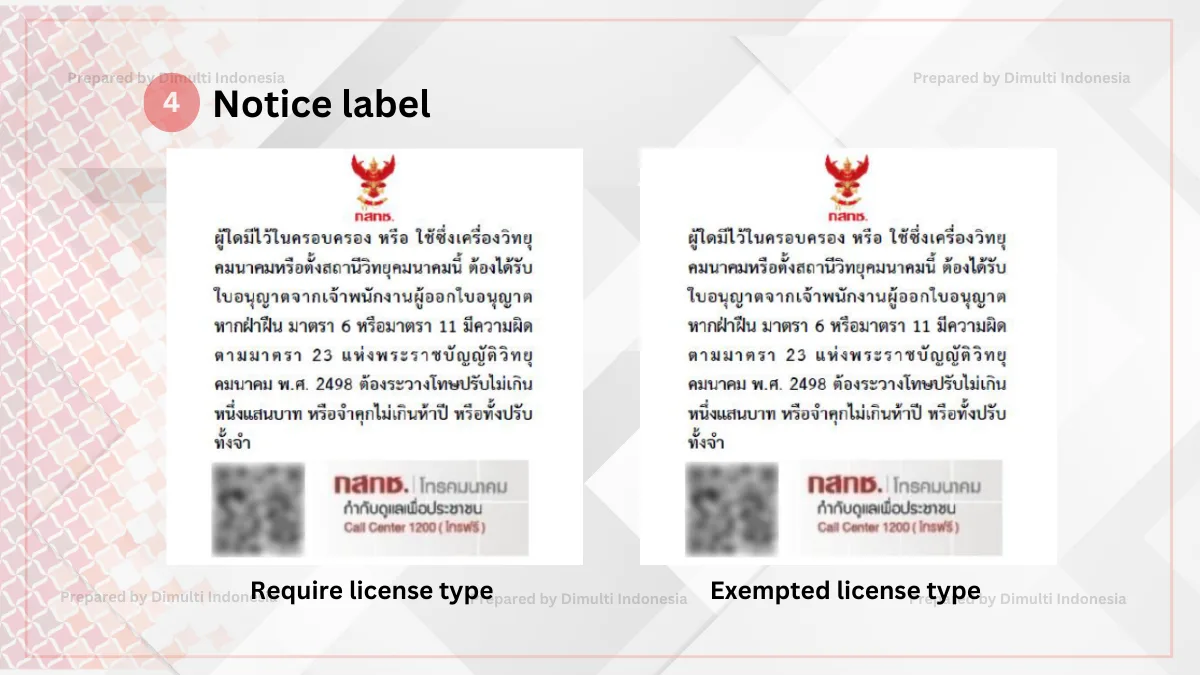
In addition to the three label requirements for Thailand type approval for Class A, Class B, and SDoC, you also need to affix a notice label. There are two types of notification labels from the NBTC Office. The first is for Class A and Class B, which require a license. The second is for SDoC, which is exempt from licensing.
A 5 cm x 5 cm warning label must be affixed to the user manual, packaging, or added as an additional sheet inside the packaging. The following is the format for the Thai warning label:
Association Between Labels and Validity
The validity period of Thailand type approval can be permanent. This applies to all classes, whether Class A, Class B, or SDoC. This is, of course, as long as there are no modifications to the RF certification of the equipment. If there are modifications to the equipment, certification is required by following the same process as the initial certificate application.
Modifications that affect recertification include replacement of the transmitter antenna, changes in transmission power or RF wave characteristics, replacement of existing interface cards, or addition of new interface cards. Regarding labeling, modified types require new labels.
That is the information regarding label requirements for Thailand type approval. By affixing labels according to the certification class and notice label requirements, you demonstrate that your product is officially certified. This means that the product is guaranteed to meet technical safety, quality, and regulatory compliance standards in Thailand.
Delays in importing and marketing your products may occur if there are problems with the labeling. You can consult with Dimulti to avoid these problems. Our team will help you ensure the labeling of your devices.
That way, your RF type approval and marketing of your products in Thailand will run effectively and efficiently. This is because we are supported by a team of professionals with more than 15 years of experience.
Do you want to access the global market and understand the certification process transparently? If so, choosing Dimulti is the right decision. We have a network in various countries and provide a certification process monitored in real-time through our Project Management System (PMS).