

All products entering the Vietnamese market require compliance permits. Therefore, manufacturers cannot underestimate the importance of obtaining Vietnam type approval certification.
Vietnam is an attractive market for the telecommunications industry. It is one of the most dynamic, rapidly developing, and strategically important industrial countries in Southeast Asia. This is driven by rapid digital transformation and its status as a global electronics manufacturing hub. Therefore, Vietnam type approval guidelines are necessary for marketing these products.
Vietnam type approval is known as MoST certification. All manufacturers, importers, and distributors must obtain the necessary instruments before they can market and use their products. To ensure smooth market entry in Vietnam, it is important to understand the guidelines covering the entire certification process.
Also Read
What is Vietnam Type Approval?
Vietnam type approval is regulated by the Vietnam Telecommunication Authority (VNTA), an agency under the Ministry of Science and Technology (MoST). This ministry is authorized to manage and oversee the telecommunications sector, including regulatory, consulting, and standardization functions.
This includes issuing conformity certifications, which the VNTA manages. MoST certification is required for every telecommunications and multimedia product manufactured, imported, distributed, or used in Vietnam. The goal is to ensure that the device meets technical, compatibility, and safety standards in accordance with applicable regulations.
Devices that have obtained MoST certification are guaranteed safe for use and will not interfere with the functionality of other devices when used simultaneously. Therefore, there is no significant risk to users when using them in their daily lives.
Scope of Product Requiring Certification
The scope of products requiring MoST certification is not limited to telecommunications products. However, all products with telecommunications or radio-frequency features are also required to be certified.
The following are some examples of products that require Vietnam type approval:
| Home Appliances: Smart Dishwasher Smart Oven Smart Washing Machine Smart Refrigerator Smart Air Conditioner Smart Wine Chiller Smart Coffee maker Smart Fan Electronic Water Meter Sensor Smart Lighting system Smart water closet Robot vacuum cleaner Smart locker Etc. | Automotive: Tire Pressure Monitoring Sensor Head Unit/Car Audio Telematic Unit Body Control Module Immobilizer Keyless Wireless Charging Unit Vehicle Radar Dashboard Camera Seat-belt Sensor Door-Lock Sensor Vehicle Dashcam Etc. |
| Audio-Video Devices: Wireless Speaker Smart Television or Digital Television Monitor Wireless Microphone Microphone Receiver In-ear monitoring device Headset/headphone True Wireless Earbuds Projector Speakerphone Etc. | Telecommunication Products: Smartphone Line/wired telephone Tablet PC Handy Talkie/Walkie Talkie Switch Router Access Point Video Conference Cordless telephone IP Phone Etc. |
| Medical and Healthcare products: Blood Glucose Monitoring System Blood pressure monitoring system MRI system Smart Operating Table Digital Radiography Smart syringe pump Body Height measurement Body weight measurement Bluetooth Oximeter Etc. | Wearable: Smartwatch Smart Ring Smart tag Running shoes tracker Smart eyeglasses Etc. |
| Environmental Monitoring Product: Wildfire Sensor Whether Sensor Etc. | Mining: Smart detonator system Tunnel light signal Etc. |
Who Should Be an Applicant for Certification?
Applicants for Vietnam type approval certification are listed in Circular No. 30/2011/TT-BTTTT. According to this regulation, MoST certification applicants must be local companies officially registered in Vietnam.
The company can be the actual importer or distributor of the product. Manufacturers can also become certificate holders if they already have a local representative in Vietnam.
For manufacturers that do not have a local representative and are not yet partnered with an importer or distributor, a local representative service provided by a Vietnamese partner agent can be used to obtain Vietnam type approval.
However, certificates held by local partner agents cannot be used for imports. They can only be used for marketing or promotional purposes. To import products for sale, manufacturers must cooperate with an actual local importer or distributor.
Furthermore, the local partner, who is the importer or distributor, will issue the certificate in their own name.
Certification Application Scheme in Vietnam
Vietnam’s type approval process differs slightly from that of some of its neighbors. Applicants can choose from two certification schemes: Scheme 1 and Scheme 7.
Scheme 1 offers two options:
- Option 1: Manufacturer with an authorized local representative in Vietnam. Test reports and certificates are issued under the manufacturer’s name and may be used by multiple importers, provided they have an authorization letter from the manufacturer.
- Option 2: The manufacturer and factory must be part of the same company group.
Scheme 7, on the other hand, applies only to each batch of imported goods. Test reports and certificates can only be in the name of a local importer appointed by the manufacturer.
MoST Certification Process
The Vietnam Type Approval certification process is divided into two methods: local testing and document evaluation. However, the local testing method is mandatory for obtaining MoST certification.
Document or paperwork evaluation is permitted as long as it uses test reports from laboratories that have Mutual Recognition Arrangements (MRAs) with Vietnam.
Local testing
Local testing for Vietnam Type Approval is a mandatory method. This method requires applicants to submit samples for testing at a local Vietnamese laboratory.
The process involves two types of testing: Radio Frequency (RF) Testing and Electromagnetic Compatibility (EMC) Testing. A minimum of two samples is typically required, depending on the product category and applicable regulations.
Apart from samples, local testing also requires several documents for subsequent submission to MoST. The following documents are required:
- Application Form (draft will be prepared by us and signed by the Type Approval (TA) cert holder)
- Product’s Specification
- Photos of the product label
- Information on the Sample
- Valid ISO 9001:2015 certificate of the manufacturing factory
- Test SOP and Software
- Factory declaration (draft will be prepared by us and signed by the manufacturer)
- Declaration of sample shipment (to be prepared by us and signed by the manufacturer)
- Business license of the TA certificate holder (to be provided by the TA certificate holder)
Document evaluation
Document evaluation or paperwork application for Vietnam type approval is an alternative method permitted by the MoST. This process requires RF and EMC test reports to be obtained from a laboratory that has an MRA with Vietnam.
Additionally, other documents and any required additional documentation must be prepared for document evaluation. This route is usually faster because it does not require local testing. However, for countries that require local testing, the document evaluation method is usually more expensive.
Certificate issuance
After all documents are submitted to the MoST, they will be evaluated. If they pass the evaluation, you can make a payment, and the certificate will be issued. However, if they fail, you will need to complete the missing documents for further evaluation.
The entire certification process, from local testing to certificate issuance, takes approximately eight weeks. This includes around five weeks for testing and three weeks for evaluation, provided there are no technical issues or missing documents.
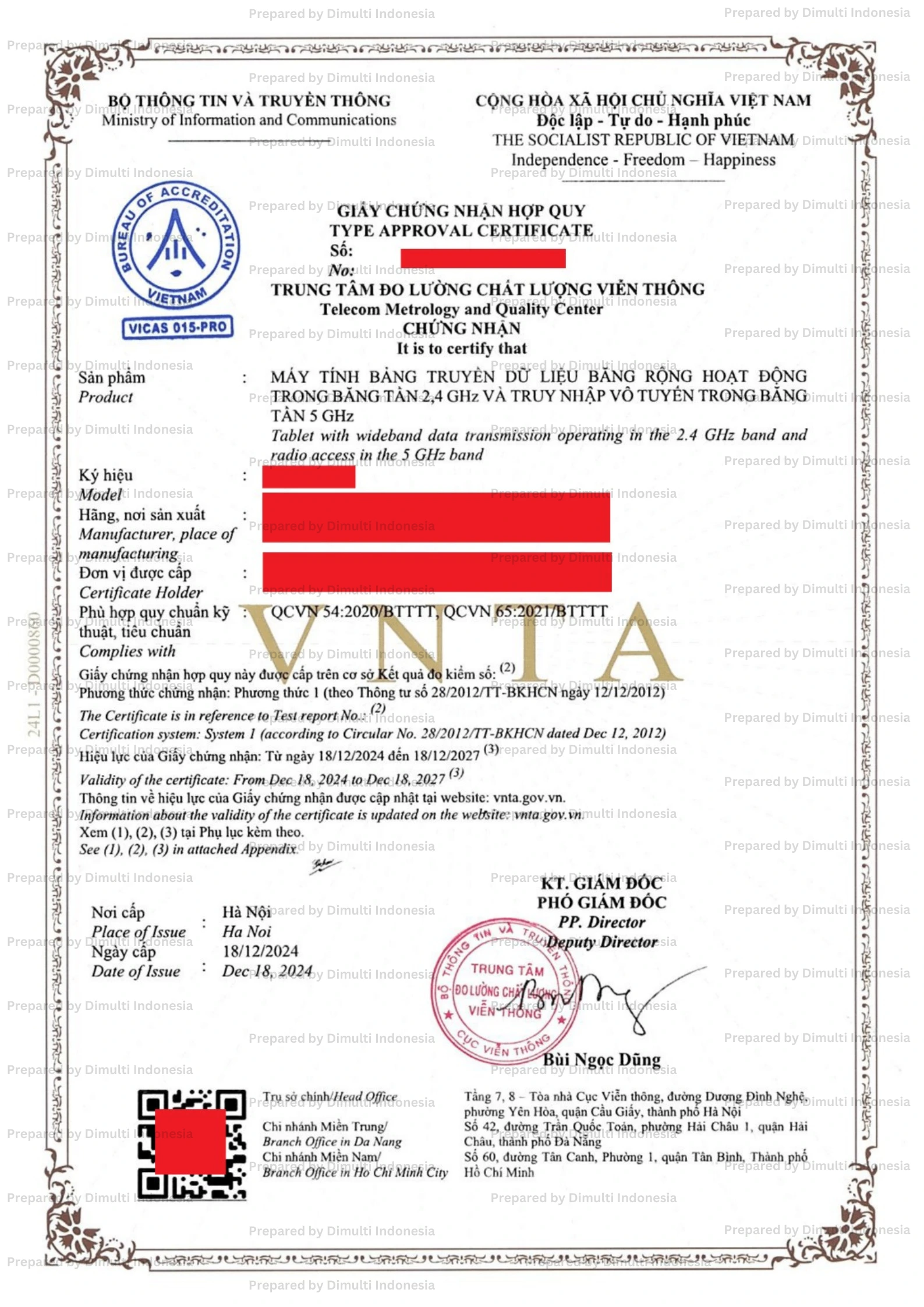
MoST certificates are valid for three years. If the product continues to be imported, sold, or used in Vietnam after this period, a certificate renewal is required.
The following is an example of a MoST certificate:
Self Declaration of Conformity (SDoC)
After obtaining Vietnam’s type approval, importers or applicants must submit a Declaration of Conformity (DCC). This is required for both imported and domestically produced products.
A SDoC (Standard DoC) is required for import processing. This document is valid for only one import batch. Obtaining an SDoC requires several documents to be submitted to the VNTA. The following documents are required:
- MoST certificate
- EMC test report
- Safety test report
- SDoC Form
- Letter of Acceptance (LoA) to Local Importer (If the certificate holder is Foreign Manufacture)
Label requirements of the Vietnam type approval
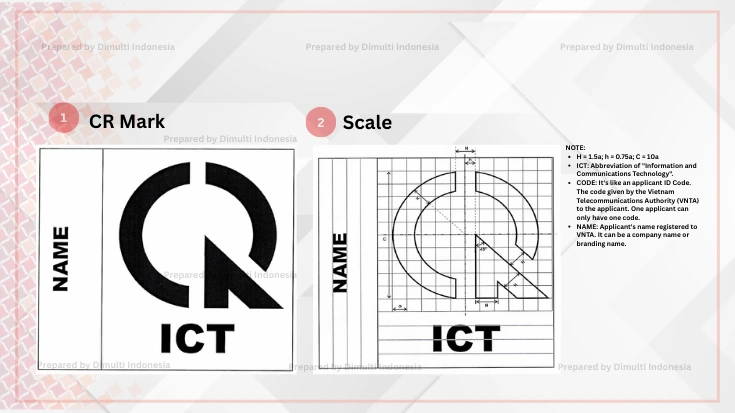
All telecom and wireless devices certified by a Vietnamese type approval body must be labeled. This is stipulated in Circular No. 30/2011/TT-BTTTT, Chapter IV concerning the Use of Regulation Conformity Marks.
Labeling requirements for Vietnam’s MoST certification require the affixation of a conformity label to all registered products, user manuals, or packaging before the product is sold.
The labeling requirement consists of three components: ICT (Information and Communication Technology), the name of the certificate holder, and the certificate holder’s code.
These three components must be permanently affixed to the product, packaging, any technical documentation included with the product, or on a label affixed to the product. The mark must be clearly visible, legible, non-erasable, and not confused with other marks.
Here is an example of the label:
MoST Certification Management Services
Does understanding the entire MoST certification process above make you more aware, or perhaps even more confused? That’s understandable, considering the lengthy process for local Vietnam type approval testing.
You can simplify the entire process. Of course, you’re not alone; you need help. This is where Dimulti Indonesia comes in, providing RF and telecommunications type approval certification services.
We are ready to help meet all your MoST certification needs. We operate not only in Vietnam but also internationally. Our network continues to grow as research and client needs evolve.
Since 2008, Dimulti has assisted hundreds of clients and thousands of RF type approval projects with efficient procedures. Our team, with over 15 years of experience, knows exactly what you need.
We have an in-house lab that allows for pre-testing. This is especially helpful for processes requiring local testing. Pre-testing helps prevent failures during live testing, thus avoiding losses.
Furthermore, we have a Project Management System (PMS) that allows you to monitor the certification process in real-time and transparently. Simply open your phone, and you’ll see how far along the certification process is.
The Vietnam type approval certification process is a lengthy process, from document collection, local testing, and document submission. Therefore, don’t hesitate to contact us to streamline and simplify your certification process.