
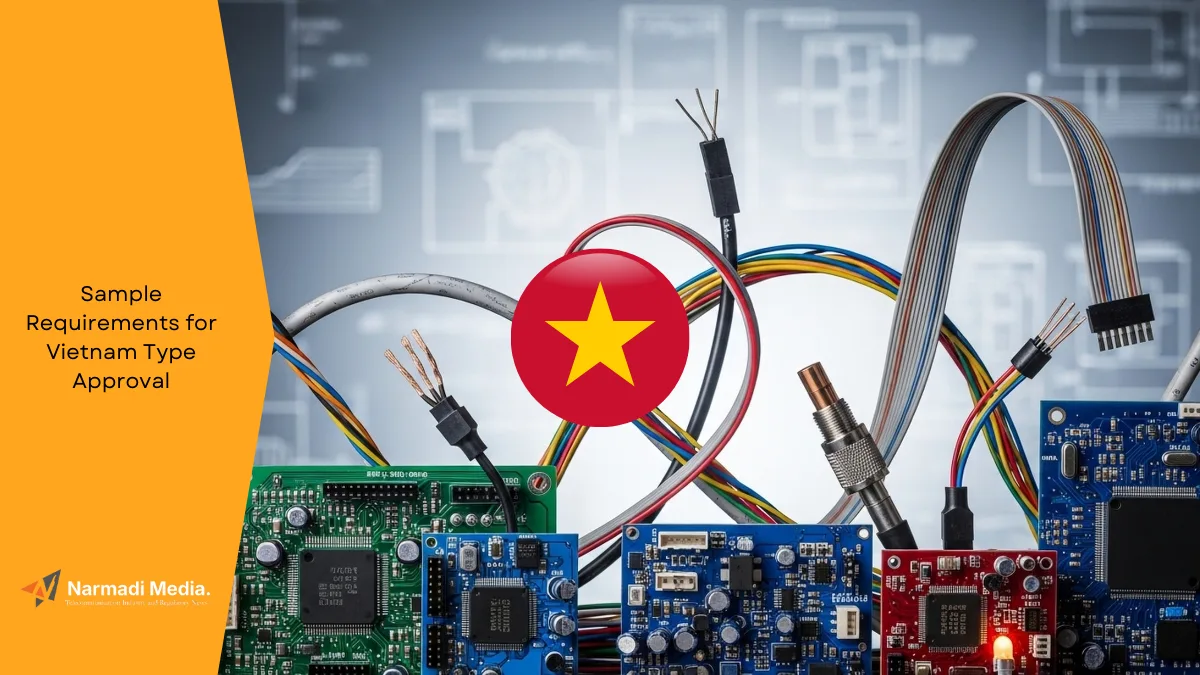
Vietnam requires local testing as a condition for obtaining MoST certification. Therefore, the sample requirements for Vietnam type approval must be understood by all manufacturers who wish to market their products in the country.
Sample requirements for Vietnam type approval are necessary to ensure that telecommunications devices to be sold and distributed meet the specified criteria. These requirements are set by the Vietnam Telecommunication Authority (VNTA). This authority is an agency under the Ministry of Science and Technology (MoST) that regulates all requirements for obtaining certification.
The criteria and number of sample requirements for Vietnam type approval greatly determine the smoothness of the certification process. To understand this more deeply, you can read this article to the end.
Also Read
What is a Testing Sample?
The test sample is the telecommunications device used in the laboratory during the certification process. This is usually required for countries that mandate local testing.
The sample will then be measured to ensure compliance with the technical standards applicable in that country. Local testing for Vietnam type approval is mandatory.
Therefore, sample requirements for Vietnam type approval are necessary in the certification application process. We will discuss the quantity and requirements in more detail in another section.
What are The Testing Processes?
Sample requirements for Vietnam type approval are used for two types of testing, namely Radio Frequency (RF) and Electrical Compatibility (EMC). RF testing is conducted on devices that use radio frequencies to evaluate wireless signal transmission.
Meanwhile, EMC testing is conducted on devices to ensure that they do not interfere with other devices. The entire process will be carried out at one of 28 local laboratories in Vietnam.
The testing location for the sample will be determined directly by VNTA. This is to accommodate the capabilities of the laboratory for the device to be tested and the availability of each laboratory.
How Many Samples are Required?
The number of samples required for Vietnam type approval depends on the specific requirements and policies of each laboratory. However, in general, only two samples are required.
One sample is for RF testing, and the other is for EMC testing. Each sample is tested under different conditions, one conducted sample and one normal sample.
Sample Requirements for Vietnam Type Approval
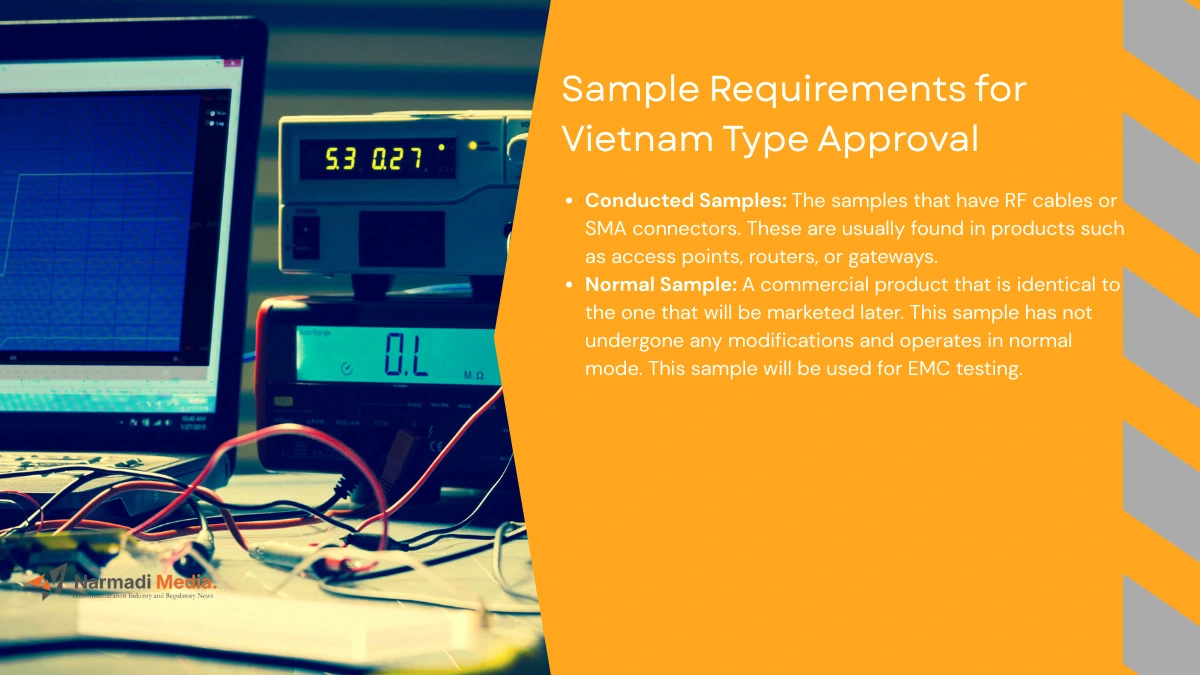
Sample requirements for Vietnam type approval refer to the mandatory local testing requirements. Applicants for Vietnam type approval must submit two samples for different requirements and conditions.
Conducted samples are required for RF testing. Meanwhile, normal samples are required for EMC testing.
Conducted sample
Conducted samples are samples that have RF cables or SMA connectors. These are usually found in products such as access points, routers, or gateways.
The RF or SMA connector, which is usually used to connect the product’s external antenna, will be removed to connect directly to the spectrum analyzer. The sample is then measured based on required parameters, including frequency range, output power, bandwidth, and spurious emissions.
For products that do not have a built-in RF or SMA connector, the RF module needs to be opened. For RF modules that have RF pins inside, the RF cable can be connected directly. Meanwhile, for those without RF pins, the RF cable will be soldered to the antenna and ground of the RF module.
This is the method that needs to be taken for products that do not have RF or SMA connectors. The aim is to make it easier for the spectrum analyzer to capture and measure the transmission emitted by the RF module.
Normal sample
A normal sample is a commercial product that is identical to the one that will be marketed later. This sample has not undergone any modifications and operates in normal mode. This sample will be used for EMC testing.
For normal samples that already have RF or SMA connectors installed, the sample can also be used as a conducted sample. That way, you only need to send one sample.
However, if the normal sample does not have an RF or SMA connector, you still need to send two samples. This is because a normal sample without an RF or SMA connector needs to be modified to become a conducted sample.
Pre-Testing to Ensure Sample Quality
Pre-testing is conducted before direct testing at an official laboratory designated by VNTA. This service is rarely offered when you partner with certification management services.
Dimulti Indonesia offers pre-testing services to ensure your products meet the testing parameters set by regulations. This will prevent failure during direct testing at the official laboratory.
We will first test the samples you send for local testing in our internal lab. In this pre-test, we will test the frequency range, output power, and bandwidth parameters.
For bandwidth testing, our equipment supports frequencies ranging from 125 kHz to 8 GHz. Frequencies outside this range must be tested directly at the official laboratory.
Those are the sample requirements for Vietnam type approval. You need at least one or two samples for RF and EMC testing. The samples required are the conducted samples and the normal samples.
If the normal sample has an RF or SMA connector, it can also be a conducted sample. However, if not, you still need to send two samples.
Problems with test samples can cause delays in the certification testing process. This can be caused by incorrect samples, insufficient samples, or sample conditions that do not match the model listed in the application.
You can contact Dimulti to avoid these problems. With a team of professionals with more than 15 years of experience, we are ready to help you overcome RF type approval issues effectively and efficiently.
With our Product Management System (PMS), you can monitor the certification process in real time. Additionally, our international network supports your expansion into global markets.
Finally, we offer pre-testing services that are rarely available from other service providers. This means you don’t have to worry about the risk of failure that can occur in official laboratories.