
Manufacturers need to understand the paperwork application for Vietnam type approval. This is not a recommended route, but it can be an option for applying for MoST certification. This is because countries that require local testing usually involve higher application costs.
The paperwork application for Vietnam type approval has several requirements that must be met. These requirements are set by the Vietnam Telecommunication Authority (VNTA). This authority is an agency under the Ministry of Science and Technology (MoST) that regulates all requirements for obtaining certification.
So, what allows the paperwork application for Vietnam type approval? Let’s walk through the procedure and process together.
Also Read
What is the Paperwork Application for RF Type Approval?
Submitting an application or evaluating documents is a generally applicable Radio Frequency (RF) type approval process. This is another option for countries that require local testing. It is a mandatory process for countries that do not require local testing.
In the application process, each country applies its own rules, especially those that allow this method as an alternative route. Typically, the requirements are stricter. In general, testing must be conducted by laboratories that meet international standards or have formal cooperation agreements with the destination country.
This is important to ensure compliance with the destination country’s requirements regarding frequency use, power levels, and emission limits. Usually, the authorities of each country already have a list of registered and accredited international laboratories. In Vietnam, document submission is permitted as an optional route for the MoST certification process.
Foreign Laboratory Testing Requirements
Local testing is the recommended method for applying for MoST certification. However, VNTA itself allows the paperwork method to be chosen as an option for certification applications.
The use of the document method means that the applicant already has test report from an approved international laboratory. The requirement is that the laboratory must have a Mutual Recognition Agreement (MRA) with Vietnam. Furthermore, the contents of the test report must comply with the requirements set by VNTA.
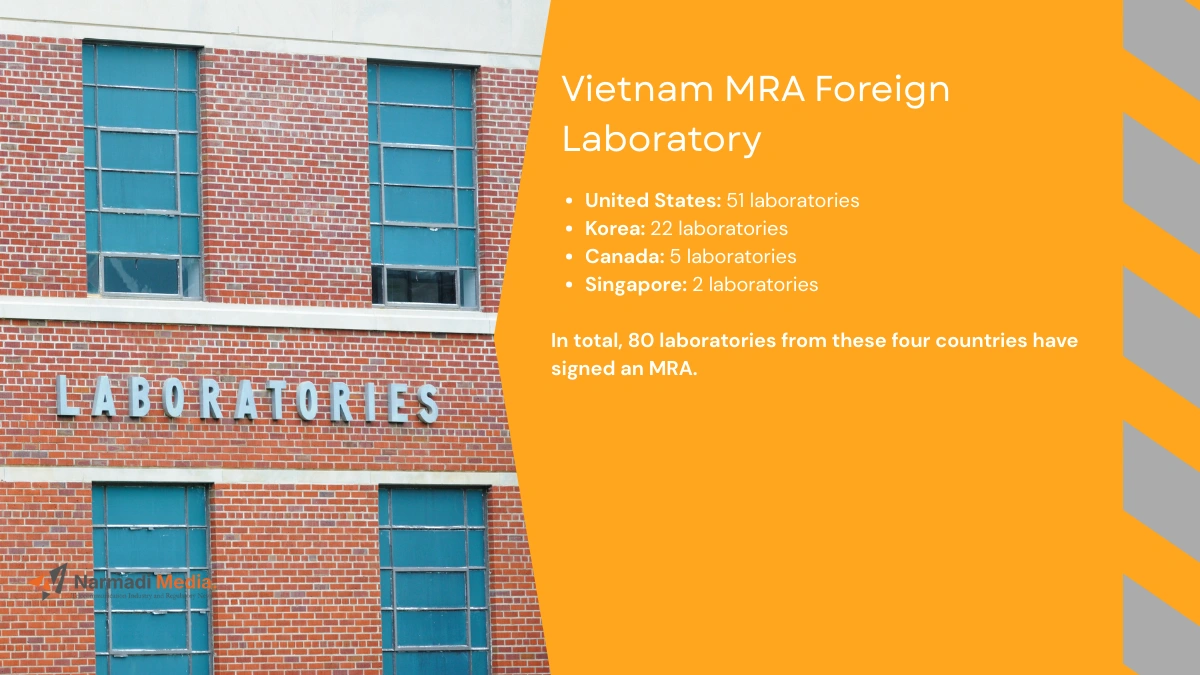
Vietnam has established cooperation with several countries, namely the United States, Korea, Canada, and Singapore. There are 51 laboratories in the US, 22 in Korea, 5 in Canada, and 2 in Singapore. In total, 80 laboratories from these four countries have signed an MRA.
For a list of international laboratories that have signed an MRA with Vietnam, please visit the following link: https://mst.gov.vn/danh-sach-cac-phong-thu-nghiem-duoc-thua-nhan-theo-cac-thoa-thuan-thua-nhan-lan-nhau-mra-19724040913424254.htm.
Test Report Parameters
Paperwork application for Vietnam type approval must go through a laboratory that has an MRA with Vietnam. This is because the test report parameters must remain consistent with those of other applicants conducting local testing.
The test report will determine whether the device meets the specified parameters. Test parameters include frequency range, output power, bandwidth, and spurious emissions. The tests are Radio Frequency (RF) Testing and Electromagnetic Compatibility (EMC) Testing.
The testing will produce an RF test report if the telecommunications and wireless products pass the testing process. If you use Dimulti’s services, pre-testing will be conducted before the samples are sent to overseas laboratories for testing.
Sample requirements for Vietnam type approval will be tested in our internal laboratory to ensure that the device meets the specified parameters. This way, you will avoid failure during direct testing.
Paperwork Application for Vietnam Type Approval Process
Document submission relies heavily on strict document requirements for Vietnam type approval. In addition to the general document requirements for MoST certification, additional supporting documents must also be submitted.
All document requirements for Vietnam type approval will be submitted directly to the VNTA office. There are three VNTA Verification and Certification Centers located in Hanoi, Ho Chi Minh City, and Da Nang City. You can submit your application based on the registered location of the certificate holder.
After the evaluation process, VNTA will notify the applicant whether the certification application is approved or rejected. If approved, an e-payment must be made to proceed with certification issuance.
If the evaluation is not passed, the documents will be returned to the applicant for revision or to add missing documents. The revised and complete documents can then be resubmitted.
After that, you can apply for the SDoC process to import goods. Goods can only be imported after the MoST Certificate and SDoC are issued.
That is all you need to know about the paperwork application for Vietnam type approval. Now you know that paperwork can be an option as a method that can be chosen in applying for MoST certification.
However, you must attach test report from an international laboratory that has an MRA with Vietnam. There are a total of 80 laboratories spread across the US, Canada, Korea, and Singapore.
Issues with the paperwork application for Vietnam type approval can cause delays in the application process. Consult with Dimulti to avoid these issues.
With a professional team that has over 15 years of experience, your certification process will be handled effectively and efficiently. Supported by pre-testing facilities and a Product Management System (PMS) for real-time monitoring, we help make global market access smoother and more reliable.