

Lead time is a frequently asked question when submitting an application, and the same applies to Vietnam type approval. Therefore, manufacturers need to understand this, especially when applying for MoST certification for the first time.
Understanding the lead time for Vietnam type approval will help you manage your business more effectively. In this case, the criteria are set by the Vietnam Telecommunication Authority (VNTA). This authority is an agency under the Ministry of Science and Technology (MoST) that regulates all requirements for obtaining certification.
The lead time for Vietnam type approval varies depending on the application method you choose. This article provides detailed information on how long the process takes for each method.
Also Read
Understanding Lead Time Helps You to Arrange the Business
Applying for Radio Frequency (RF) type approval inevitably requires a series of steps. Of course, this takes time, from preparing documents and conducting local testing to issuing the certificate.
Not to mention that after the certificate is issued, VNTA requires a Self Declaration of Conformity (SDoC) application for your goods to be imported. Given the length of this process, careful planning is necessary for certification applications.
This relates to product marketing schedules, market readiness, and budget planning. Although not a technical issue, understanding the lead time for Vietnam type approval will indirectly impact your business management.
MoST Certification Application Process
Before discussing the lead time for Vietnam type approval, it is important to understand how the process works. The MoST certification process is divided into two options, namely local testing and document evaluation.
Local testing is the most recommended method for applying for this certification process. However, VNTA provides the option of document evaluation or paperwork as an alternative route with several strict conditions.
Local testing
Local testing for Vietnam type approval is the most comprehensive recommended pathway. By choosing this method, you must conduct testing at a local Vietnamese laboratory.
There are two testing processes required for Vietnam type approval: Radio Frequency (RF) testing and Electromagnetic Compatibility (EMC) testing. This process requires sample requirements for Vietnam type approval. During the process, samples will be measured to ensure their compliance with applicable technical standards.
Document evaluation
Document evaluation or paperwork application for Vietnam type approval is an alternative option available. Choosing this method means that you already have test reports from overseas laboratories that have collaborated with Vietnam.
The requirement is that you must have a test report from an international laboratory that is registered and accredited by VNTA. In addition, the test report from the international laboratory must still comply with the technical testing standards applicable in Vietnam.
After that, the required RF and EMC test reports are collected together with other document requirements for type approval in Vietnam.
SDoC
Self Declaration of Confirmation (SDoC) is a series of processes that must be followed after receiving the MoST certificate. Although this process is important for importers before importing their goods, domestically manufactured products also need to submit it.
In this process, you only need to submit the required documents. Although it is purely a document evaluation, it still takes a considerable amount of time. Please note that an SDoC is valid for only one import.
If you are going to import more than once, you will need more than one SDoC. So, consider this carefully.
Lead Time for Vietnam Type Approval
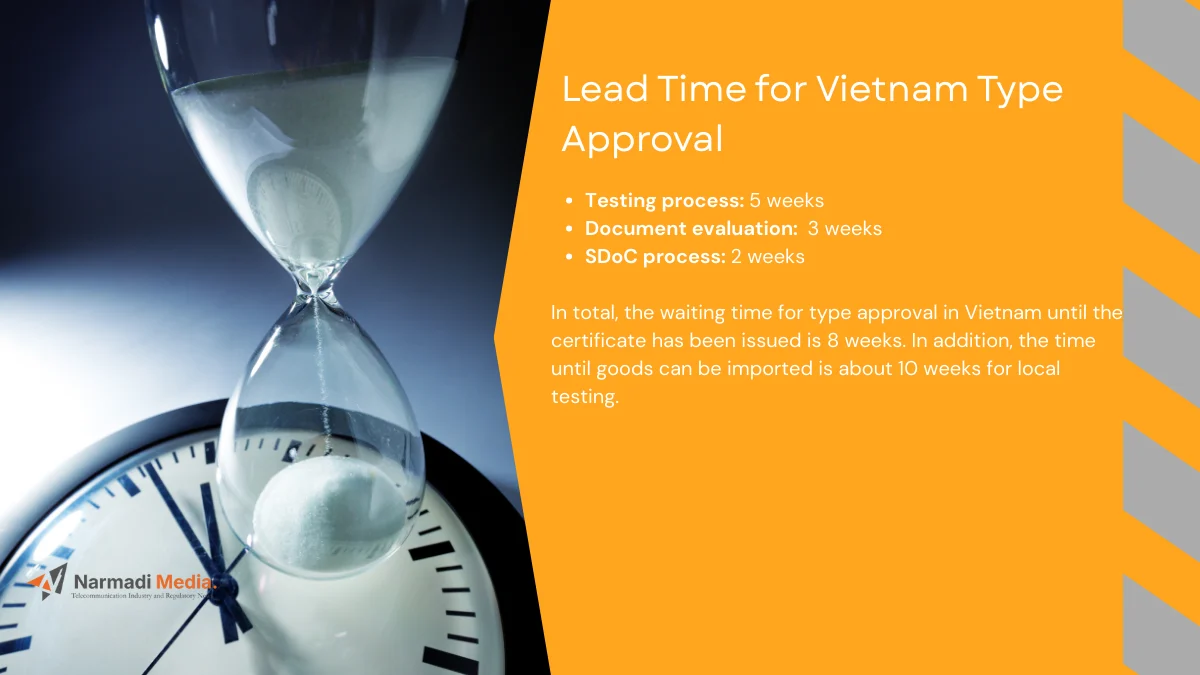
Each MoST certification application process has a different waiting period. The lead time for Vietnam type approval through local testing takes eight weeks. Five weeks for testing and three weeks for document evaluation.
Of course, this is longer than a document evaluation, which only takes two to three weeks. After the certification process is complete, an SDoC application must be submitted. This process is similar to document evaluation and usually takes around two weeks.
In total, the lead time for Vietnam type approval until goods can be imported is approximately 10 weeks for local testing. Meanwhile, document evaluation takes approximately four to five weeks.
That is a brief description of the lead time for Vietnam type approval. In general, the recommended approach is local testing. Although it offers a shorter time frame, the paperwork method is only an option for MoST certification applications.
The time required for MoST certification will indirectly affect your business, from launch planning, market readiness, and budgeting. Therefore, it is important to ensure that the entire process runs smoothly.
Delays in Vietnam type approval can significantly impact your product’s entry into the market. By contacting Dimulti for consultation, you can avoid this.
Our professional team, with over 15 years of experience, will assist you throughout the RF type approval process effectively and efficiently, ensuring that MoST certification can be completed as planned.