

All telecom and wireless devices entering the Philippine market require compliance approval. Therefore, manufacturers should not underestimate the importance of obtaining the Philippines type approval certification.
The Philippines is a promising market in Southeast Asia. The country has shown steady growth in terms of technology adoption, as evidenced by the number of Information and Communication Technology (ICT) products. Therefore, the Philippines type approval guidelines are necessary to market these products.
The Philippines type approval is known as NTC certification. All manufacturers, importers, and distributors must obtain the necessary instruments before they can market and use their products. To ensure smooth market entry in the Philippines, it is important to understand the guidelines that cover the entire certification process.
Also Read
What is the Philippines Type Approval?
NTC stands for “National Telecommunications Commission,” an agency under the Department of Information and Communications Technology (DICT). This ministry is authorized to set communication technology standards and conduct product testing through its local laboratories. This includes issuing conformity certifications, commonly referred to as NTC certifications.
These certifications are required for every telecommunications and multimedia product manufactured, imported, distributed, or used in the Philippines. They ensure that the device meets technical, compatibility, and safety standards in accordance with applicable regulations.
Devices that have obtained NTC certification are guaranteed safe to use and will not interfere with the functionality of other devices when used simultaneously. Therefore, there is no significant risk to users when using them in their daily lives.
Scope of Products Requiring Certification
The Philippines type approval is divided into three classification schemes. These classes are Radio Communications Equipment (RCE), Customer Premises Equipment (CPE), and Grant Equipment Conformity (GEC).
The scope of products requiring NTC certification is not limited to telecommunications products. However, all products with telecommunications or radio frequency features are also required to be certified.
The following are some examples of products that require Philippines type approval:
| Clacification | Equipment Category | Product Example |
| RCE | This classification is for radio communications equipment with a radio frequency feature | – Bluetooth – WiFi – Wireless charging – And other Short-Range Device (SRD) features |
| CPE | This classification is for customer premises equipment and is used to access public telecommunications networks | – GPON/EPON devices – Analog telephones- Fax machines |
| GEC | This classification is for telecommunications devices that exhibit both RCE and CPE functionalities | – Smartphones – 2G/3G/4G LTE/5G NR – Wireless access points – WWAN-enabled SRDs |
Who Should Be an Applicant for Certification?
The applicant for the Philippines type approval is slightly different from those in other countries in Southeast Asia. In this country, foreign companies are still allowed to be certificate holders. This certainly makes it easier for manufacturers who do not yet have a local company or representative in the Philippines.
The final version of the NTC certificate will include information on the manufacturer and applicant. Generally, the applicant and manufacturer are mostly the same entity. This certainly makes the certification process easier.
However, NTC also allows different entities to act as applicants, provided that the manufacturer has an official partner in the Philippines. Additionally, the manufacturer must also issue a power of attorney to appoint another company as the type approval applicant.
NTC Certification Process
Basically, the Philippines type approval certification process focuses on document evaluation. Therefore, applicants are expected to have conducted testing at an ISO/IEC 17025-accredited international laboratory.
These standards refer to Conformité Européenne (CE) or Federal Communications Commission (FCC) for Radio Frequency (RF) testing, Electromagnetic Compatibility (EMC) testing, and electrical safety testing.
Document evaluation
To apply for the Philippines type approval, applicants must submit the required documents. Before submitting the application, it is important to ensure that all documents are complete. The required documents include:
- Application form specified by the NTC Office
- Letter of Authorization (LoA) from applicants to Dimulti
- Declaration of product specification, including photos, description, and RF features
- Manufacturer’s declaration of conformity
- RF test report
- EMC test report
- Safety test report
Once the documents have been collected and prepared, they will be sent directly to the NTC office. Along with the submission of documents, you will also be asked to make a document evaluation payment so that NTC can evaluate them.
If the evaluation is successful, the applicant will be requested to pay the certificate issuance fee before the certificate is released. If the evaluation is unsuccessful, the missing documents must be completed, and then they will be re-evaluated by NTC.
Certificate issuance
The NTC certificate will be issued after going through the above process. The processing time for Philippines type approval applications, which are generally document-based, is relatively long compared to neighboring countries that use the same method.
The average waiting time is approximately 20–25 working days after all required documents are received by the NTC office. This long waiting time is due to the certification process in the Philippines, which does not yet use an online system.
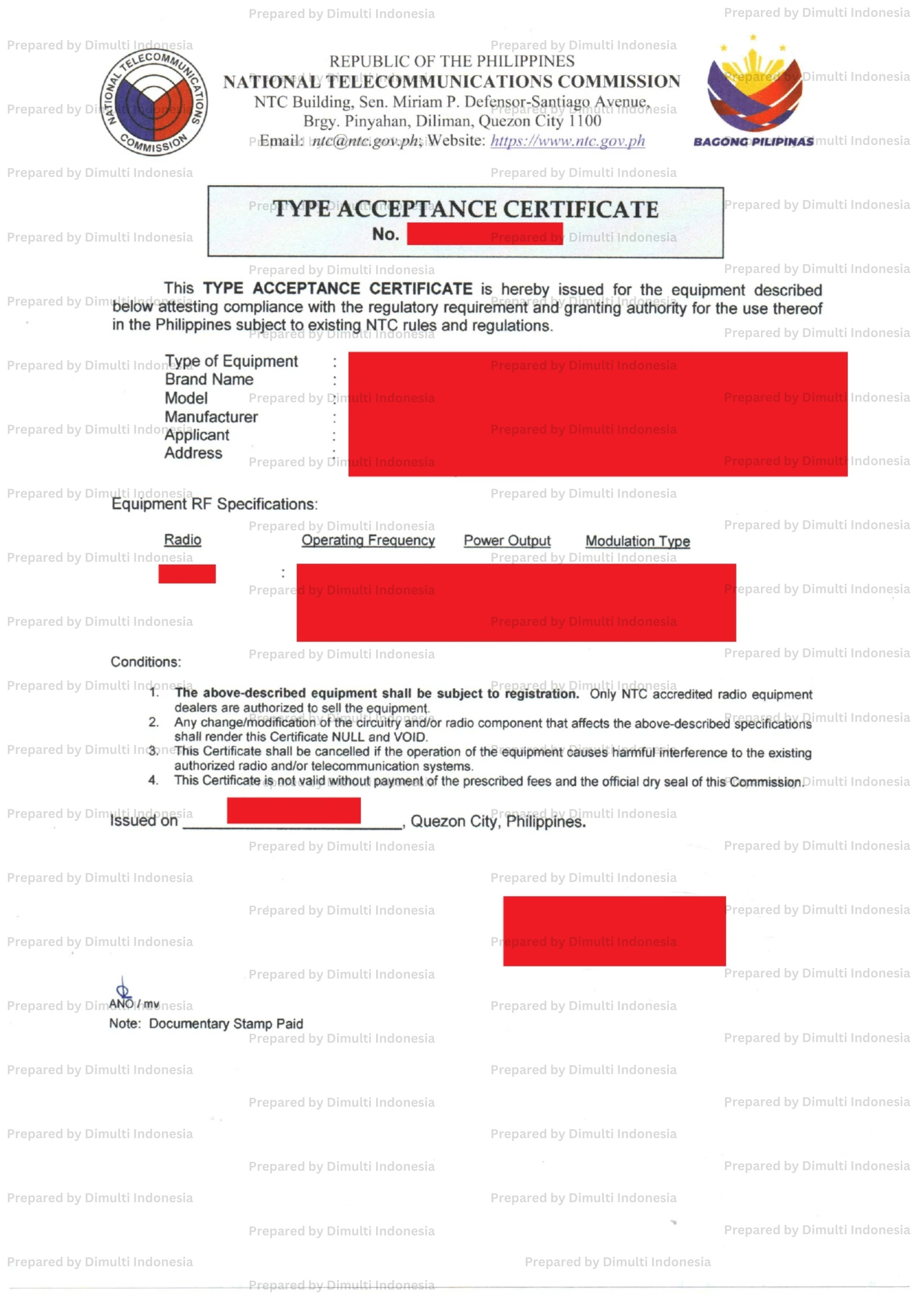
NTC certificates are valid indefinitely, provided there are no changes to the RF specifications of the equipment. Certificate modifications are permitted as long as they do not affect RF parameters. Examples include changes to the applicant’s name or address, equipment type or model, or manufacturer name.
The following is an example of an NTC certificate:
Labeling
All telecommunications and wireless devices that have been certified by the Philippines type approval body must be labeled. This is stated in Memorandum Circular No. 02-01-2001, specifically in section VI.
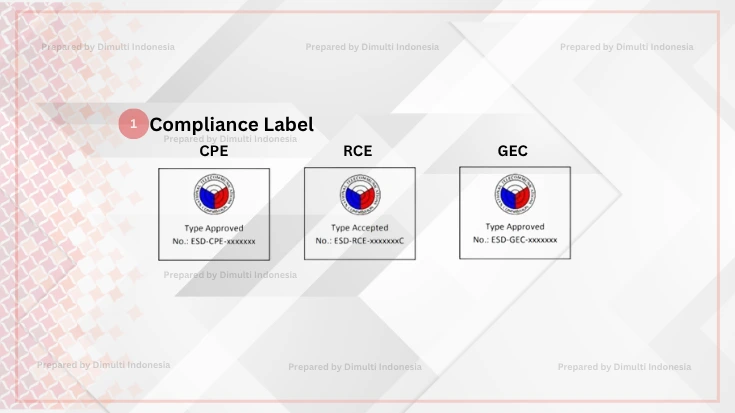
Labeling requirements consist of three components:
- ESD (Equipment Standards Division)
- The NTC product classification scheme (SPE, RCE, or GEC)
- A seven-digit certificate number
The labeling requirements for NTC Philippines certification require the affixing of a compliance label on all registered products, user manuals, or packaging before the product is sold.
Electronic labels are permitted; however, they cannot replace physical labels, as Memorandum Circular No. 02-01-2001 requires the use of physical labeling.
Here is an example of the label:
NTC Certification Management Services
Understanding the entire NTC certification process above doesn’t necessarily eliminate confusion. This is understandable, given the lengthy document submission process that must be completed in person for the Philippines type approval.
To resolve your confusion, you may need assistance. We, Dimulti Indonesia, are here to help you resolve the confusion surrounding RF and telecommunications type approval certification.
What does Dimulti offer? Of course, we’re here for you. We have over 15 years of experience, a global network, an in-house lab for pre-testing, and a certification process that can be monitored in real time.
1. Over 15 years of experience
Since 2008, Dimulti has assisted hundreds of clients and thousands of RF type approval projects with efficient procedures. Our team, with over 15 years of experience, knows exactly what you need.
2. Global network
We support certification needs not only in the Philippines but also worldwide. Our network continues to expand in line with regulatory developments and client requirements.
3. Internal lab for pre-testing
We have an internal laboratory that allows for pre-testing. This is especially helpful for processes that require on-site testing. Pre-testing helps prevent failures during live testing, thus avoiding losses.
4. Real-time monitoring of the certification process
Our Project Management System (PMS) allows clients to monitor the certification process transparently and in real time. With just a mobile device, you can track the progress of your certification at any stage.