

Each certification has a validity period. This determines how long telecommunications and wireless devices can be marketed in the country. Therefore, you need to understand the validity period of Philippines type approval.
The validity period of the certificate is closely related to the legality of your device being marketed in the country. By understanding the validity period of Philippines type approval after the certificate is issued, you can estimate when renewal will be necessary.
The criteria are set by the National Telecommunications Commission (NTC). This authority, an agency under the Department of Information and Communications Technology (DICT), regulates all requirements for obtaining certification.
Also Read
Certificate Issuance Process
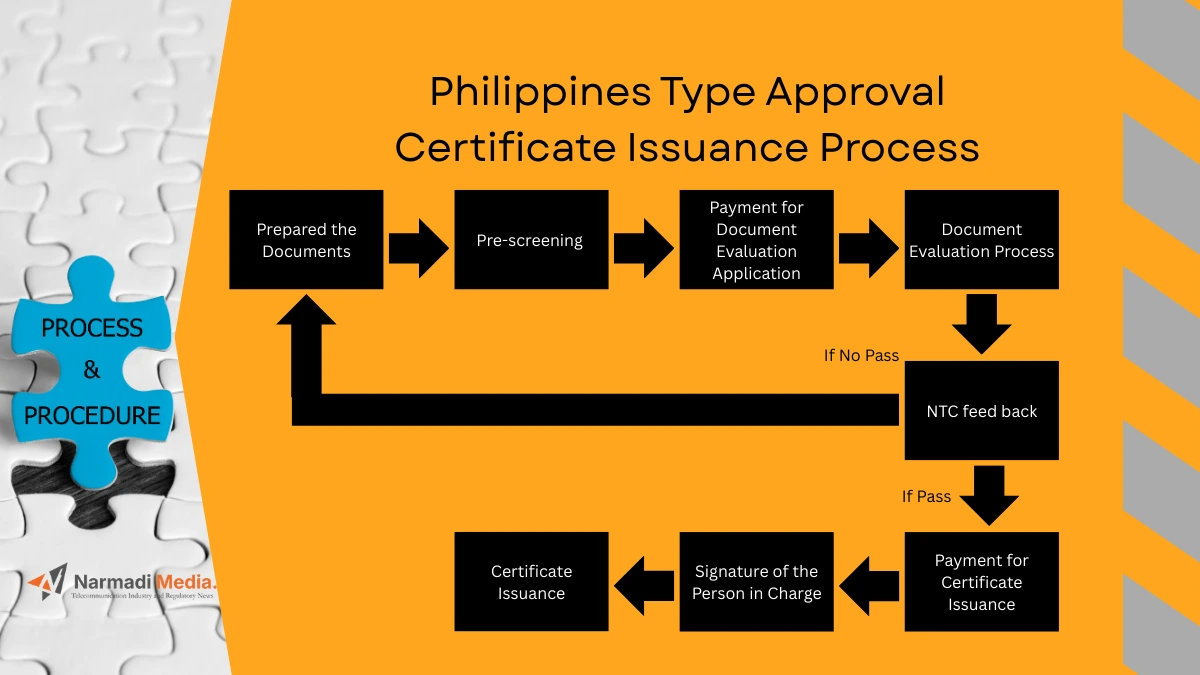
Before learning about the validity period of Philippines type approval, it’s important to understand how certificates are issued. The NTC certificate issuance process doesn’t require local testing. However, the process isn’t quick either.
Therefore, you shouldn’t underestimate this process, which includes document compliance, document evaluation, and certification application.
Document requirements
The following is a list of documents required to apply for NTC certification:
- Application form specified by the NTC Office
- Letter of Authorization (LoA) from applicants to Dimulti
- Declaration of product specification, including photos, description, and RF features
- Manufacturer’s declaration of conformity
- RF test report
- EMC test report
- Safety test report
Essentially, each type of NTC certification scheme—Radio Communications Equipment (RCE), Customer Premises Equipment (CPE), and Grant Equipment Conformity (GEC)—requires the same documentation.
Document submission and evaluation
Once all document requirements for Philippines type approval have been collected and prepared, they must be submitted directly to the NTC office. This is because the Philippines does not yet have an online application procedure.
Once the NTC Office receives all complete documents and payment for the document evaluation, the documents will be evaluated. If the evaluation is successful, you will need to pay again for the certificate issuance.
If the evaluation is unsuccessful, the applicant must complete any missing or incomplete documents before resubmitting the documents for re-evaluation.
Certificate issuance
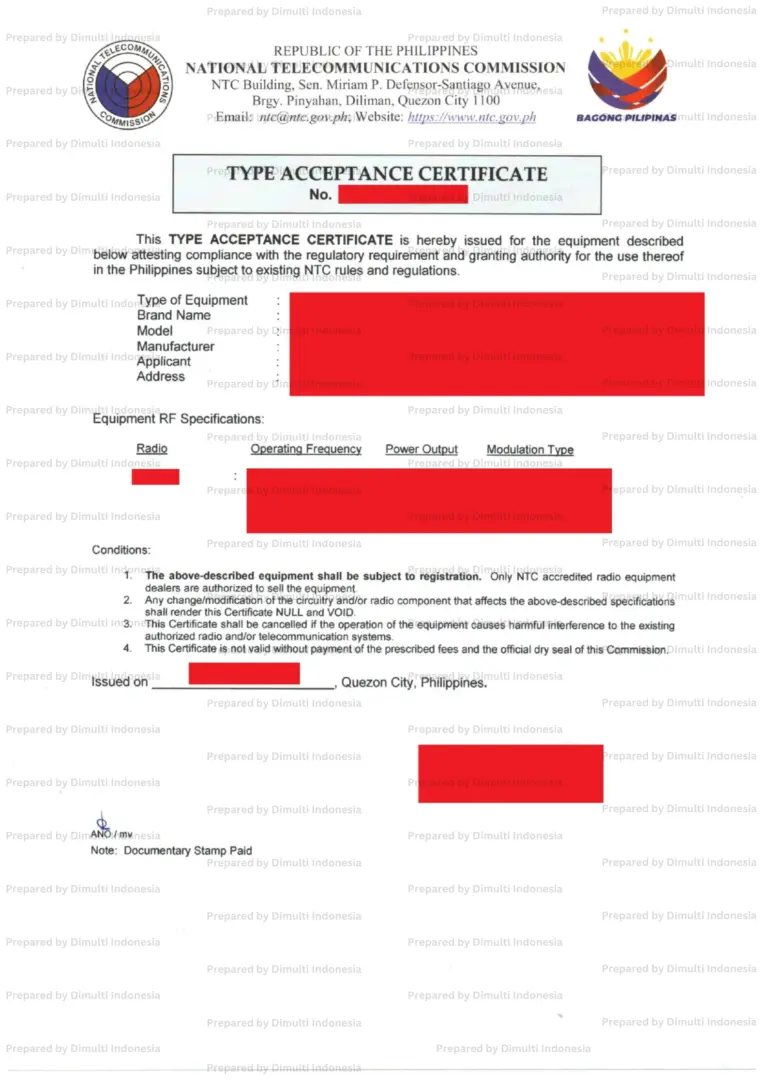
When a Philippines type approval certificate is issued, it means your product has officially received permission for marketing and use. The certificate issuance date becomes the effective date of the Philippines type approval certificate.
The following is an example of an NTC certificate:
The lead time for Philippine type approval through the paperwork method is not short. The waiting time is 20-25 business days. This is relatively long compared to neighboring countries.
The issuance of the final certificate will also depend on several factors. This will depend on the speed of confirmation and verification by the laboratory that has the test report, the number of applications pending at the NTC Office, and national holidays.
Even force majeure events declared by the authorities will affect the issuance of certificates.
Labeling
The NTC Philippines certification labeling requirements require compliance labels on all registered products, user manuals, or packaging before the product is sold. This requirement is stipulated in Memorandum Circular No. 02-01-2001, specifically in Section VI.
The labeling requirements consist of three components: ESD (Equipment Standards Division), the NTC product classification scheme (SPE, RCE, or GEC), and the seven-digit certificate number. Additionally, electronic labels are permitted, but they do not replace physical labels.
Validity Period of Philippines Type Approval
Understanding the validity period of Philippines type approval is crucial for marketing planning in the country. NTC certificates generally have no expiration date.
This means the certificate is valid indefinitely, provided there are no modifications to the equipment’s RF specification. Modifications to the certificate are permitted as long as they do not affect the RF parameters. Examples include changes to the applicant’s name or address, the type or model of the equipment, or the manufacturer’s name.
If there are modifications to the equipment, certification is required following the same process as the initial certificate application. Modified devices must be re-certified to ensure that the latest product model still complies with applicable NTC standards and technical requirements.
This explains the validity period of Philippines type approval. A lack of understanding of certificate validity and renewal can lead to illegal products being circulated in the market.
If you are having difficulty understanding NTC certification, you can consult with Dimulti. Our services will assist you from the document submission process to the direct delivery of documents to the NTC Office.
With Dimulti, your RF type approval challenges will be handled effectively and efficiently. Supported by a professional team with over 15 years of experience, we also offer pre-testing services to reduce the risk of laboratory failure and a Product Management System (PMS) for real-time certification monitoring.