
All telecom and wireless devices entering a country’s market require compliance approval, and Cambodia is no exception. Therefore, it’s important to understand how to obtain a Cambodia type approval.
Cambodia is a rapidly growing market in Southeast Asia, encouraging the growth of various telecommunications companies. The market size is estimated to reach USD 0.92 billion in 2025 and is expected to reach USD 1.03 billion by 2030, with a CAGR of 2.33% during the forecast period (2025-2030).
Therefore, Cambodia type approval guidelines, known as TRC certification, are required for marketing telecommunications products.
Also Read
All manufacturers, importers, and distributors must obtain Cambodia type approval before they can market and use their products. To ensure smooth market entry in Cambodia, let’s discuss the guidelines that cover the entire certification process.
What is Cambodia Type approval?
TRC stands for “Telecommunication Regulator of Cambodia,” the primary regulatory body in Cambodia that handles product approvals.
This certification is required for every telecommunications and wireless product manufactured, imported, distributed, or used in Cambodia. This certification ensures that the device meets the technical, compatibility, and safety standards required by applicable regulations.
Devices that have obtained TRC certification are guaranteed to be safe to use and will not interfere with the functionality of other devices when used simultaneously. Therefore, there is no significant risk to users when using them in their daily lives.
Scope of Product Requiring Certification
The scope of products requiring TRC certification is not limited to telecommunications products. However, all products with telecommunications or radio-frequency features are also required to be certified.
The following are some examples of products that require Cambodia type approval:
| Home Appliances: Smart Dishwasher Smart Oven Smart Washing Machine Smart Refrigerator Smart Air Conditioner Smart Wine Chiller Smart Coffee maker Smart Fan Electronic Water Meter Sensor Smart Lighting system Smart water closet Robot vacuum cleaner Smart locker Etc. | Automotive: Tire Pressure Monitoring Sensor Head Unit/Car Audio Telematic Unit Body Control Module Immobilizer Keyless Wireless Charging Unit Vehicle Radar Dashboard Camera Seat-belt Sensor Door-Lock Sensor Vehicle Dashcam Etc. |
| Audio-Video Devices: Wireless Speaker Smart Television or Digital Television Monitor Wireless Microphone Microphone Receiver In-ear monitoring device Headset/headphone True Wireless Earbuds Projector Speakerphone Etc. | Telecommunication Products: Smartphone Line/wired telephone Tablet PC Handy Talkie/Walkie Talkie Switch Router Access Point Video Conference Cordless telephone IP Phone Etc. |
| Medical and Healthcare products: Blood Glucose Monitoring System Blood pressure monitoring system MRI system Smart Operating Table Digital Radiography Smart syringe pump Body Height measurement Body weight measurement Bluetooth Oximeter Etc. | Wearable: Smartwatch Smart Ring Smart tag Running shoes tracker Smart eyeglasses Etc. |
| Environmental Monitoring Product: Wildfire Sensor Whether Sensor Etc. | Mining: Smart detonator system Tunnel light signal Etc. |
Who Should Be an Applicant for Certification?
An applicant for Cambodia type approval must be a registered local company. They can be an importer or distributor. Foreign companies can also appoint a local representative for the certificate applicant, but the TRC still requires the name of the local importer before submitting the application.
The TRC will require the applicant’s details during the certification process. Local Cambodian companies acting as certificate applicants must submit a letter of acknowledgement as an importer, distributor, or local representative.
The TRC has also published a list of companies that have met the requirements for importing and distributing communications equipment in Cambodia. You can check it at https://www.trc.gov.kh/en/resources/qualified-import-agents/.
TRC Certification Process
Generally, the type approval process in several countries is divided into two parts: local testing and document evaluation. In Cambodia, documents play a crucial role in the Cambodia type approval certification process.
This is because the document evaluation or paperwork method is the only available process. Local testing is not mandatory and is common in Cambodia.
Therefore, applicants are expected to have conducted testing in an international laboratory accredited to ISO/IEC 17025. These standards refer to Conformité Européenne (CE) or the Federal Communications Commission (FCC).
Testing includes Radio Frequency (RF) testing, Electromagnetic Compatibility (EMC) testing, safety testing, EMF testing, and health testing. The test report of these tests will be evaluated by the TRC.
Document evaluation
To apply for Cambodia type approval, applicants must submit the required documents. Before submitting an application, it’s important to ensure all documents are complete. Required documents include:
- Application form specified by the TRC Office
- Compliance certificate from an international certification body
- RF test report and its appendix
- EMC test report
- Safety test report
- EMF or Health test report
- Trademark certificate
- User manual
- Technical specification
- Appointment letter as a local importer, distributor, or local agent
Once the documents are collected and prepared, they must be submitted to the TRC office. If the evaluation is successful, a certificate will be issued. If the evaluation is unsuccessful, missing documents must be completed and then re-evaluated by the TRC.
Certificate issuance
The TRC certificate will be issued after going through the above process. The lead time for Cambodia type approval, which is generally document-based, is relatively short, although not short.
The average wait time is around 15 working days after all required documents are received by the TRC office.
The TRC certificate is valid indefinitely; it has no expiration date. While it can be valid indefinitely, it does not apply to devices with modified RF equipment features.
Modifications to the equipment’s RF specifications will require a new certificate application. This is to ensure the modified device still meets applicable Cambodian standards.
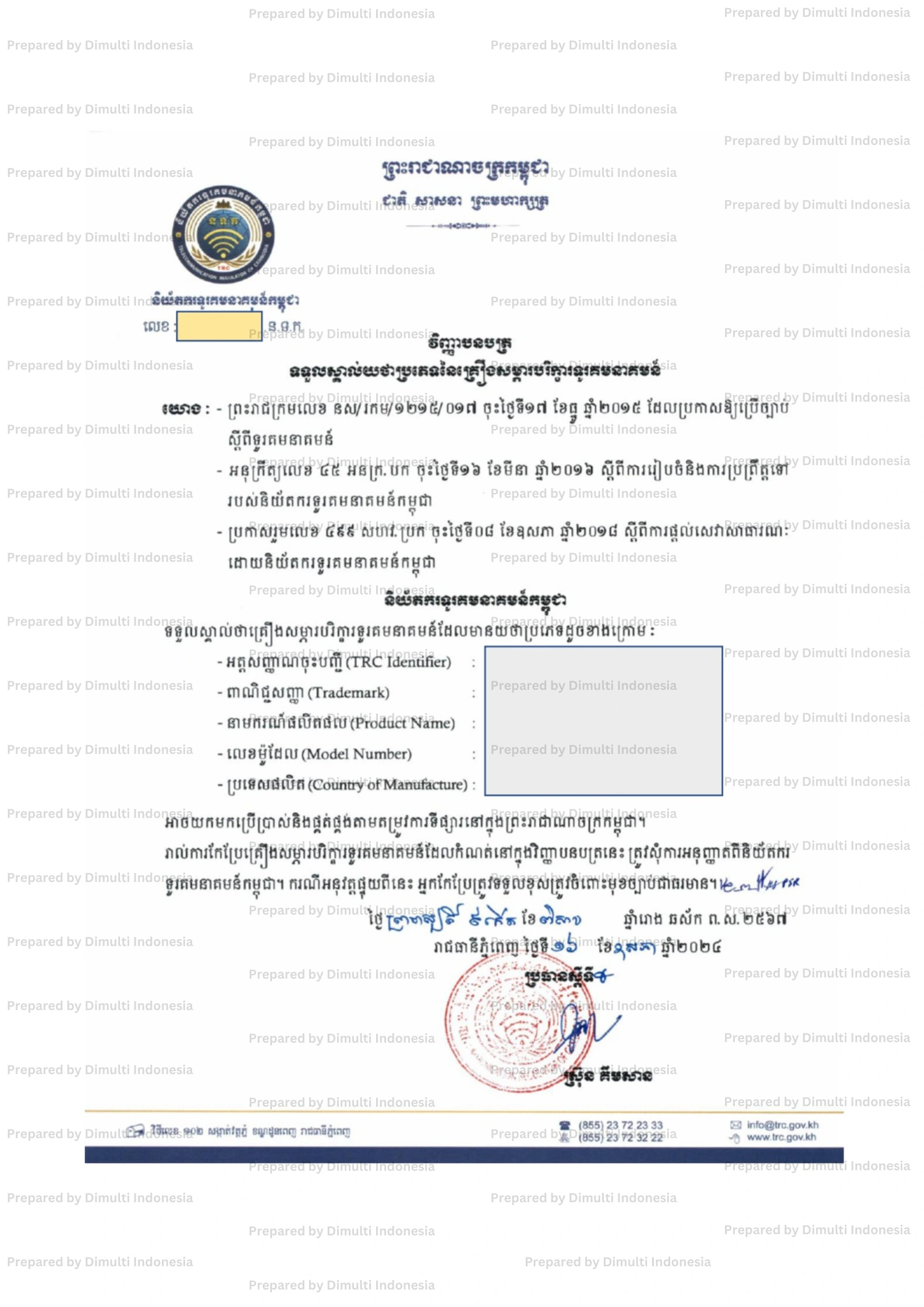
The following is an example of a TRC certificate:
Labeling
Cambodia is a bit different when it comes to labeling. Compared to some of its neighbors, Cambodia does not require labeling under type approval.
The TRC does not stipulate specific labeling requirements for radiocommunication and telecommunications equipment approved in Cambodia. Once the certificate is issued, the product can be directly imported and sold in Cambodia.
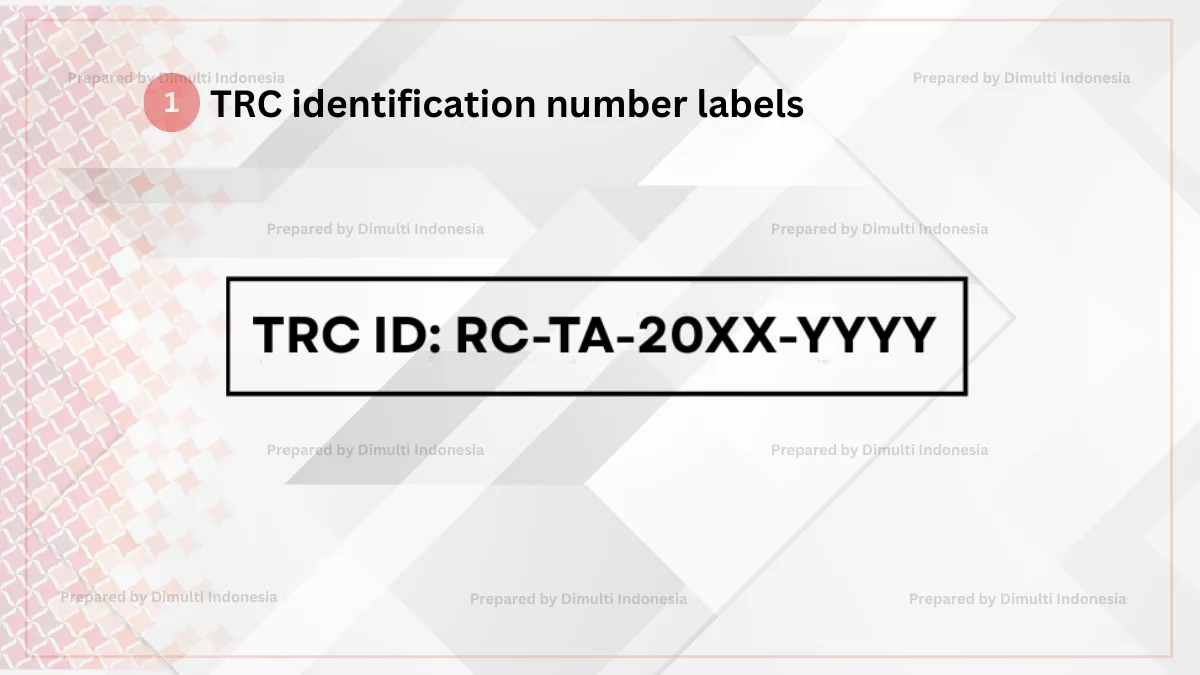
Although not mandatory, local manufacturers or importers often affix the TRC identification number to approved equipment. This serves as proof to assure the public that the product is legal and certified.
Here are examples of commonly used TRC identification number labels:
TRC Certification Management Services
Understanding the entire TRC certification process above doesn’t necessarily eliminate confusion. This is understandable, especially if you’re applying for Cambodia type approval for the first time.
To resolve your confusion, you may need assistance. Dimulti Indonesia is here to help you navigate the confusion surrounding RF and telecommunications type approval certification.
What does Dimulti offer? Of course, we’re ready to help. We have extensive experience in product certification, a widespread international network, pre-testing services, and a certification process that can be monitored in real time.
1. Extensive experience in product certification
Dimulti has been in the product certification industry since 2008. With over 15 years of experience, we have handled hundreds of clients and thousands of RF type approval projects.
We know exactly what you need. We will assist you in your certification process with effective and efficient procedures.
2. Extensive international network
Our experience has enabled us to meet and build relationships with various international partners. This allows us to assist you with your certification process, not only in Cambodia but also worldwide.
This way, you can simply contact one point of contact to open up numerous product marketing opportunities in various countries. Our network continues to expand in line with regulatory developments and client needs.
3. Pre-testing services
Pre-testing services are rarely found among other service providers. However, this service is very useful for avoiding losses in the event of failed testing in the laboratory.
We have an in-house laboratory that allows pre-testing. This will help you prevent test failures.
4. The certification process can be monitored in real time
Transparency is crucial in the certification process. Without transparency, you may not know how far along the process is. This lack of understanding can cause the certification process to take longer than expected.
Dimulti has a Project Management System (PMS) that allows clients to monitor the certification process transparently and in real time. This system allows you to track certification progress at every stage using only a mobile device.