
All telecom and wireless devices entering a country’s market require compliance approval, including India. Therefore, it is important to understand how to obtain India type approval certification.
The Indian telecommunications market is one of the most dynamic and promising. It is the second largest in the world, after the United States. This is driven by the adoption of 5G, the growth of data users, and the rise in average revenue per user (ARPU). Therefore, India type approval guidelines are required to market these products.
India type approval is known as WPC ETA and TEC MTCTE certification. All manufacturers, importers, and distributors must obtain these instruments before marketing and using their products. Understanding the entire certification process is crucial to ensuring smooth market entry in India.
Also Read
What is India Type Approval?
Understanding India type approval is inseparable from its regulatory body. It’s important to note that there are several types of certification in India, each issued by a different authority based on its specific requirements.
Here are the five types of certification in India:
- Equipment Type Approval (ETA), which is issued by Wireless Planning & Coordination (WPC)
- Compulsory Registration Scheme (CRS), which is issued by the Bureau of Indian Standards (BIS)
- Certification of Telecom Equipment, which is issued by the Telecommunication Engineering Centre and Mandatory Testing and Certification of Telecom Equipment (TEC MTCTE)
- BEE certification, which is issued by the Bureau of Energy Efficiency
Information and Communication Technology (ICT) products focus on two types of certification: WPC ETA and/or TEC MTCTE. WPC ETA certification is required for products operating in license-free frequency bands.
Meanwhile, TEC MTCTE certification is required for all telecommunications products directly connected to telecommunications networks. This certification verifies compliance with technical and safety standards set by the Department of Telecommunications (DoT).
1. About WPC ETA
WPC ETA stands for Wireless Planning & Coordination (WPC), Equipment Type Approval (ETA). WPC is part of the Department of Telecommunications, which falls under the Indian Ministry of Communications.
WPC is responsible for issuing radio licenses, managing spectrum allocations, and monitoring the process. This organization also provides solutions to various issues related to the International Telecom Union (ITU) through its Standing Advisory Committee on Radio Frequency Allocation (SACFA).
2. About TEC MTCTE
TEC MTCTE stands for Telecommunication Engineering Centre and Mandatory Testing and Certification of Telecom Equipment. TEC is an authority under the Department of Telecommunications, Ministry of Communications and Information Technology of India.
TEC is responsible for establishing standards and requirements, including document requirements, interface requirements, services, and networks. Furthermore, through its subordinate divisions, TEC also manages telecommunications technology.
TEC manages telecommunications technology:
- Information Technology
- External Plant
- Optic Transmission
- Networks
- Line Transmission
- Radio Transmission
- Mobile Communication
- Switching
- Valued Aided Services
- Trials and Standardization of New Technology
Scope of Products Requiring Certification
India type approvals, which focus on ICT products, are divided into two types: WPC ETA and TEC MTCTE. Both have a specific scope of products that require certification.
All products operating in license-exempt frequency bands require WPC ETA certification. The following is a list of products:
| No | Frequency Band | Maximum Effective Isotropic Radiated Power |
| 1 | 2400MHz-2483.5MHz | 36dBm |
| 2 | 2695.7MHz-2738.3MHz | 36dBm |
| 3 | 5150MHZ-5350MHz | 23dBm |
| 4 | 5725MHz-5875MHz | 23dBm |
| 5 | 5825MHz-5875MHz | 36dBm |
| 6 | 865MHz-867MHz | 36dBm |
| 7 | 402MHz-405MHz | Maximum Effective Radiated power of 25 Micro Watt or less, with channel emission bandwidth within 300 kHz |
| 8 | 13.533MHz-13.567MHz | 42 dBµA/m at 10 meters or 93.5dB µV/m at 10 meters |
| 9 | 433MHz-434MHz | 10 milliwatts with a channel bandwidth within 10KHz(10dBm) |
| 10 | 50kHz-59.750kHz | 72dBµA/m or 123.5 dBµV/m at 10 Meters |
| 11 | 59.750kHz-60.250kHz | 42dBµA/m or 93.5dBµV/m at 10 Meters |
| 12 | 60.250kHz-70kHz | 69dBµA/m or 120.5dBµV/m at 10 Meters |
| 13 | 70kHz-119kHz | 42dBµA/m or 93.5dBµV/m at 10 Meters |
| 14 | 119kHz-135kHz | 66dBµA/m or 93.5dBµV/m at 10 Meters |
| 15 | 135kHz-140kHz | 42dBµA/m or 93.5dBµV/m at 10 Meters |
| 16 | 140kHz-148.5kHz | 37.7dBµA/m or 89.2dBµV/m at 10 Meters |
| 17 | 148kHz-200kHz | 30.0dBµA/m or 81.5dBµV/m at 10 Meters |
| 18 | 9Khz to 50KHz | 72dBµA/m or 123.5dBµV/m at 10 Meters |
| 19 | 335.7125-335.8375MHz | 1mW(Emission 10KoF1D) |
| 20 | 76 to77 GHz | 5W (37dBm) |
| 21 | 433MHz-434.79MHz | 10 milliwatts with a channel bandwidth within 10KHz(10dBm) |
| 22 | 302-351KHz | -15dBµA/m (H-Field Strength) at 10 Meters |
| 23 | 36 to 38 MHZ | 50mw Maximum audio channel Bandwidth of 200 kHz |
| 24 | 446-446.2 MHz | 25W |
Meanwhile, all telecommunications products directly connected to the telecommunications network require TEC MTCTE certification. Here is a list of these products:
Who Should Be an Applicant for Certification?
Applicants for India type approval for WPC ETA and TEC MTCTE certification fall into several categories. They are local Indian companies that are local manufacturers, local brand owners, or authorized representatives of foreign manufacturers.
Foreign companies can collaborate with local companies acting as Authorized Indian Representatives (AIRs). This is indicated by a Memorandum of Understanding (MOU) or contract.
Then, applicants for WPC ETA and TEC MTCTE certification need to create accounts on their respective authority portals to submit the required documents. For WPC ETA certification, the Saral Sanchar portal is used, and for TEC MTCTE certification, the MTCTE portal is used.
Certification Process
India’s type approval process differs for both WPC ETA and TEC MTCTE certifications. WPC ETA certification involves document or paperwork evaluation only. TEC MTCTE, on the other hand, involves local testing.
For the document evaluation method, applicants must have obtained test reports from an International Laboratory Accreditation Cooperation (ILAC)-accredited laboratory. Accreditation is based on ISO/IEC 17025, with standards that refer to Conformité Européenne (CE) or the Federal Communications Commission (FCC).
For the local testing method, testing will be conducted at a local Indian laboratory. Local testing requires sample submission. The number and type of samples will depend on the device’s features and the type of testing required.
1. Document evaluation for WPC ETA certification
To apply for India type approval for WPC ETA certification, applicants must submit the required documents. Ensuring complete documentation will expedite the certification process. Required documents include:
- Business License and its English translation
- ISO Quality Management (9001: 2015)
- RF test reports
- Trademark Certificate
- Technical Specification of the Product
- User Manual of the Product
- Contact Details as per Form A (Format Attached)
- GST /COI of the Indian Company
- KYC of the Authorized Signatory
- Authorization letter from the manufacturer for AIR
Once the documents are collected and prepared, they will be submitted through the Saral Sanchar portal. The submitted documents will be evaluated by the WPC.
If the evaluation is successful, the certificate will be issued immediately. If the evaluation is unsuccessful, the missing documents must be completed for re-evaluation by the WPC.
2. Local testing for TEC MTCTE
To apply for India type approval for the TEC MTCTE certification type, applicants must undergo local testing. This means submitting samples.
The number of samples depends on the device’s features and the type of testing required. Conducted samples will be required for some tests, while normal or irradiated samples will be required for others.
The Dimulti team will discuss the sample type with the relevant laboratory before the testing is conducted. Generally, three to five samples are required to process TEC certification.
Additionally, some documents must be completed for the TEC MTCTE certification process. The required documents include:
- Testing Document- Test SOPs, Commands, and SWs
- AIR company registration document
- MOU between AIR and Manufacturer
- User Manual
- Specification sheet
- Product photos
- Label Artwork
- BOM (Bill of Materials)
Once the documents are collected and prepared, they will be submitted through the MTCTE portal. The submitted documents will then be evaluated by the TEC.
3. Certificate issuance
WPC ETA and TEC MTCTE certificates will be issued after going through the above process. The lead time for India type approval will differ for the two types of certification.
WPC ETA has a shorter processing time because it only involves document evaluation. This type of certification can be completed in one to two weeks.
TEC MTCTE, which goes through a local testing process, has a longer lead time. This process can take 8-12 weeks, depending on the readiness of the sample and required documents.
The validity period for India type approval also varies depending on the certificate type. WPC ETA is valid for life as long as there is no revocation by the authority or modification of the RF device. Meanwhile, TEC MTCTE is valid for 10 years from the date of certificate issuance.
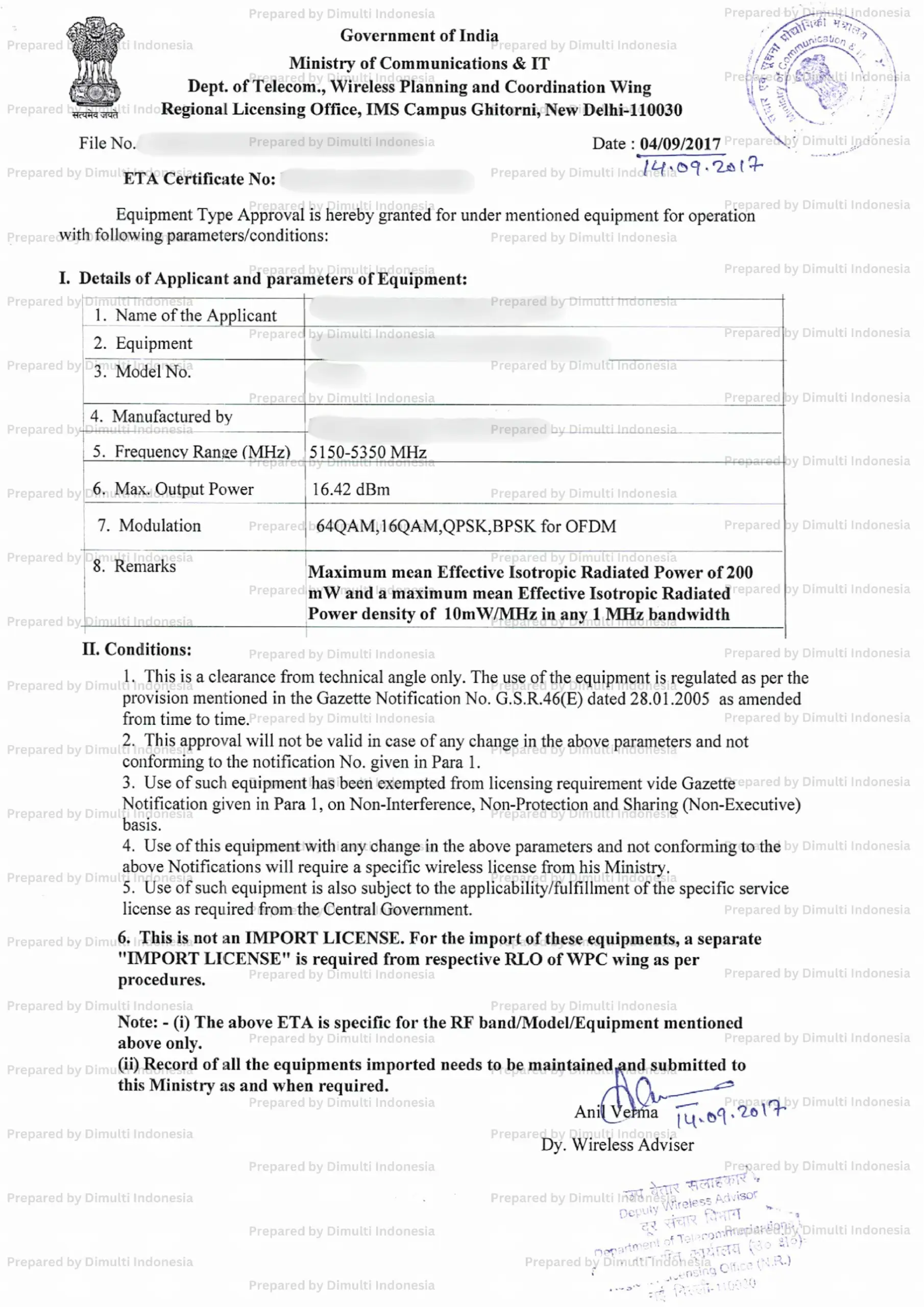
The following is an example of a WPC ETA certificate:
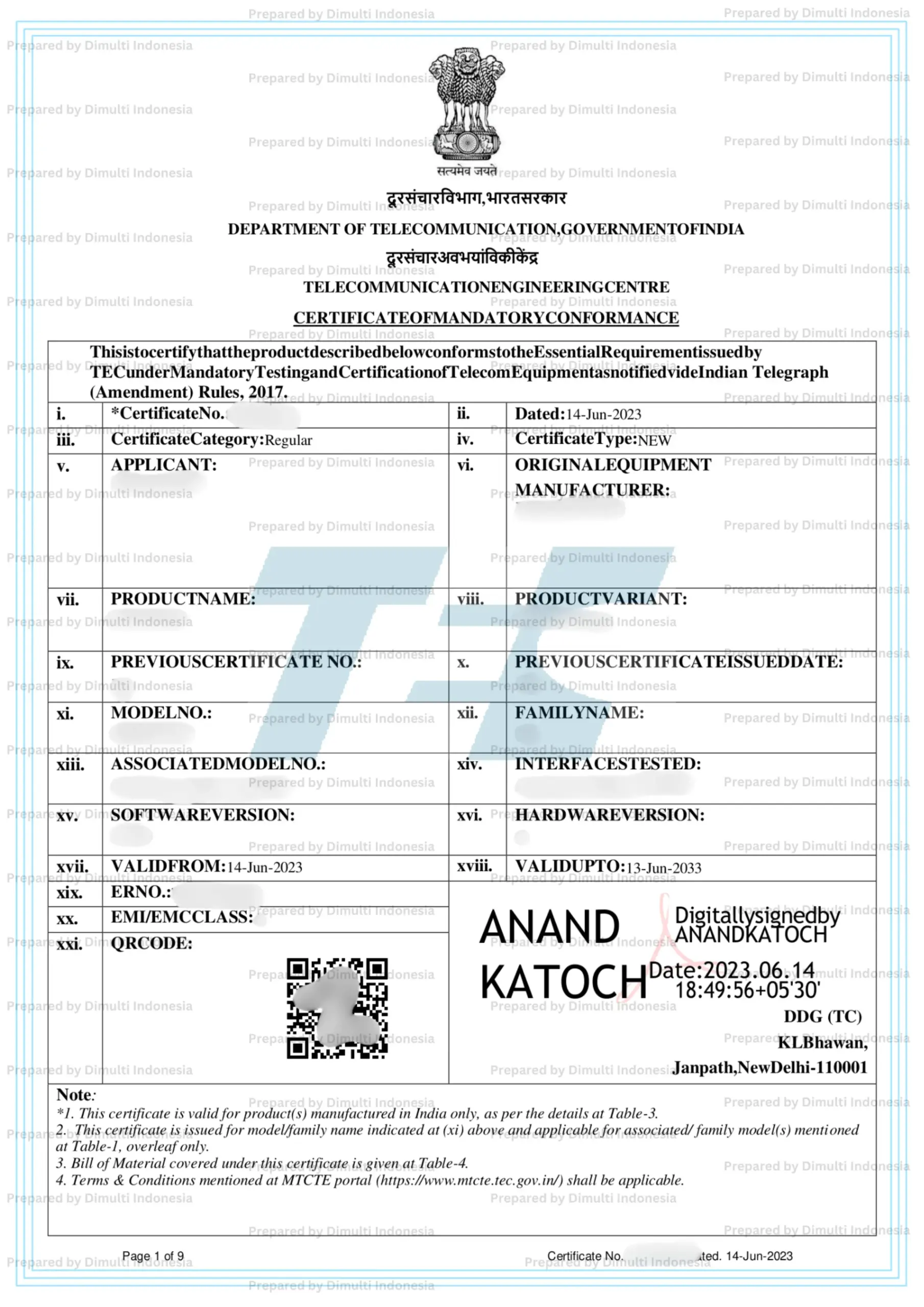
The following is an example of a TEC MTCTE certificate:
4. Labeling
Label requirements for India type approval differ for the WPC ETA and TEC MTCTE certificates. WPC ETA does not require labeling on devices or product packaging.
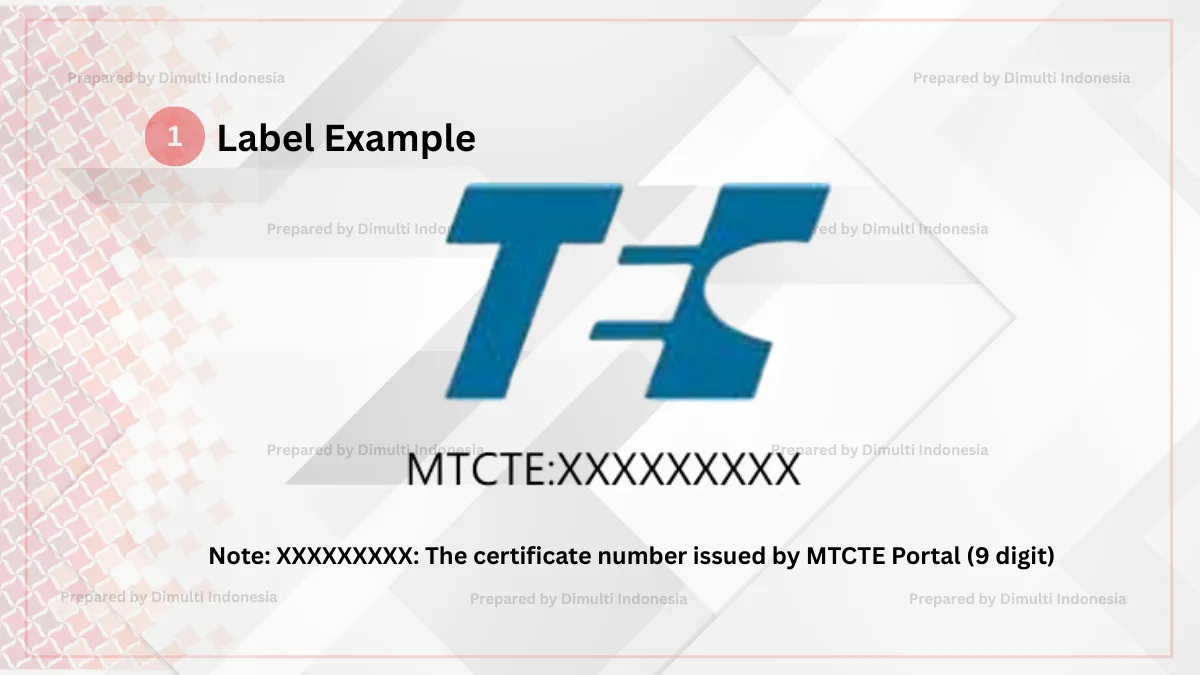
The TEC MTCTE, however, requires labeling on all products. Labeling requirements consist of three components: the TEC logo, the word “MTCTE,” and the certificate number. The TEC can be affixed as a physical label or an electronic label (e-label).
Here is an example of a label:
WPC ETA and TEC MTCTE Certification Management Services
Do you find WPC ETA and TEC MTCTE certification difficult to manage? It can be, especially considering the two distinct processes involved in each certification type.
This can be simplified by choosing the right India type approval certification management service. Dimulti, as a provider of RF and telecommunications type approval certification services, is ready to help meet your needs.
We are ready to partner with manufacturers, importers, or distributors unfamiliar with the WPC ETA and TEC MTCTE certification process.
This ensures that all certification process issues are handled by our team of experts with over 15 years of experience. We will help you manage all aspects of the compliance certification process.
Since 2008, we have assisted hundreds of clients and thousands of RF type approval projects with efficient procedures.
Here are our advantages:
- Certification process monitoring: You can monitor the certification process in real-time and transparently through the Project Management System (PMS).
- Pre-testing: Not many partners offer pre-testing services. Our in-house laboratory testing process prevents immediate test failures that can lead to costly losses.
- Global access: Not only in India, but we also have a worldwide network of partners. For those of you who want to market globally, through Dimulti, you don’t need to bother finding partners in your target country. The certification process becomes more efficient and cost-effective.
The India type approval certification process requires a thorough understanding of the different certifications. This includes understanding each application method, document collection, and submitting the certification application on the official portal. To make it efficient and easy, don’t hesitate to consult us!