
Understanding the document requirements for Japan type approval is crucial for marketing telecom and wireless devices in the country. These documents are required for the MIC certification process.
This certification serves as proof that devices distributed and marketed in Japan meet established safety and quality standards. The Ministry for Internal Affairs and Communication (MIC), formerly known as the Ministry of Public Management, Home Affairs, Post, and Telecommunications (MPHPT), is responsible for this certification.
MPHPT is a merger of the “Ministry of Post and Telecommunications,” “Ministry of Home Affairs,” and “Management and Coordination Agency.” One of the MIC’s duties is to regulate the document requirements for Japan type approval.
Also Read
This article will help you understand the document requirements for Japan type approval. This way, you can prepare ahead of time and avoid errors or missing documents.
Local Testing Process
Before understanding the document requirements for Japan type approval, you first need to understand local testing. This process is the only method required to obtain MIC certification.
Local testing will be conducted at a local laboratory affiliated with a designated Certification Body (CB) in Japan. The process involves three testing stages: Radio Frequency (RF), Electromagnetic Compatibility (EMC), and Safety testing.
The type of device testing required for each product will vary depending on the product type. Local testing in Japan requires you to submit samples for testing. We will explain more details about local testing and samples in a later article.
What are the Document Requirements for Japan Type Approval?
Documents are a requirement for submitting to the MIC certification process. This is done after completing all local testing and receiving a test report.
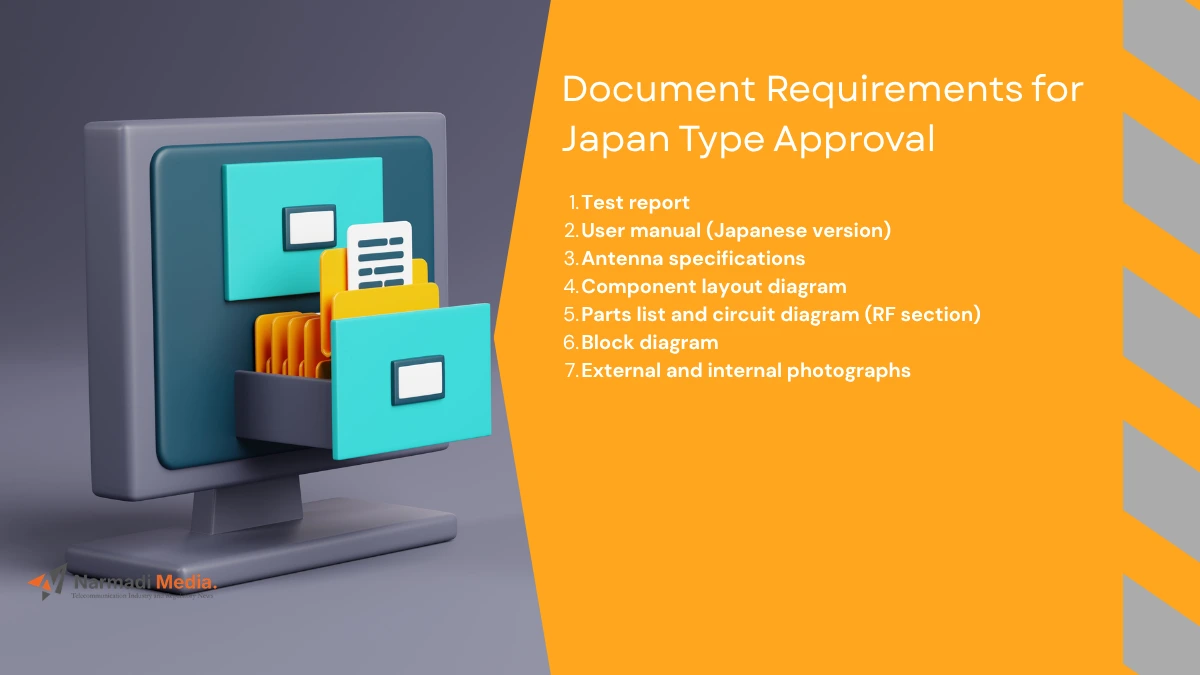
In general, there are several document requirements for Japan type approval that must be prepared and submitted. The following documents are required:
1. Test report
A test report is the result of device testing conducted in a designated CB laboratory. The number of test results will depend on the requirements of the device being tested.
This document will indicate whether the device complies with the standard Japan type approval test parameters.
2. User manual
A user manual is a document describing the device, its operation, and its RF specifications. It should also include information demonstrating that the device operates in accordance with legal standards. This document must be in Japanese.
3. Antenna specifications
Antenna specifications are technical documents detailing the physical and electrical characteristics of an antenna. This document ensures that the device complies with the frequency, power, and safety requirements set by the MIC.
This document also serves as proof that the device does not cause harmful electromagnetic interference and meets performance requirements.
4. Component layout diagram
A component layout diagram is a document that displays a drawing or physical map of the location of the main components of the RF section. It is used to demonstrate the physical structure of a device that meets technical compliance.
5. Parts list and circuit diagram (RF section)
The parts list and circuit diagram for the RF section are documents that detail all components and radio signal paths in a wireless device. They also serve as proof that the device’s technical specifications are consistent, safe, and do not interfere with other radio frequencies.
6. Block diagram
A block diagram is a document that illustrates the workflow, interconnections of major components, oscillator frequencies, and RF signal paths in a wireless device. This document is used to prove that the device complies with established frequency spectrum regulations and technical standards.
7. External and internal photographs
External and internal photographs are images of the appearance of the device being submitted for certification. The images must clearly show the details of the external physical construction and internal components of the product.
These photographs are used to ensure that the mass-produced device is identical to the test sample.
8. Additional documents
Additional documents may be required for certain product types or application methods. Before starting the process, the Dimulti team will typically conduct a more in-depth analysis of the product you wish to apply for certification.
From there, they will determine which documents are truly required for the process. All these documents will then be submitted to the designated CB.
Make the Process Easy
Failing to understand the document requirements for Japan type approval will delay or even reject your certification process. Therefore, you need to understand and prepare for them well in advance, before the application process begins.
It’s certainly not easy to understand all the requirements and navigate the process from start to certification issuance. However, with the help of an experienced team and network in Japan, the certification process will be much easier.
This is where Dimulti comes in. Our team, with over 17 years of experience, will ensure your RF type approval certification process runs effectively and efficiently.
If you’re unsure about our experience, let us tell you what we do to simplify your MIC certification application.
1. Pre-testing
We’ll let you know right from the start that we offer a pre-testing service. This is a service rarely offered by other certification services.
This is a necessary step to ensure that samples for local testing comply with Japanese technical standards. This way, you don’t have to worry about failure during live testing.
2. Local testing assistance
After pre-testing, the samples will be sent to the designated CB’s lab for live testing. Our local team will fully assist with all testing.
This assistance ensures the testing runs smoothly and without any hiccups.
3. Document preparation
Our team will ensure the completeness and compliance of all the document requirements for Japan type approval, as mentioned above. If any documents need to be prepared, we will assist with the process.
So, you don’t need to worry about preparing declaration documents; simply sign the required documents.
4. Communicate with the CB
The Registered Certification Body (RCB) is the authority appointed by the MIC to conduct the testing process and issue certifications. We will communicate intensively with relevant parties to ensure the entire process runs smoothly.
5. Process all payments in advance
Documentation issues are often associated with administrative issues. Working with Dimulti eliminates this. We will cover all payment requirements throughout the process. Simply make the full payment to us after the certification is issued.