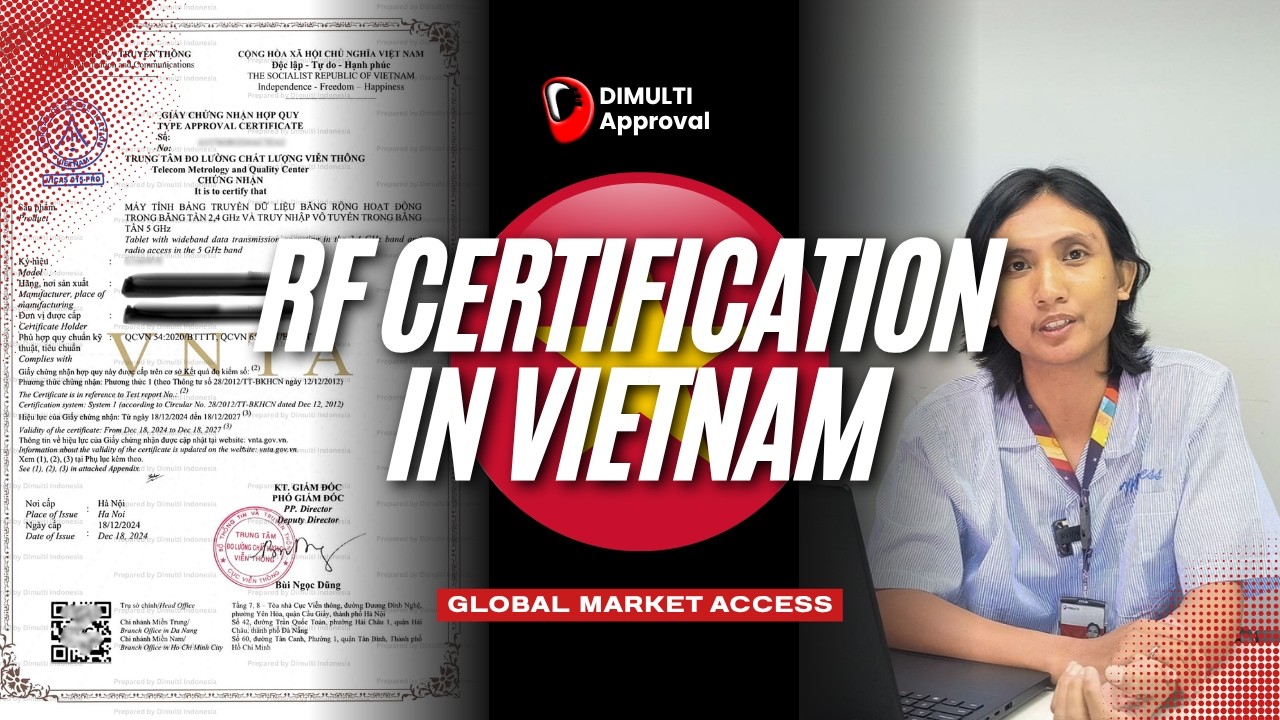
Document Requirements for RF Certification in Vietnam: 9 for Type Approval, 5 for SDoC
Document requirements for Radio Frequency (RF) certification are key to a product’s entry into the global market. In Vietnam, these requirements are necessary at every stage of the process, from before to after testing.
Incomplete documentation for RF certification in Vietnam will bring the entire process to a halt. Why did Narmadi Company call this the key? Because this is what determines whether an application is accepted or rejected.
We’ll cover everything you need to know about the document requirements for RF certification in Vietnam across all certification schemes. You can also watch the full video to ensure there are no errors in gathering the documents.
Two Schemes, Two Document Sets
The Ministry of Science and Technology (MoST) has implemented two schemes for applying for RF certification in Vietnam: Type Approval and Self-Declaration of Conformity (SDoC). These two schemes have different documentation requirements.
Type Approval is a long-term certification scheme that covers a product. This scheme allows your product to be imported and sold in multiple batches.
On the other hand, SDoC is a mandatory scheme for each shipment. Each new import batch requires an SDoC, which must be submitted to MoST.
Document Requirements for Type Approval
Type approval requires nine documents. Here are the nine documents you need to prepare:
- Application form
- Product specification
- Photos of the product label
- Information on the sample
- Valid ISO 9001:2015 certificate for the manufacturing facility
- Test SOP and software
- Factory declaration
- Declaration of sample shipment
- Business license of the Type Approval certificate holder
The factory declaration and the declaration of sample shipment are two documents that often pose challenges. If you work with Narmadi Company, our team will prepare the application form, factory declaration, and sample shipment requirements. You’ll only need to sign the prepared document drafts.
Document Requirements for SDoC
SDoC requires five documents. Here are five documents you need to prepare:
- The MoST certificate
- EMC test report
- Safety test report
- SDoC form
- Letter of Acceptance to the local importer
For each new import shipment, you must submit a new SDoC. Failure to do so will prevent your products from being processed by Vietnamese Customs.
Type Approval Scheme
In addition to the two document submission schemes—type approval and SDoC—type approval itself has two sub-options for submission. Option 1: The manufacturer appoints an authorized representative in Vietnam, and Option 2: The manufacturer and the factory are part of the same corporate group.
- Option 1: Test reports and certificates are issued in the manufacturer’s name. The same certificate can be used by multiple importers with a power of attorney from the manufacturer.
- Option 2: This option features a more integrated structure, as it does not require an external local representative.
The choice of option will depend on your company’s structure. It will also determine which documents need to be submitted. Choosing the wrong option could result in your application being rejected outright.
Local Testing: What It Means For Your Documents
Local testing is the recommended route for obtaining RF certification in Vietnam. Therefore, manufacturers or importers must prepare samples to be sent to a local laboratory accredited by the Vietnam Telecommunication Authority (VNTA).
The number and type of samples will depend on the product type and testing requirements. In Vietnam, a minimum of two samples must be submitted—one for RF testing and one for Electromagnetic Compatibility (EMC) testing.
Vietnam only permits local testing to be conducted at three VNTA Verification and Certification Centers. These centers are located in Hanoi, Ho Chi Minh City, and Da Nang.
The registered location of the certificate holder will determine which center you will use. All nine Type Approval documents must be ready before testing begins.
Once local testing is complete and the product has passed, you will receive a test report. This report, along with the other documents, will then be submitted to the VNTA.