
Manufacturers need to recognize the importance of Singapore type approval. It is one of the keys to accessing the Lion City market.
Singapore is globally recognized as a telecommunications hub in the Asia-Pacific region. This is due to its strong track record in digital competitiveness and smart infrastructure. Therefore, Singapore type approval guidelines are necessary for marketing these products.
Singapore type approval is referred to as IMDA certification, a compliance instrument that must be adhered to by manufacturers, importers, and distributors. By understanding the complete guidelines for this process, your products will be easier to market and use in Singapore.
Also Read
What is Singapore Type Approval?
Singapore type approval is regulated by the Ministry of Digital Development and Information or MDDI. This ministry is responsible for issuing policies, regulations, or programs related to telecommunications standards, as well as establishing user data protection schemes from false information and online manipulation.
Additionally, the ministry also issues a compliance certificate called the “IMDA Certificate”. IMDA stands for “Infocomm Media Development Authority”.
The IMDA certification process is necessary to ensure that telecommunications and wireless devices meet technical, compatibility, and security standards in accordance with applicable regulations in Singapore.
Devices that have obtained IMDA certification are guaranteed to be safe for users and will not interfere with the functioning of other devices when used simultaneously.
Products Requiring Certification
Products that require Singapore type approval certification are divided into five classifications. These classifications are Enhanced Simplified Equipment Registration (ESER), Simplified Equipment Registration (SER), General Equipment Registration (GER), General Equipment Registration by Certification Bodies (GER-CB), and Confirmation of Conformity (COFC).
Here are some examples of products that require Singapore type approval:
| Clacification | Equipment Category | Equipment Type |
| Enhanced Simplified Equipment Registration (ESER) | Short-range or low-power device | – CT0 and DECT cordless phone – 446MHz portable radio (PMR446) and 446MHz multi -channel portable radio (MCR446) at less than 500mW – Alarm, RFID, radio-detection, on-site paging and vehicle radar systems, remote controls, telecommand, telemetry, wireless microphone and video transmitter, wireless LAN, Bluetooth, and non-specific short-range devices. |
| Complex or multi-line equipment | – PABX, KTS, multi-line system, voice messaging system – ISDN basic access, primary rate access, and NT1 equipment – Powerline Communications (PLC) home networking equipment – Coin phone or payphone | |
| Integrated receiver decoders for use with the 2nd generation digital terrestrial television broadcasting system (DVB-T2 IRD) | – Receiver set-top box – Integrated Digital TV (IDTV) – In-vehicle receiver | |
| Residential gateway | Home router | |
| Simplified Equipment Registration (SER) | Mobile terminals | – 3G, LTE, or 5G cellular mobile terminal. – Global Mobile Personal Communication Satellite (GMPCS) terminals. |
| Broadband access equipment | – Asymmetric Digital Subscriber Line (ADSL) modem. – Cable modem. – Coaxial Cable Home Networking (CCHN) Equipment. | |
| General Equipment Registration (GER) | This is the type of application specialized for equipment that has a high potential of causing interference to other telecommunication devices or unstable new technologies. | – Land Mobile Radio (LMR). – Mobile or Internet of Things (IoT) base stations. – Wireless Broadband Access (WBA). – Internet of Things (IoT). – TV White Space Devices. – Dedicated Short-Range Communications in Intelligent Transport Systems. – Ultra-Wideband (UWB). – Short-range devices, where the operation requires IMDA approval. |
| General Equipment Registration by Certification Bodies (GER-CB) | You may register any type of equipment under GER-CB unless it is prohibited telecommunication equipment. | – |
| Confirmation of Conformity (COFC) | – | – Telephone (standard, multi-feature, image, data, or switching). – Line interface – cordless phone. – Telephone ancillary.- Auto-dialer. – Auto answering or recording set. – Caller identification equipment. – Security alarm system. – Facsimile transceiver or fax modem. – Voice band modem. – EFTPOS or CCAT. – Digital leased circuit equipment. |
Who Can Apply for Certification?
Applicants for Singapore type approval certification are regulated in the Telecommunications (Dealers) Regulations in Part II, about Licensing of Dealers, and Part V about Import, Manufacturer and Sale of Telecommunication Equipment. The regulations explain that applicants for Singapore IMDA certification must be a local supplier or dealer in Singapore.
Local suppliers or dealers who wish to manufacture, import, or sell telecommunications equipment must first be registered and obtain a license. Applicants in this registration process must be companies registered with the Accounting and Corporate Regulatory Authority (ACRA) and hold a valid telecommunications dealers license from IMDA.
Foreign manufacturers or brand owners who wish to market their products in Singapore are required to appoint a local representative, such as a local importer or distributor, who holds a valid license. This local entity will then act as the official applicant and certificate holder, responsible for product compliance after the product is introduced to the Singapore market.
IMDA Certification Process
Essentially, the type approval certification process in Singapore focuses on document evaluation. Therefore, applicants are expected to have conducted testing at an ISO/IEC 17025-accredited international laboratory.
These standards refer to Conformité Européenne (CE) or the Federal Communications Commission (FCC) for Radio Frequency (RF) testing and Electromagnetic Compatibility (EMC) testing.
Document evaluation
To apply for Singapore type approval, applicants must provide the required documents. Document requirements will depend on the type of application submitted, as each type of application has its own list of requirements.
Therefore, before applying, we need to check whether all the required documents are complete. The following is a list of documents required, depending on the type of application selected.
- Confirmation of Conformity (COFC)
- Supplier’s Declaration of Conformity (SDoC)
- Photographs of equipment
- Product brochure
- Test reports are acceptable according to IMDA standards
- General Equipment Registration by Certification Bodies (GER-CB)
- A certificate issued by a certification body recognised by IMDA
- Photographs of equipment
- General information or product brochure
- General Equipment Registration (GER)
- Supplier’s Declaration of Conformity (SDoC)
- Photographs of equipment
- General information about the product
- Product brochure
- Test reports
- User Guide
- Simplified Equipment Registration (SER)
- Conformity assessment
- Supplier’s Declaration of Conformity (SDoC)
- Photographs of equipment
- Product brochure
- EU-Type Examination Certificate (EU-TEC)
- User manual
- Safety information
- Enhanced Simplified Equipment Registration (ESER)
- Conformity assessment
- Product brochure
- Supplier’s Declaration of Conformity (SDoC)
Once the documents have been collected and prepared, they will be submitted via https://licensing.gobusiness.gov.sg/. After all documents have been submitted, you will need to make a payment before the documents are evaluated by IMDA.
If the evaluation is successful, the certificate will be issued immediately. However, if it is unsuccessful, the missing documents must be completed, and then they will be re-evaluated by IMDA.
Certificate issuance
The IMDA certificate will be issued after going through the above process. The processing time for Singapore type approval applications, which are generally document-based, is relatively short. The waiting time is approximately three working days after all required documents are received.
This short waiting time makes the type approval process in Singapore faster than in neighboring countries.
IMDA certificates are valid for five years from the date of issue. Except for ESER, which has no expiration date, meaning the certificate is valid indefinitely.
Certified equipment can be renewed when the five-year validity period is about to expire. The renewal process will be the same as submitting a new application, including processing fees.
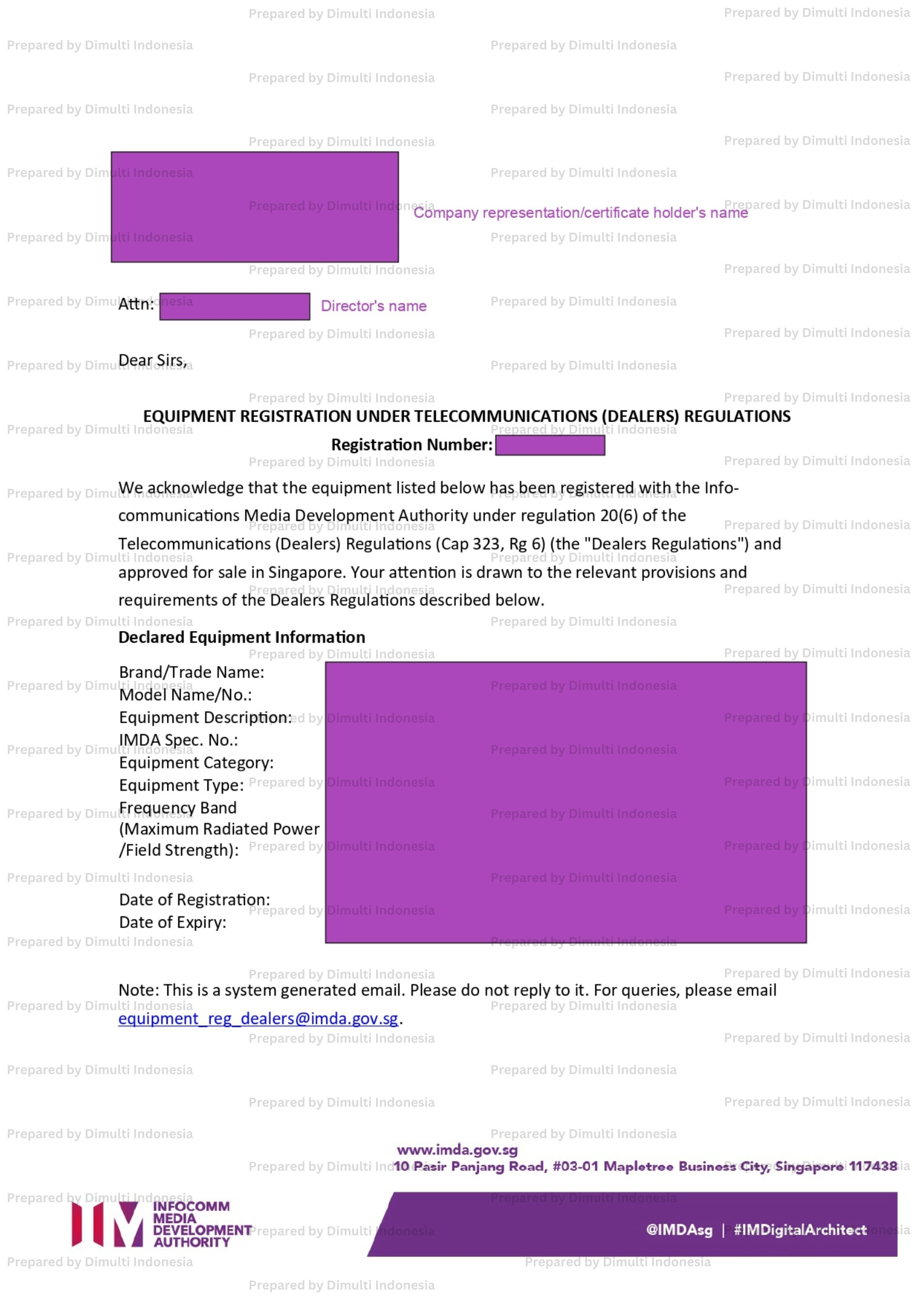
The following is an example of an IMDA certificate:
Labeling
All telecommunications and wireless devices that have been certified by the Singapore type approval body must be labeled. This is stated in condition 8(c) of the Dealer Class License and condition 12(a) of the Individual Dealer License.
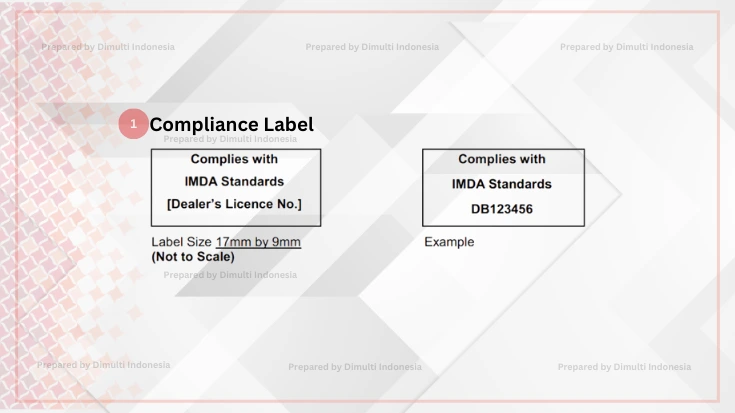
The labeling requirements for Singapore IMDA certification require the affixing of compliance labels on all registered products, user manuals, or packaging before the products are sold, and are not required for imports.
Alternatively, applicants are also allowed to apply electronic labels. This is implemented by displaying the label on the device’s built-in screen/display. If using the electronic labeling (E-labeling) method, an instruction manual or brochure must be provided in the packaging.
It should contain procedures on how customers can access the electronic compliance label on the display. In addition, applicants are also allowed to include the label in a digital copy of the instruction manual.
Here is an example of the label:
IMDA Certification Management Services
Do you find IMDA certification difficult to manage? It may seem that way, especially considering that there are five product classifications to be aware of. However, this can be simplified by choosing the right Singapore type approval certification management service.
Narmadi Company, as a provider of RF and telecommunications type approval certification services, is ready to help meet your needs. Are you unfamiliar with the IMDA certification process? Don’t worry, we are ready to be a partner for manufacturers, importers, or distributors for the certification process.
This way, all issues in the certification process will be handled properly. We have a team of experts with more than 15 years of experience who are ready to help you manage all aspects of the compliance certification process.
Since 2008, we have helped hundreds of clients and thousands of RF type approval projects with efficient procedures.
Here are our advantages:
- Certification process monitoring: You can monitor the certification process in real-time and transparently through the Project Management System (PMS).
- Pre-testing: For processes that require local testing, this will be very helpful, as not many partners offer pre-testing services. Testing conducted in our internal laboratory before live testing will prevent failure. This way, you will avoid costly losses.
- Global access: Not only in Singapore, but we also have a network of partners around the world. For those of you who want to do global marketing, through Narmadi Company, you don’t need to bother looking for partners in your destination country. The certification process becomes more efficient and cost-effective.
The type approval certification process in Singapore requires product classification, document collection, and certification application submission. To make it efficient and easy, don’t hesitate to consult with us!