

Understanding the lead time for Brazil type approval is the most important step before submitting your application. This is because the certification application process differs from the standard procedures in other countries.
Generally, applicants can choose between local testing or a documentation-based approach for type approval. However, in Brazil, the process combines both methods. Consequently, the lead time for Brazil type approval differs from that of other countries.
The Brazilian National Telecommunications Agency determines all certification requirements. This agency is known as ANATEL, which stands for “Agência Nacional de Telecomunicações” in Portuguese. This article provides detailed information about the lead time for Brazil type approval.
Also Read
The Uncommon Certification Process
Brazil has what is probably the most difficult certification application process in the world. This pertains to the process and lead time for Brazil type approval.
The combined method of paperwork and local testing—commonly referred to as “partial paperwork”—makes the process more complicated than in other countries. Although it is simplified by not requiring full local testing, in reality, the process can actually be longer than one involving full local testing alone.
Partial paperwork is indeed not a method commonly used in many countries. Only a few countries implement this approach. In Asia, for example, Indonesia and Malaysia use the same method.
What sets Brazil apart is that in Indonesia, partial paperwork is only an option. In Malaysia, this method is reserved for specific product types only. In Brazil, however, the combination of paperwork and local testing is mandatory for all types of devices.
The Process for Brazil Type Approval
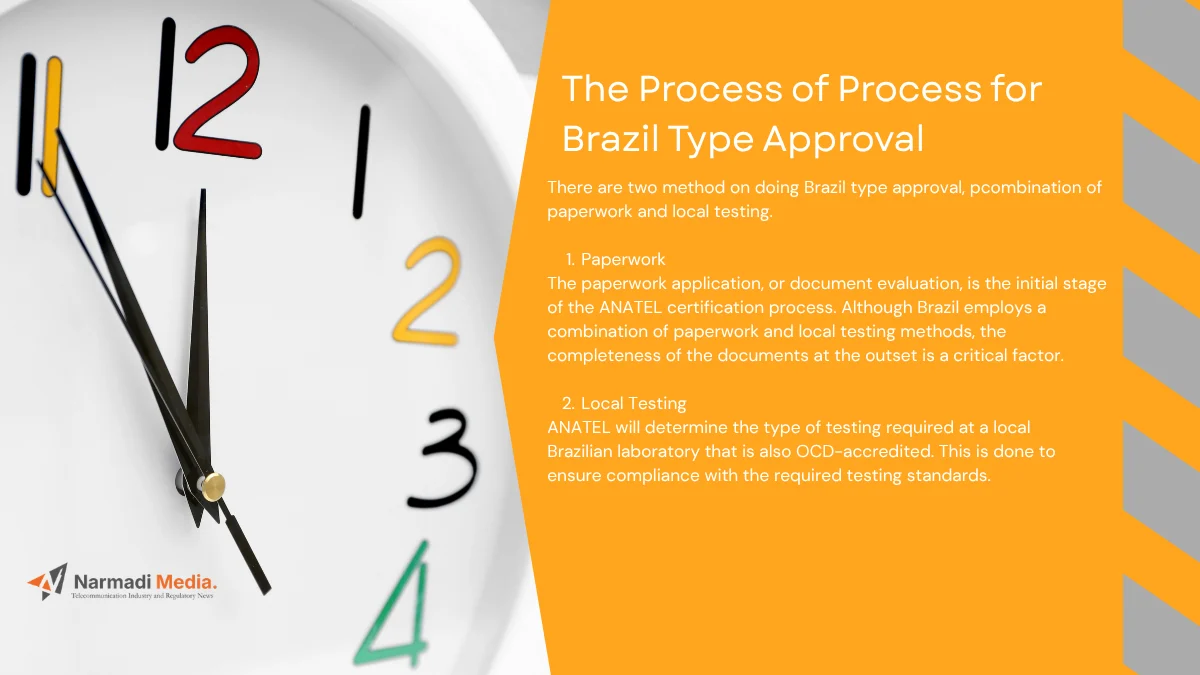
To understand the lead time for Brazil type approval, you need to understand the certification application process from start to finish. The paperwork application for Brazil type approval is a mandatory step at the beginning, before proceeding to the local testing phase and obtaining the ANATEL certificate.
1. Paperwork application
The paperwork application, or document evaluation, is the initial stage of the ANATEL certification process. Although Brazil employs a combination of paperwork and local testing methods, the completeness of the documents at the outset is a critical factor.
Incorrect or incomplete documents will prevent you from advancing to the next stage. Therefore, you must ensure that all document requirements for Brazil type approval are met.
One of the key documents in this process is the test report from a foreign laboratory. For the paperwork application for Brazilian type approval, test results from a foreign laboratory must meet ANATEL-accredited standards (OCD-accredited laboratories).
The laboratory must hold ISO/IEC 17025 accreditation. These testing standards generally align with Conformité Européenne (CE) requirements. The types of testing include Radio Frequency (RF), Electromagnetic Compatibility (EMC), and electrical safety.
All complete documents will be evaluated by ANATEL to determine whether they pass or fail. If the documents pass the evaluation, the types of local testing that need to be conducted will then be determined.
2. Local testing
ANATEL will determine the type of testing required at a local Brazilian laboratory that is also OCD-accredited. This is done to ensure compliance with the required testing standards.
During the local testing phase, you will be asked to submit samples. The number and type of samples will depend on the laboratory’s analysis of the submitted documents. The laboratory also has its own policies regarding sample requirements.
Narmadi Company always communicates with the laboratory to ensure the required samples are provided. Since different products have different sample requirements.
If the local testing is passed, you will receive the test results. Only then can you obtain ANATEL certification.
Lead Time for Brazil Type Approval
Looking at the process above, you can probably imagine how long the ANATEL certification application process takes. Yes, this process is considered the longest of all the certification processes we’ve handled.
This is due to the combination of paperwork and local testing. The lead time for Brazil type approval by the combined method is approximately 8–12 weeks.
Please note that this lead time can be met only if there are no obstacles. A single obstacle can delay the entire process and make it take longer.
You certainly don’t want this to happen. Any obstacles that arise will have a significant impact on your product’s entry into the market. Therefore, it is crucial to ensure all documents are complete and samples are compliant from the very beginning.
Partnering with Narmadi Company will help you avoid this. With over 18 years of experience in RF type approval certification, our professional team has developed a proven approach to ensure the entire process is completed effectively and efficiently.
The lengthy certification process can be completed on time without any obstacles. One way to do this is by ensuring that the samples meet the testing parameters. We do this through pre-testing, so you can avoid the risk of failure during official testing.
Meanwhile, a transparent process will also allow you to track the progress of your certification application. With the Project Management System (PMS), you can monitor the certification process in real time. This ensures that the ANATEL certification process is completed on time.