

To determine how long a certified device can be marketed, you need to understand its validity period. Therefore, you need to understand the validity period of Japan type approval.
The legality of marketing a device in a country is inextricably linked to the validity period of the certificate. By understanding the validity period of Japan type approval, you can estimate when renewal will be necessary.
These criteria are established by the Ministry for Internal Affairs and Communication (MIC). This agency was previously known as the Ministry of Public Management, Home Affairs, Post, and Telecommunications (MPHPT). MIC regulates all certification requirements.
Also Read
Certificate Issuance Process
Before learning about the validity period of Japan type approval, it’s important to understand how certificates are issued. The MIC certificate issuance process involves local testing, but in Japan, the process is not as lengthy as in other Asian countries.
However, you shouldn’t underestimate this process, which includes local testing, document compliance, and certification applications.
1. Testing
Local testing for Japan type approval is mandatory. The process includes three testing stages: Radio Frequency (RF), Electromagnetic Compatibility (EMC), and Safety Testing.
The type of testing will be determined by the features of the proposed device. Local testing will require samples for the testing process. The number and type of samples will also determine the testing to be performed.
2. Document requirements
The following is a list of document requirements for Japan type approval:
- Test report
- User manual (Japanese version)
- Antenna specifications
- Component layout diagram
- Parts list and circuit diagram (RF section)
- Block diagram
- External and internal photographs
Additional documents may be required for certain product types or application methods.
3. Document submission and evaluation
All submitted documents will then be submitted to the designated Certification Body (CB). The CB will then evaluate the completeness of the documents.
If the evaluation passes, the certificate will be issued immediately. However, if it fails, you will need to complete any missing or incorrect documents. You can then resubmit to the CB for re-evaluation.
4. Certificate issuance
The designated CB will issue a Japan Type Approval Certificate. This certificate signifies that your product has officially received permission to be marketed and used. The certificate issuance date becomes the effective date of the Japan Type Approval Certificate.
The following is an example of a MIC certificate issued by the Telecom Engineering Center (TELEC) certification body:
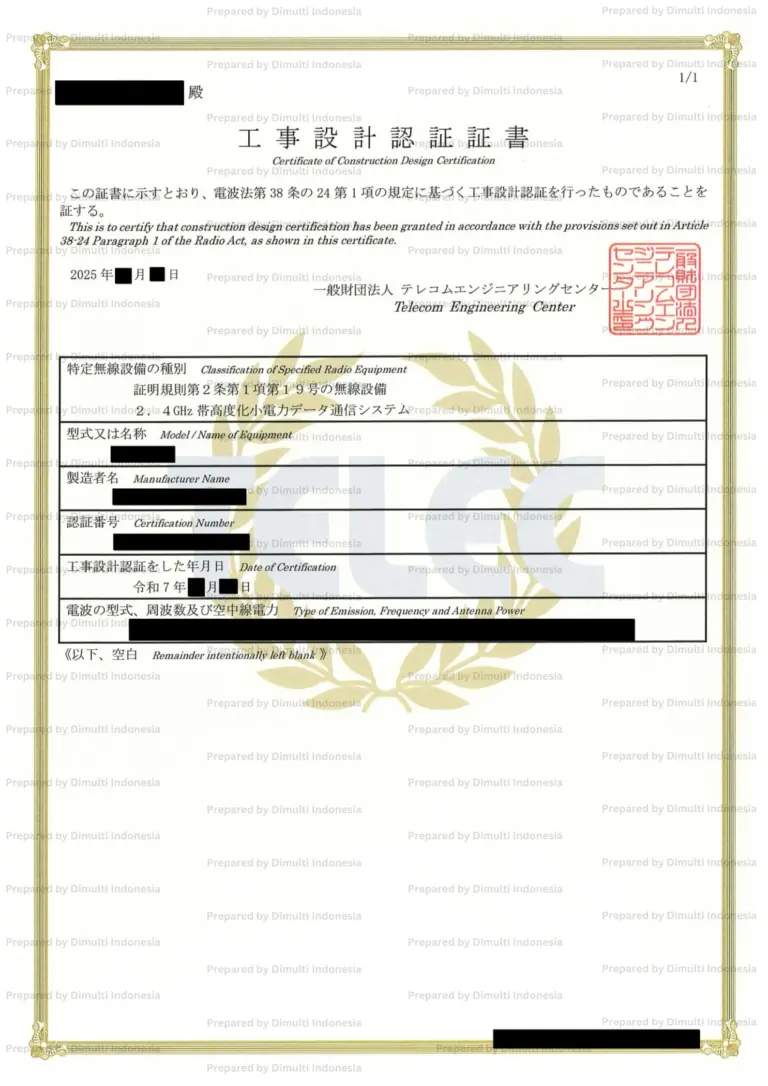
The lead time for Japan Type Approval through the local testing method is not very long. The maximum waiting time is three to four weeks. This is relatively short compared to other Asian countries.
5. Labeling
All telecom and wireless devices that have passed Japanese type approval certification must be labeled. The format of the MIC label varies depending on the device classification.
There are five device classifications for Japanese certification: Specific Radio Equipment (SRE), Special Specific Radio Equipment (SSRE), Telecommunications Terminal, High Frequency Device (HFD), and Ultra Low Power Device (ELP).
Three types of labels will be affixed to certified products depending on the device classification: Giteki, HFD, and ELP. The Giteki label is intended for the SRE, SSRE, and Communications Terminal classifications.
Validity Period of Japan Type Approval
Understanding the validity period of Japan type approval is crucial for marketing planning in the country. MIC certificates generally have no expiration date.
This means the certificate is valid indefinitely, provided there are no modifications to the equipment’s RF specifications. Modifications will affect the product’s compliance with the technical standards established by the MIC.
Therefore, modified devices must be recertified. This is done to ensure that the latest product model still complies with the applicable MIC standards and technical requirements.
That explains the validity period of Japan type approval. Understanding the validity period and certificate renewal will prevent your product from being distributed illegally on the market.
If you have difficulty understanding MIC certification, you can consult with Narmadi Company. Our services will assist you from the local testing process to the issuance of the MIC certificate.
With Narmadi’s experience since 2008, we will ensure your RF type approval process is completed effectively and efficiently. We will periodically ensure that your certificate remains within the appropriate validity period, both in terms of duration and the absence of modifications to the RF features.