There is no doubt that Indonesia has become a key market for the telecommunications industry. Manufacturers, importers, and distributors must be fully informed about all aspects of RF certification in Indonesia.
This is crucial for ensuring compliance with and legality of telecommunications products when marketing and using them in the country. RF certification in Indonesia is not just about compliance; it is also about building customer trust in the safety of the devices they use.
By understanding the comprehensive guide to RF certification in Indonesia, your products will be easier to market and use in this country.
What is RF Certification in Indonesia?
Radio Frequency (RF) certification in Indonesia is known as the "DJID certificate", a compliance requirement for manufacturers, importers, and distributors. DJID stands for "Directorate General of Digital Infrastructure." The Ministry of Communication and Digital Affairs, or KOMDIGI, regulates this certification.
Obtaining the DJID certification means that telecommunications and wireless devices have met the technical, compatibility, and security standards set by applicable Indonesian regulations.
Scope of Products Requiring Certification
The scope of products requiring RF certification in Indonesia is regulated by the Decree of the Minister of Communication and Digital Affairs (Kepmen Komdigi) No. 469 of 2025.
The regulation specifies that products required to hold a DJID certificate are not limited to telecommunications products alone. Rather, this certification is also mandatory for all products that incorporate telecommunications features or radio frequencies.
Who Can Apply for Certification?
Applicants for DJID certification must be business entities registered in Indonesia. Companies may manufacture, assemble, or import telecommunications equipment for trade or use.
They may include local manufacturers, brand owners, distributors, importers, or brand representatives. This refers to Articles 2 and 10 of Ministerial Regulation No. 3 of 2024.
DJID Certification Process
To obtain RF certification in Indonesia, you must complete several steps before the certificate is issued. This process includes document requirements, testing, certification application, and document evaluation.
Document requirements
Ensuring all documents are complete is the first step before submitting a certification application. These documents include:
- Product specifications and the model name.
- Photos of the product.
- Supporting test reports. A completed PM5 application form.
- A Declaration of Conformity bearing the Local Representative's signature.
- An MoU or Distributor Agreement between the Brand Holder and the Local Representative.
- Local Representative details, covering the company name, address, contact person, and official email.
Testing
Local testing is the most recommended option in Indonesia, as it will become mandatory in 2027. However, testing through international laboratories for documentation purposes is still accepted at this time.
The testing will include:
- Radio Frequency.
- Electromagnetic Compatibility.
- Electrical Safety applies to AC-powered devices.
- Laser Safety.
- Specific Absorption Rate (SAR) is specifically required for tablets and mobile phones.
For those of you who choose the paperwork method, only test reports from international labs accepted for RF, EMC, and Electrical Safety are accepted. For Laser Safety and SAR, testing must still be conducted at a local lab in Indonesia.
For those of you who choose the local testing route, you will be required to provide samples for testing. The number and type of samples will depend on the testing method and the product's RF features.
Submit the certification application
All documents, whether for local testing or the paperwork method, must be submitted via the DJID e-certification website to be placed in the evaluation queue. Once in the queue, the authorities will evaluate the documents within 24 hours.
After the evaluation process, DJID will provide feedback. If approved, a Certificate Payment Invoice (SP2) will be sent. The certificate will be issued automatically once the invoice is paid.
Lead Time and Validity
The entire certification application process described above will differ for local testing and paperwork submissions. The lead time for local testing is approximately five to six weeks. Meanwhile, the processing time for paperwork is typically three to five business days.
RF certification in Indonesia remain valid for three years from the date of issuance. Products that are still being manufactured, assembled, or imported for sale or use after three years must undergo recertification.
Label Requirements
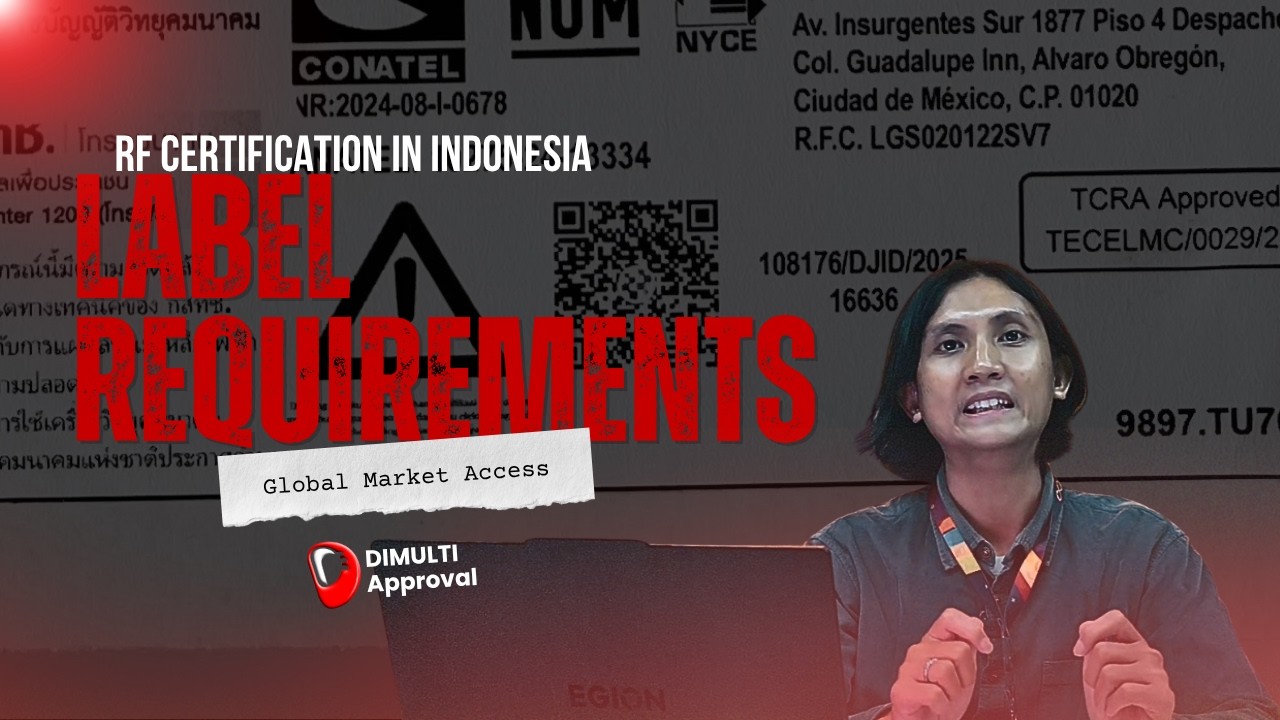
Once the certificate has been issued, there is one more step to complete RF certification in Indonesia: labeling. These labeling requirements are outlined in Article 25 of Ministerial Regulation No. 3 of 2024.
Labeling requirements include:
- Certificate number and PLG ID.
- QR code.
- And a warning label.
All three labels must be affixed to the product and its packaging, or only the packaging, if the product is too small.