
Understanding the document requirements for South Korea type approval is essential for marketing telecom and wireless devices in the country. These documents are required for the KC certification process.
This certification serves as proof that devices distributed and marketed in South Korea meet established safety and quality standards. Korean Certification (KC) is issued by a Certification Body (CB), which may be either a state-owned or private third-party entity.
These bodies are supervised by the Korean Agency for Technology and Standards (KATS). This is a government agency under the Ministry of Trade, Industry, and Energy (MOTIE).
Also Read
This article will help you understand the document requirements for South Korea type approval. This way, you can prepare them from the start and avoid errors or missing documents.
Certification Schemes
Before understanding the document requirements for South Korea type approval, it is important to understand the certification schemes required to market products in this country. There are three schemes: Conformity of Certification (CoC), Registration of Compatibility, and Interim Certificate of Conformity (IoC).
All three schemes require the same documents to be submitted. Understanding these schemes will help you choose the appropriate path for the device you are submitting.
- Conformity of Certification (CoC): Most commonly applied to all broadcasting and communication products, including Bluetooth, Wi-Fi, and 4G LTE/5G NR devices.
- Registration of Compatibility: Mandatory for all broadcasting and communication products that are not required to obtain a Certificate of Conformity (CoC).
- Interim of Conformity (IoC): Applies when a product does not meet the technical criteria for conformity assessment in South Korea and therefore uses standards from another country.
What Are the Document Requirements for South Korea Type Approval?
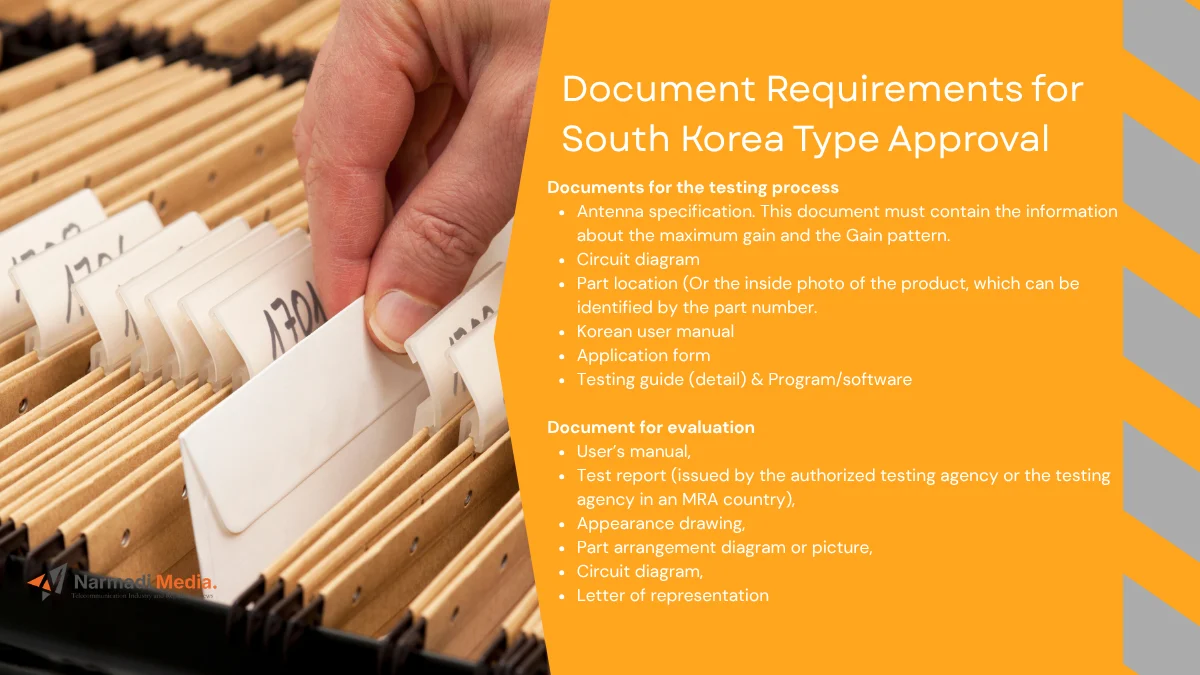
Now that you understand the differences between the various applicable schemes, it’s time to review the document requirements for South Korean type approval. The document requirements are divided into two categories: those needed for the testing process and those required after local testing for evaluation.
1. Documents for the testing process
Local testing is mandatory for South Korea type approval. Therefore, you need to gather the necessary documents to submit for the testing process.
The following documents are required:
- Antenna specification. This document must contain the information about the maximum gain and the Gain pattern.
- Circuit diagram
- Part location (Or the inside photo of the product, which can be identified by the part number.
- Korean user manual
- Application form
- Testing guide (detail) & Program/software
2. Document for evaluation
Once testing is complete, you will receive a test report. If the product passes, this document must be submitted along with the other required documents.
All documents must be submitted to proceed to the evaluation process before the certificate is issued. The following documents are required:
- User’s manual,
- Test report (issued by the authorized testing agency or the testing agency in an MRA country),
- Appearance drawing,
- Part arrangement diagram or picture,
- Circuit diagram,
- Letter of representation
Local Testing Process
Local testing for South Korea type approval is mandatory. In other words, all telecommunications and wireless devices entering South Korea must undergo testing at a local laboratory.
To streamline the certification application process, all type approval documents must be prepared before the local testing process begins. This includes documents required after passing the tests to proceed with the evaluation process.
In addition to requiring complete documentation, local testing also requires samples. At least two samples are required for Radio Frequency (RF) Testing and Electromagnetic Compatibility (EMC) Testing.
For some products, Specific Absorption Rate (SAR) testing is also mandatory. If this testing is required, additional samples will need to be submitted.
The number and type of samples required will depend on the type of testing being conducted. For products that need to undergo these three tests, at least three types of samples will be required: a conductive sample, a normal sample, and a radiation sample.
Those are the document requirements for South Korea type approval that you must prepare. Incomplete documents or a lack of understanding of the testing pathway will result in delays or rejection of your KC certification application.
Therefore, it is important to understand and prepare all required documents in accordance with the selected certification pathway from the early stages of product planning. This will help ensure smooth and efficient access to the South Korean market.