
Just because a KC certificate has been issued doesn’t mean the product can be marketed immediately; there are label requirements for South Korea type approval that must be taken into account. Labeling is crucial for the distribution and marketing of a product.
Label requirements for South Korea type approval serve as proof that the device has successfully passed the certification process. In this case, the criteria are set by the National Radio Research Agency (RRA). This authority regulates all requirements for obtaining certification.
By meeting the label requirements for South Korea type approval, you are not only fulfilling compliance obligations. However, this serves as a sign to consumers that your product is safe for use. Consequently, customer trust will naturally increase.
Also Read
The Importance of Label Requirements
Label requirements are common once telecommunications products have been certified. Each country has different regulations regarding this matter.
Most countries require this, while others do not. So, just how important is labeling on telecommunications products?
Labels play a crucial role in legal verification, market surveillance, and ensuring the validity of devices. In fact, the presence of labels enhances safety and consumer confidence.
- Legal verification: Labels serve as proof that a telecommunications product meets the applicable requirements in a given country.
- Market surveillance: Labels on devices are used by a country’s authorities during market surveillance to ensure validity and compliance.
- Ensuring device validity: The presence of a label makes it easier for consumers to independently verify that a device has passed certification through the listed code.
- Enhancing consumer safety and trust: The presence of a label instills greater consumer confidence in the safety of the products they use.
Label Requirements for South Korea Type Approval
Label requirements for South Korea type approval are mandatory. Before a product is distributed and used, it must bear the “KC Mark,” which stands for “Korean Certification Mark.”
These labeling requirements cover the components, dimensions, and placement of the mark. The following details the requirements in detail.
1. Components
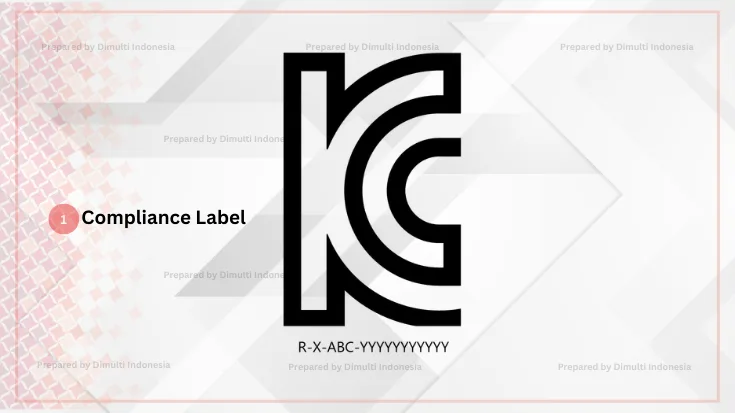
The KC Mark consists of several components: the KC logo, equipment identification code, certification scheme code, applicant identification code, and product identification code.
- KC Logo: This is the official KC logo, indicating compliance.
- Equipment Identification Code: Broadcasting and communication equipment is marked with the letter “R.”
- Certification scheme code: Corresponds to the selected certification scheme code: “С = Certification,” “R = Registration,” or “I = Interim.”
- Applicant identification code: Assigned by the RRA, typically consisting of three letters.
- Product identification code: A unique numerical code associated with the certified product.
Here is an example of the label:
2. Size
Label requirements for South Korea type approval specify a certain size. Generally, the KC Mark must be at least 5 mm in size. However, this size may be adjusted to fit the product’s dimensions.
If a product has small dimensions, a smaller label size is permitted. This certainly makes things much easier for manufacturers with small-sized products.
3. Placement
The KC Mark cannot be placed arbitrarily. This mark must be affixed to all registered products, user manuals, or packaging. Ensure it is placed in an easily visible location.
Label dan Validitas
Generally, the label and the certificate’s validity are two interrelated matters. When the certificate’s validity expires and must be renewed, the label also becomes invalid.
This is because most products display the identification number of a valid certificate. However, this does not apply to countries where certificates have no expiration date.
There is no expiration date associated with the validity period of South Korea type approval. This means that a KC certificate remains valid as long as there are no modifications to the RF features.
If modifications are made, the device must be retested. This is necessary to ensure compliance with South Korean technical standards.
The absence of an expiration date for South Korean certification simplifies labeling. Manufacturers or importers do not need to update the label as long as there are no changes to the certificate.
If a product is modified and recertified, the old product can no longer be used. The label on the product must also be replaced to match the new certificate identification number.
Issues related to label requirements for South Korean type approval can delay the import and distribution of your goods. You can avoid this by contacting Narmadi Company.
Our team, with over 18 years of experience, will help ensure proper labeling for your devices. This way, your RF type approval process will proceed effectively and efficiently, leading to the successful launch of your product in South Korea.