
Understanding the validity period of South Korea type approval is essential for manufacturers, importers, and distributors. This pertains to the legality of products marketed and used in this country.
In some countries, marketing products with expired certificates can result in penalties. By understanding the validity period of South Korea type approval, you are taking proactive steps to avoid such issues.
The criteria for the validity period of South Korea type approval are established by the National Radio Research Agency (RRA). This agency oversees certificates issued by registered Certification Bodies (CBs).
Also Read
The Process of Certificate Issuance
Before understanding the validity period of South Korea type approval, you need to know about the certificate issuance process. The KC certificate is issued through a local testing method.
The lead time for South Korea type approval via the local testing method takes approximately eight weeks. The process includes document preparation, local testing, and document evaluation.
1. Document preparation
Before submitting a KC certification application, you need to prepare all the required documents. In South Korea, there are two stages of documentation: before local testing and after local testing.
The following documents are required before local testing:
- Antenna specification. This document must contain the information about the maximum gain and the Gain pattern.
- Circuit diagram
- Part location (Or the inside photo of the product, which can be identified by the part number.
- Korean user manual
- Application form
- Testing guide (detail) & Program/software
The following documents are required after local testing:
- User’s manual,
- Test report (issued by the authorized testing agency or the testing agency in an MRA country),
- Appearance drawing,
- Part arrangement diagram or picture,
- Circuit diagram,
- Letter of representation
2. Local testing
Local testing for South Korean type approval is the only method available to obtain certification. This method requires you to conduct testing at a local laboratory, which involves a fairly lengthy process.
The testing laboratory will be designated by the Certification Body (CB) based on testing requirements and schedule availability. There are three testing processes required for South Korean type approval:
- Radio Frequency (RF) Testing
- Electromagnetic Compatibility (EMC) Testing
- Specific Absorption Rate (SAR) Testing
The features of the telecommunications device will determine the testing requirements. Sample requirements for South Korean type approval are necessary for local testing. The number and type of samples will depend on the device’s features and the type of testing.
3. Document evaluation
Once you have passed the local testing, you will receive a test results report. This report will then be compiled with the other documents and submitted to the CB. The CB will then evaluate all of these documents.
If the evaluation is successful, the certificate will be issued immediately. However, if it fails, you will need to provide any missing or incomplete documents. After that, you can resubmit them to the CB for re-evaluation.
4. Certificate issuance
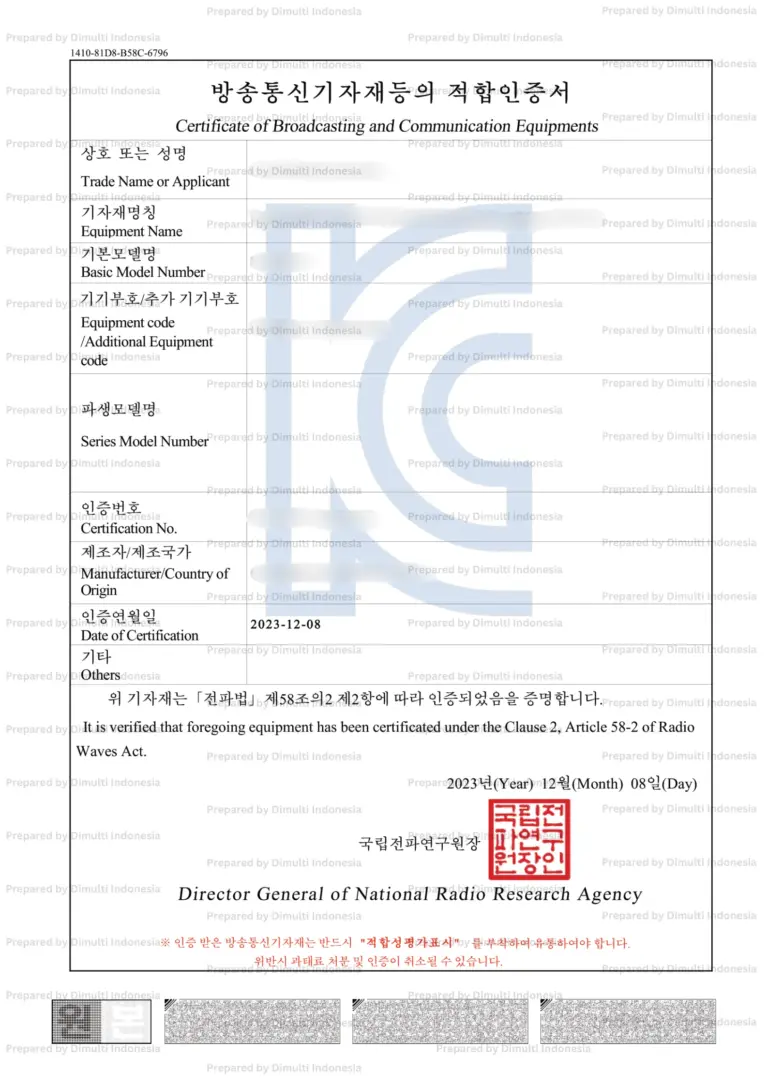
The designated certification body will issue a South Korean type approval certificate. This certificate indicates that your product has officially received approval for marketing and use. The date of issuance of the certificate is the effective date of the certificate.
The following is an example of a KC certificate issued by one of the certification bodies:
5. Labeling
All telecommunications and wireless devices that have passed South Korea’s type approval certification must be labeled. This label is known as the “KC Mark,” which stands for “Korea Certification Mark.”
The labeling requirements consist of five components: the KC logo, the equipment identification code, the certification scheme code, the applicant identification code, and the product identification code. The size of the label may be adjusted to fit the product.
Validity Period of South Korea Type Approval
Your marketing planning will be greatly aided if you understand the validity period of South Korea type approval. KC certificates generally do not have an expiration date.
This means the certificate remains valid indefinitely, provided there are no significant modifications to the RF features. Modifications to the RF features require you to apply for recertification.
Recertification is required to ensure that the latest product model still complies with the applicable KC standards and technical requirements. The recertification application will follow the same process as the initial certification application.
The permanent validity of the KC certificate simplifies matters for manufacturers, importers, and distributors. This eliminates the need to worry about renewal requirements.
That is a brief explanation regarding the validity period of South Korea type approval. A lack of understanding regarding the certificate’s validity period and renewal process can result in illegal products circulating in the market.
To avoid this, you can contact Narmadi Company. We will assist you from the document preparation process through to submitting the KC certification application.
With Narmadi’s experience dating back to 2008, we will ensure your RF type approval process is completed effectively and efficiently. We will regularly verify that your certificate remains within the appropriate validity period, both in terms of duration and the absence of modifications to RF features.