
Understanding the entire local testing process for Japan type approval is crucial for manufacturers. It is one of the required steps in the MIC certification process.
Local testing for Japan type approval is conducted by the Ministry of Internal Affairs and Communications (MIC). This agency was formerly known as the Ministry of Public Management, Home Affairs, Post, and Telecommunications (MPHPT). MIC regulates all certification requirements.
This testing is used to ensure that devices distributed and marketed in Japan meet safety and quality standards. This article will provide you with everything you need to know about local testing for Japan type approval.
Also Read
Local Testing for RF Type Approval
To apply for Radio Frequency (RF) type approval certification, two methods must be followed: local testing and document evaluation. The methods used by each country will vary depending on the policies of each authority.
Some countries offer the option of applying for certification through local testing or document evaluation. Some countries require only local testing, while others require only document evaluation.
Countries that require local testing require testing in a laboratory located in that country. This process will require samples for testing.
With local testing, products are evaluated for spectrum, interference limits, and safety standards that comply with the target country’s standards. This ensures that the product marketed is safe for operation in that country’s environment.
Local testing for Japan type approval is the only way to complete the certification process. Therefore, it is important for applicant for Japan type approval to understand the procedures.
Local Testing for Japan Type Approval
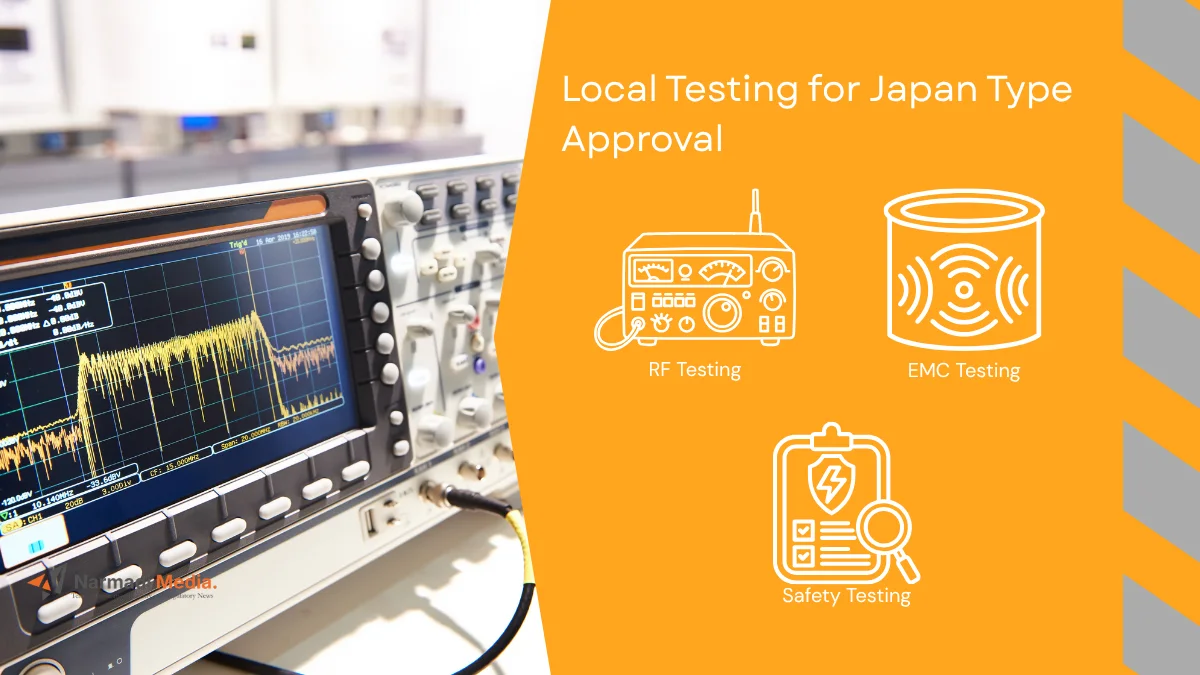
Local testing for Japan type approval is mandatory for obtaining MIC certification. Three stages of testing must be conducted at a local Japanese laboratory before all documents are submitted to the authorities. The required tests are as follows.
- Radio Frequency (RF) Testing: This process is performed on devices that use radio frequencies to evaluate wireless signal transmission.
- Electromagnetic Compatibility (EMC) Testing: A testing process for devices to ensure they do not interfere with other devices.
- Safety Testing: Ensuring that the device is safe for use with equipment and power adapters.
The product being proposed and laboratory policies will determine the type of testing and number of samples required.
Typically, testing only requires one standard sample with the appropriate accessories. However, additional samples with special settings may be required for some products.
For sample requirements, our team always consults with experts and the laboratory. This ensures that the samples submitted will meet the testing needs in the field.
Testing Laboratory Requirements
When discussing local testing for Japan Type Approval, accredited testing laboratories and their availability are crucial. This mandatory testing requirement requires Japan to provide several accredited local laboratories for testing.
It’s important to remember that the MIC collaborates with certification bodies (CBs) in the certification process and issuance of certificates. CBs typically already have relationships with laboratories for local testing.
Another important consideration is that each laboratory has different testing capabilities and availability. Therefore, a single device may be tested in several different laboratories.
List of Laboratories in Japan
The following is a list of laboratories that can be used for local testing to obtain Japan type approval for MIC certification:
| Laboratory | Accreditation Identification | Japan Corporate Number |
| Yokohama Laboratories, Japan Electrical Safety and Environment Technology Laboratories(JET) | JNLA Z80112JP Testing | 9011005003367 |
| Safety & EMC Center, Japan Quality Assurance Organization | JNLA Z80114JP Testing | 9010005016585 |
| Yokohama Laboratory, TÜV Rheinland Japan Ltd | JNLA Z90120JP Testing | 5020001022136 |
| Osaka Laboratory, TÜV Rheinland Japan Ltd. | JNLA Z90123JP Testing | 5020001022136 |
| Tokyo Laboratories, Japan Electrical Safety and Environment Technology Laboratories (JET) | JNLA 060221JP Testing | 9011005003367 |
| Kansai Laboratories, Japan, Electrical Safety and Environment Technology Laboratories (JET) | JNLA 060222JP Testing | 9011005003367 |
| OCTO Corporation Testing Laboratory | JNLA 090268JP Testing | 2011401001204 |
| Yonezawa Testing Center, TÜV SÜD Japan Ltd. | JNLA 090279JP Testing | 2020001037401 |
| Quality and Environment Planning Department, Technology, Production, and Quality Planning Division, Toshiba Lighting & Technology Corporation | JNLA 120336JP Testing | 5021001044112 |
| Tokushima Prefectural Industrial Technology Center | JNLA 140357JP Testing | 4000020360007 |
| Kita-Kansai Testing Center, Japan Quality Assurance Organization | JNLA Z80115JP Testing | 9010005016585 |
Pre-Testing: Important Things to Do Before Official Testing
We already know that local testing for Japan type approval is a mandatory requirement. Samples that do not meet the required test parameters will fail.
Failing local testing will result in losses and delays in the certification process. Therefore, you need to conduct pre-testing first. Pre-testing is a service not offered by many certification agencies.
Even if they do, there is usually an additional fee for pre-testing. Narmadi Company, as an RF type approval certification service, offers free pre-testing for every certification process we undertake.
During pre-testing, your sample will be tested in our in-house laboratory using a spectrum analyzer. This process ensures that the submitted device sample meets the technical standards of the destination country.
This way, you avoid the risk of failing local testing and the expense of re-testing. If any issues arise during pre-testing, you can identify and resolve them early.