
Manufacturers must understand the entire process of local testing for South Korea type approval. This is the only step that must be taken to obtain KC certification.
Local testing for South Korea type approval is conducted by a Certification Body (CB), which acts as a third party and may be either state-owned or private. These bodies are supervised by the Ministry of Trade, Industry, and Energy (MOTIE) under the National Radio Research Agency (RRA).
This testing is used to ensure that devices distributed and marketed in South Korea meet safety and quality standards. This article will provide you with everything you need to know about local testing for South Korea type approval.
Also Read
Local Testing for RF Type Approval
When applying for Radio Frequency (RF) type approval certification, there are three methods commonly used: local testing, document evaluation, and a combination of both. The policies of each national authority determine which method is used.
Some countries offer the option to apply for certification through local testing or document evaluation. Some countries require only local testing, while others require only document evaluation.
Countries that require local testing mandate that testing be conducted in a laboratory located within that country. This process will require samples for testing.
Local testing is the only way to complete the process for KC certification. Therefore, applicant for South Korea type approval need to understand the procedure.
Local Testing for South Korea Type Approval
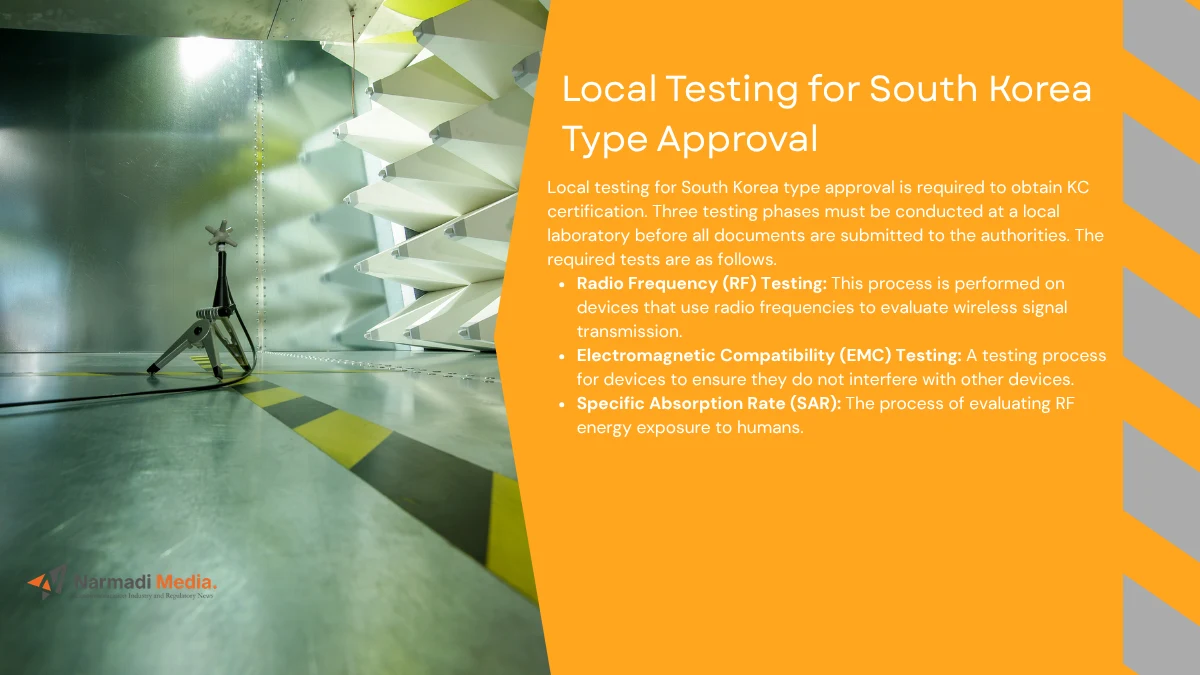
Local testing for South Korea type approval is required to obtain KC certification. Three testing phases must be conducted at a local laboratory before all documents are submitted to the authorities. The required tests are as follows.
- Radio Frequency (RF) Testing: This process is performed on devices that use radio frequencies to evaluate wireless signal transmission.
- Electromagnetic Compatibility (EMC) Testing: A testing process for devices to ensure they do not interfere with other devices.
- Specific Absorption Rate (SAR): The process of evaluating RF energy exposure to humans.
Typically, each test requires one sample. Therefore, for devices requiring all tests, you will need at least three samples.
The test must meet two sample conditions: an irradiated sample and a normal sample. RF testing generally refers to four parameters: frequency range, output power, bandwidth, and spurious emissions.
- Frequency Range: The range or spectrum of frequencies generated.
- Output Power: The transmission power generated when activated.
- Bandwidth: Data transmission speed.
- Spurious emissions: Unwanted radio frequency emissions.
1. Document requirements
Local testing for South Korea type approval requires several documents. These documents must be submitted to the laboratory or Certification Body (CB) before the test samples are submitted.
The following are the document requirements for South Korean type approval before testing:
- Antenna specification. This document must contain the information about the maximum gain and the Gain pattern.
- Circuit diagram
- Part location (Or the inside photo of the product, which can be identified by the part number.
- Korean user manual
- Application form
- Testing guide (detail) & Program/software
2. Testing laboratory requirements
When discussing local testing for South Korea type approval, the local testing laboratories themselves cannot be overlooked. As mentioned earlier, local testing is the only option for KC certification.
Therefore, it is important to identify qualified laboratories. Some of these include the Korea Testing Laboratory (KTL), the Korea Testing & Research Institute (KTR), Korea Testing & Certification (KTC), DT&C, and Nemko Korea Co., Ltd.
It is important to note that each laboratory has different capabilities. Therefore, testing can be conducted at more than one laboratory. For example, RF and EMC testing can be performed at Laboratory A, while SAR testing can be performed at Laboratory B.
Preliminary Testing to Avoid Failure
The local testing requirements for South Korea type approval make it essential that submitted samples meet all required testing parameters. You need to avoid failure to prevent losses and delays in the certification process.
How can this be avoided? Narmadi Company can be the solution. We provide pre-testing services for every product undergoing RF testing. This process involves testing samples in our in-house laboratory using spectrum analysis.
Compliance with the destination country’s technical standards can be ensured through pre-testing. Even if issues arise, you can immediately identify areas that need improvement to ensure compliance with technical standards.
We prioritize transparency; you can monitor the pre-testing process directly via teleconference. This also streamlines our process, particularly regarding the product’s Standard Operating Procedures (SOPs).