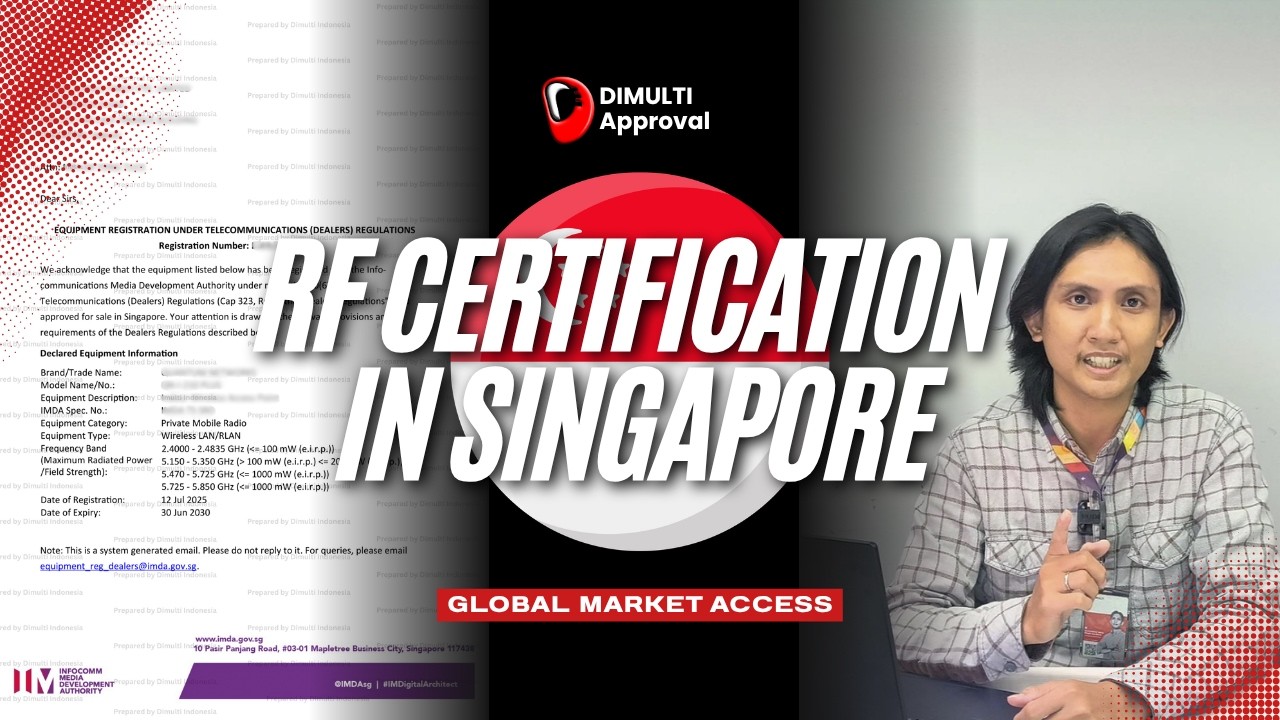
In many countries, obtaining a new certificate is the first step. The next step before a product can be marketed and used is to affix a label.
Label requirements for RF certification in Singapore are mandatory. Ignoring these requirements will result in serious consequences, ranging from fines to imprisonment.
In this article, we’ll cover everything you need to know about labeling requirements for RF certification in Singapore. You can also watch the full video to learn the requirements in detail.
Labeling Requirements for RF Certification in Singapore
The Infocomm Media Development Authority (IMDA) requires that labeling be completed before a product is sold in Singapore. Knowing the requirements in advance will help you be better prepared for the labeling process.
There are several things you need to know regarding the labeling requirements for RF certification in Singapore. These relate to the label components, label size, and label placement.
Label Components
The Singapore RF certification compliance label consists of two components: the phrase “Complies with IMDA Standards” and the Dealer’s License Number. Both components must be included without exception.
- The phrase “Complies with IMDA Standards”: This is the official indicator that the product has been certified by IMDA.
- Dealer’s License Number: The number printed on your IMDA certificate.
These components must appear together on the label. They cannot be used separately.
Label size
When it comes to labels, Singapore is not flexible—including regarding their size. The IMDA’s label size requirements are very specific. The required dimensions are exactly 17 millimeters by 9 millimeters.
You cannot arbitrarily change the size, whether by making it smaller or larger. However, you might be wondering what to do if the product is too small for that size.
If the product is too small, you need to obtain written approval from IMDA. No written approval means no adjustments. You can only make adjustments to the label after IMDA grants permission.
Label Placement
Another strict requirement for RF certification in Singapore is label placement. The label must not be placed haphazardly.
You must place the label clearly, so it is easy to read and accessible to consumers. IMDA provides three permitted placement options: directly on the product, in the product’s user manual, and on the product packaging.
In addition, IMDA also allows electronic labeling for devices equipped with a built-in screen or display. Electronic labeling must be accompanied by an instruction manual or brochure included in the packaging.
This is necessary to explain to customers how to access the electronic label on the screen. A digital copy of the instruction manual containing the label is also permitted.
Penalties for Non-compliance
Labeling requirements in Singapore come with consequences for non-compliance. Failing to affix a label to a certified device is not merely an administrative issue.
There are real consequences you will face if you violate these requirements. These consequences include fines, imprisonment, or both. These penalties may be imposed without warning. If your products are displayed on shelves without labels, IMDA will immediately take action against such violations.
Labeling and Renewal
Certificate renewal affects labeling. When a new certificate is issued, it comes with a new certificate number. This means the Dealer Authorization Number on your label will change.
New labels with the new Dealer Authorization Number will apply to units manufactured after the renewal. Meanwhile, units already on the market are still permitted to use the existing labels.
As we discussed in a previous article, the validity period for RF certification in Singapore is five years. The exception is ESER, which has no expiration date. Therefore, if your products fall under the SER, GER, GER-CB, or COFC categories, you’ll need to prepare for labeling requirements when renewing your certification.