
Understanding the applicant for South Korea type approval is crucial for marketing telecom and wireless devices. The applicant is responsible for securing the KC certification.
The applicant for South Korea type approval is established by the Ministry of Trade, Industry, and Energy (MOTIE). KC certificates for telecommunications devices classified under the broadcasting and communications equipment category are issued by the National Radio Research Agency (RRA). This authority regulates all requirements for obtaining certification.
Applicant for South Korea type approval must ensure that their devices meet the established safety and quality standards. So, who can apply for KC certification? This article explains the requirements to help you better understand the criteria for applicants.
Also Read
The Importance of Applicant Status
Meeting the requirements as an applicant for South Korea type approval is crucial. Specific criteria will determine whether you can apply for certification.
Failure to meet the established criteria will result in your certification application being rejected. Therefore, you must meet the criteria set by the RRA.
The requirements for certification applicants in South Korea are relatively straightforward. This is because foreign companies are still permitted to apply for and hold certificates.
This flexibility certainly benefits manufacturers who do not yet have a local company or representative. In this country, importers play a significant role, as they are the only entities authorized to handle the import process.
Applicant for South Korea Type Approval
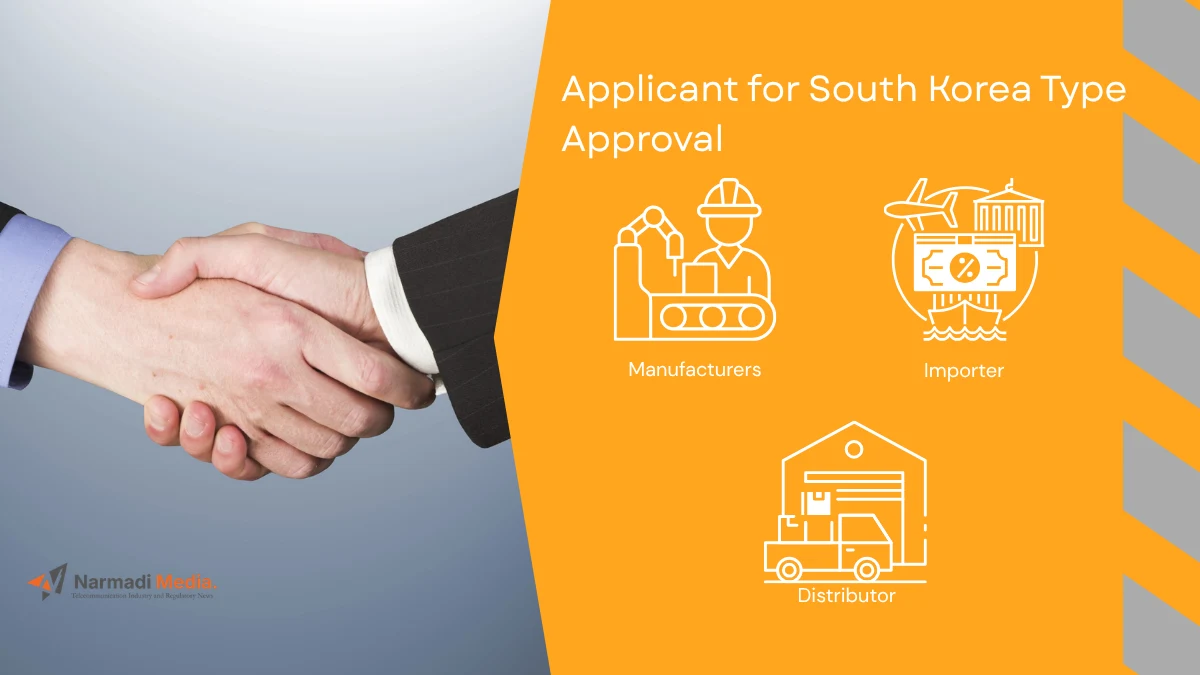
Who can be an applicant for South Korea type approval? RRA requires that only local companies may apply for certification. These may be manufacturers, importers, or distributors.
Foreign companies cannot initiate the certification process directly. They must appoint a registered company to act as their local representative, or have a company registered in South Korea that acts as their importer or supplier.
1. Manufacturers
Manufacturers are entities that produce telecom or wireless equipment. Manufacturers can be either domestic or foreign companies. In South Korea, both can act directly as certificate applicants.
For foreign manufacturers, the issued certificate can be used by importers later. An importer is a local representative in South Korea who can act as both the certificate applicant and the certificate holder. This entity will be responsible for all requirements related to importing goods from the brand owner into South Korea.
2. Importir
An importer is a local representative in South Korea who can act as both the certificate applicant and the certificate holder. This entity will be responsible for all requirements related to importing goods from the brand owner into South Korea.
One disadvantage of choosing an importer as the certificate holder is that the import process can only be carried out by the entity holding the certificate. The certificate cannot be used by other companies for imports.
For manufacturers with many importer partners, this option seems inefficient. You can appoint an importer only after the certification process is complete.
3. Distributor
A distributor is a local representative in South Korea responsible for marketing the brand owner’s products. They may or may not act as an importer.
A distributor acting as an importer can use the certificate for the import process. The certificate is valid only for that company. The distributor cannot give a certificate to another party to import the product.
The Applicant Must Be Aware of These Things
Now you know which entities can apply for South Korean type approval. Next, as a certification applicant, there are several things you need to keep in mind to ensure the certification process runs smoothly.
1. Understanding the process
The KC certification application process requires local testing. The process takes a considerable amount of time compared to paperwork-based methods.
This process also involves a significant number of document requirements for South Korea type approval. You need to prepare documents both before and after local testing.
A lack of understanding of these requirements will inevitably cause delays in the certification process.
2. Understanding applicable standards and regulations
Standards are not static. Standards and regulations related to certification frequently change to align with conditions in a particular country.
Therefore, it is crucial for an applicant for South Korea type approval to stay updated on the latest regulatory developments. This ensures that your devices comply with the most current standards and regulations.
3. Hiring a certification consultant
By hiring a certification consultant, you eliminate the need to understand the two points above. They will take full responsibility for all applicable processes and standards in a given country.
Narmadi Company is a certification consultant with more than 18 years of experience. We will help you manage all aspects of the South Korean type approval certification process to ensure it runs smoothly.
We have an international network that consistently provides the latest information on regulatory developments. This ensures your products comply with applicable standards. In fact, we’re ready to assist you with RF type approval certification processes not only in South Korea but worldwide.