


Entering a country’s market to distribute telecom and wireless products requires compliance approval, including in Yemen. Therefore, it is important to understand how to obtain Yemen type approval certification.
The Yemeni telecommunications market is, by global standards, quite complex. Although hampered by damaged infrastructure and political fragmentation, the market holds untapped growth potential and is highly promising for alternative technologies, such as satellite services. Consequently, Yemen type approval guidelines are necessary for marketing these products.
Yemen type approval is known as MTIT certification. Due to conflict and regime divisions, a dual regulatory framework has been in effect in the country since 2015. Two authorities govern two distinct regions: the Aden Authority and the Sana’a Authority. Understanding the entire certification process is essential to ensure a smooth market entry in Yemen.
Also Read
What is Yemen Type Approval?
Understanding Yemen’s type approval process is inseparable from its regulatory bodies. Generally, certification is overseen by the Ministry of Telecommunications and Information Technology (MTIT).
However, this authority is currently divided into two entities: the Aden Authority for the southern region and the Sana’a Authority for the northern region. Both authorities are officially responsible for issuing Yemen type approval certificates within their respective jurisdictions.
Certificates issued by one region are not valid in the other. Therefore, two certificates (from Sana’a and Aden) must be issued to ensure full compliance with regulatory requirements and distribution throughout Yemen.
1. Aden authority
The Ministry of Telecommunications and Information Technology (MTIT) in Aden is an authority under the legitimate and internationally recognized government of Yemen. Its jurisdiction covers Aden and other southern regions.
The MTIT under the Aden authority officially began issuing certificates in early 2026. This authority is responsible for certifying imports entering through southern entry points.
2. Sana’a authority
The Ministry of Telecommunications and Information Technology (MTIT) in Sana’a is an authority under the Houthi government. Its jurisdiction covers the northern regions and the capital, Sana’a.
The MTIT under the Sana’a authority has been issuing certificates for some time and has long been recognized. It continues to issue certifications for products destined for the areas under its control.
The Scope of Products Requiring Certification
The scope of products requiring MTIT certification is not limited to telecommunications products. However, all products with telecommunications features or radio frequencies must also be certified.
The following are some examples of products that require Yemen type approval:
| Home Appliances: Smart Dishwasher Smart Oven Smart Washing Machine Smart Refrigerator Smart Air Conditioner Smart Wine Chiller Smart Coffee maker Smart Fan Electronic Water Meter Sensor Smart Lighting system Smart water closet Robot vacuum cleaner Smart locker Etc. | Automotive: Tire Pressure Monitoring Sensor Head Unit/Car Audio Telematic Unit Body Control Module Immobilizer Keyless Wireless Charging Unit Vehicle Radar Dashboard Camera Seat-belt Sensor Door-Lock Sensor Vehicle Dashcam Etc. |
| Audio-Video Devices: Wireless Speaker Smart Television or Digital Television Monitor Wireless Microphone Microphone Receiver In-ear monitoring device Headset/headphone True Wireless Earbuds Projector Speakerphone Etc. | Telecommunication Products: Smartphone Line/wired telephone Tablet PC Handy Talkie/Walkie Talkie Switch Router Access Point Video Conference Cordless telephone IP Phone Etc. |
| Medical and Healthcare products: Blood Glucose Monitoring System Blood pressure monitoring system MRI system Smart Operating Table Digital Radiography Smart syringe pump Body Height measurement Body weight measurement Bluetooth Oximeter Etc. | Wearable: Smartwatch Smart Ring Smart tag Running shoes tracker Smart eyeglasses Etc. |
| Environmental Monitoring Product: Wildfire Sensor Whether Sensor Etc. | Mining: Smart detonator system Tunnel light signal Etc. |
Who Can Be an Applicant for Certification?
Applicants for Yemen type approval for MTIT certification in Aden or Sana’a must be registered local companies. These may include local representatives, importers, or distributors.
Foreign companies cannot apply for certification directly. They must appoint a registered company to act as their partner.
Subsequently, that company will act as the certificate holder. For those who do not yet have a local partner based in Yemen, foreign companies may appoint a service provider or certification body to serve as the certificate holder.
It is important to note that we must work with a responsible and easily accessible certification body. This is because the service provider will need to issue a letter of authorization to the importer or distributor to use the certificate for their import needs.
Certification Process
Essentially, the Yemen type approval certification process for Aden or Sana’a focuses on document evaluation. Therefore, applicants are expected to have conducted testing at an ISO/IEC 17025-accredited international laboratory.
These standards refer to Conformité Européenne (CE) for Radio Frequency (RF) testing, Electromagnetic Compatibility (EMC) testing, and safety testing.
1. Document evaluation
To apply for Yemen type approval, applicants must submit the required documents. Before submitting the application, it is important to ensure that all documents are complete. The required documents include:
- Completed application form, signed and stamped by your applicant.
- Technical specifications (TCF) and test reports for Radio, EMC, and Safety in compliance with international/IEC or European standards.
- Declaration of Conformity (DoC), issued and signed by the manufacturer.
- User manual and Schematic.
- Internal and external product photos.
- An authorization letter from the manufacturer or end client to Narmadi, signed and stamped.
- Authorization letter from Narmadi to Yamani agency, signed and stamped.
- For renewal applications, please attach the previous certificate to be renewed.
In general, certification applications submitted to the authorities in Aden and Sana’a require the same documents, but there are some minor differences. It should be noted that each authority has its own separate application form.
For applications submitted to the Aden authority, an additional list of countries where the relevant equipment has been approved is required.
All documents will then be submitted to the respective authorities for evaluation.
2. Certificate issuance
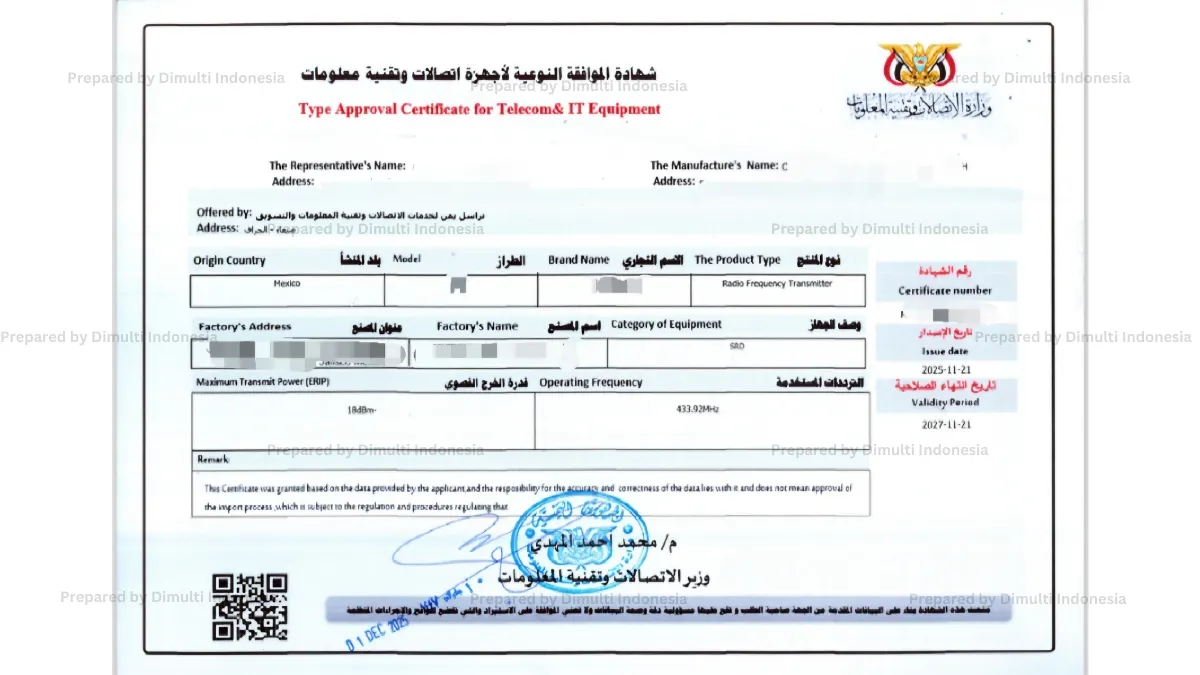
The MTIT certificate will be issued after completing the above process. The processing time for Yemen type approval applications, whether for Aden or Sana’a, requires a lead time of four to eight weeks.
The MTIT certificate is valid for two years from the date of issuance. Therefore, you need to be aware that as the expiration date approaches, the certificate renewal process must be initiated.
The following is an example of an MTIT certificate issued by the Sana’a authority:
3. Label requirements for Yemen type approval
Unlike other countries, which generally require labeling, labeling is not mandatory in Yemen. Telecom and wireless products certified by the MTIT are not required to display labels on the products or their packaging.
Yemen has some flexibility in this regard. Even in some countries that do not require labeling, local importers often include the certification identification number.
In Yemen, this is also not required. No additional steps are needed to affix the MTIT approval label. Products can be imported and distributed for sale immediately after obtaining certification.
MTIT Certification Management Services
The MTIT certification process involving paperwork applications is arguably not as straightforward as in other countries that follow the same procedure. Not to mention that in Yemen, there are two different authorities.
Naturally, this makes the certification process more confusing and not as easy as one might imagine. Therefore, you may need assistance to complete the certification process in this country.
Narmadi Company is the right place to resolve your confusion regarding RF type approval and telecommunications certification. With our extensive experience and international network, we will guide you through the certification process from initial testing services to the issuance of the certificate, all of which can be monitored in real-time.
1. Over 18 years of experience
From 2008 to the present, we have handled hundreds of clients and thousands of RF type approval projects. Our extensive experience allows us to fully understand your needs. We will ensure the certification process is completed efficiently.
2. Global network
Throughout our journey in the certification industry, we have built an international network spanning the globe. Our team continuously develops certification services worldwide to meet client needs. This enables us to serve you not only in Japan but also across the globe.
3. Pre-testing services
You rarely find this service offered by other certification management providers. However, pre-testing can help you prevent failures during the actual certification process. We have an in-house laboratory that can verify the compliance of your test samples.
4. Processes can be monitored in real time
Knowing exactly where the certification process stands is crucial. This is essential to ensure the certification is completed within the lead time. With this in mind, we have a Project Management System (PMS) that allows you to monitor the certification process at every stage in real time.