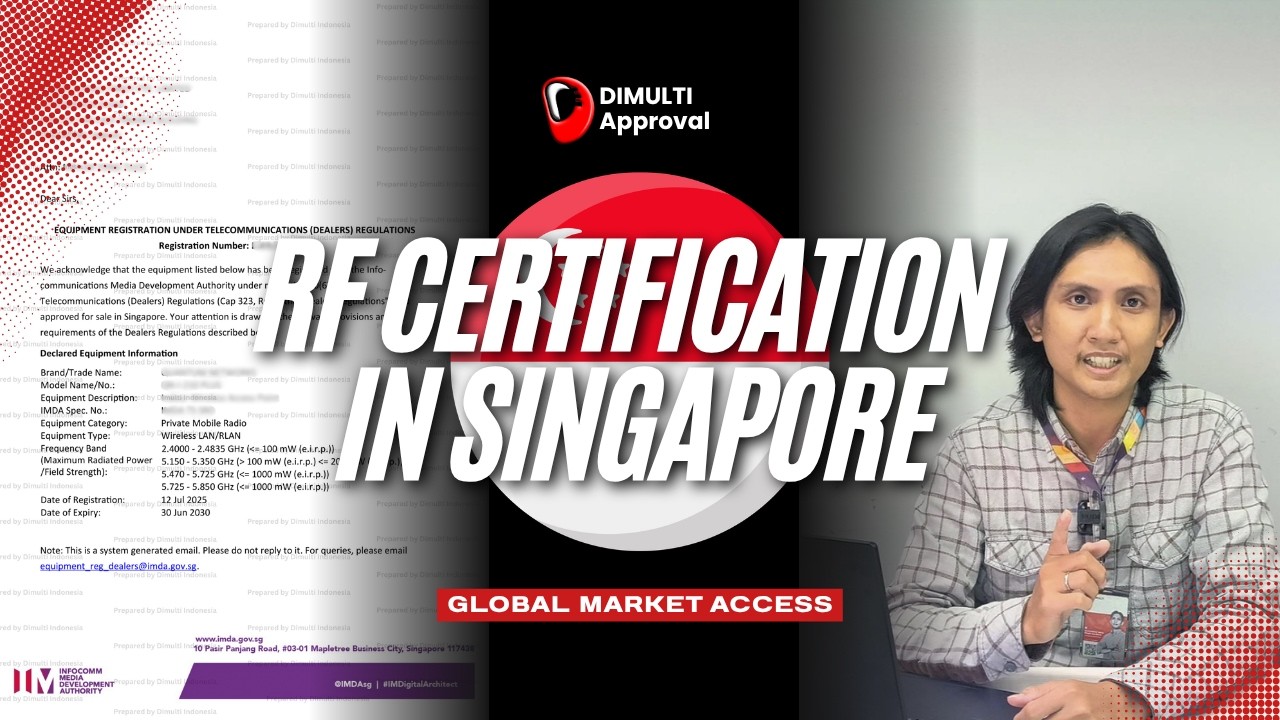
No local testing is required to apply for RF certification in Singapore. The process is entirely document-based, so it is essential to ensure that all documentation is complete.
The document requirements for RF certification in Singapore depend on the type of registration being applied for. IMDA classifies these into five categories, each with different requirements.
We will cover everything you need to know about the document requirements for RF certification in Singapore, as well as the steps involved in the process. You can also watch the full video to ensure there are no errors when compiling your documents.
Five Registration Types
Before looking into the documentation requirements for RF certification in Singapore, you need to be aware of the five available registration types. That way, you will know which one applies to the product being submitted.
The five types of registration:
- Enhanced Simplified Equipment Registration (ESER)
- Simplified Equipment Registration (SER)
- General Equipment Registration (GER)
- General Equipment Registration by Certification Bodies (GER-CB)
- Confirmation of Conformity (COFC)
Different types of registration require different documents and cover different products. If you submit ESER documents for a GER product, your application will be rejected straight away. It is therefore important to get this right from the outset.
1. ESER
Enhanced Simplified Equipment Registration (ESER) is the simplest process amongst the four other types of registration. It is a process of self-assessment and self-declaration.
This type applies to short-range, low-power devices, including:
- Alarms
- RFID
- Radio detection
- On-site paging systems
- Vehicle radar
- Remote controls
- Remote commands
- Telemetry
- Wireless microphones
Document requirements:
- Conformity assessment
- Product brochure
- Supplier’s Declaration of Conformity (SDoC)
IMDA does not charge an assessment fee for this automatic approval process. The certificate also has no expiry date.
2. SER
Simplified Equipment Registration (SER) is a process applicable to mobile systems. Examples of products covered by this type of registration include:
- 3G mobile phones
- LTE
- GMPCS
- Broadband access equipment such as ADSL
- Cable modems
- CCHN equipment
Document requirements:
- Conformity assessment
- Supplier’s Declaration of Conformity (SDoC)
- Photographs of equipment
- Product brochure
- EU-Type Examination Certificate (EU-TEC)
- User manual
- Safety information
3. GER
General Equipment Registration (GER) is the most comprehensive registration route. High-risk equipment products must follow this route. This route is also optional for ESER and SER products if you wish IMDA to evaluate your test reports directly.
Examples of products falling under this registration category include:
- Mobile base stations and IoT
- Repeater systems
- Land mobile radios
- Walkie-talkies
- TV White Space devices
- UWB
- DSRC
- IoT user equipment
- As well as short-range devices not covered by the ESER
Document requirements:
- Supplier’s Declaration of Conformity (SDoC)
- Photographs of equipment
- General information about the product
- Product brochure
- Test reports
- User Guide
4. GER-CB
General Equipment Registration by Certification Bodies (GER-CB) is a type of registration available only to applicants that are certification bodies. Bodies recognised by IMDA are listed in Phase II of the MRA.
This route covers all types of equipment. The process is handled entirely by the certification body; applications are not submitted directly to IMDA. If you choose this route, a certification body recognised under this scheme will handle the entire document submission process on your behalf.
Document requirements:
- A certificate issued by a certification body recognised by IMDA
- Photographs of equipment
- General information or product brochure
5. COFC
Confirmation of Conformity (COFC) is a voluntary procedure. This process applies to equipment exempt from the registration requirement. Examples of such products include fax machines and standard telephone equipment.
There are two COFC pathways: self-declaration and declaration evaluated by IMDA.
- Self-declaration: Carrying out a self-assessment of conformity based on test reports and submitting the relevant documents.
- Declaration evaluated by IMDA: Submitting test reports for direct evaluation by IMDA.
Document requirements:
- Supplier’s Declaration of Conformity (SDoC)
- Photographs of equipment
- Product brochure
- Test reports are acceptable according to IMDA standards
General Document Rules
Regardless of the type of registration, there are certain rules that apply to all documents. These include test reports, Supplier Declarations of Conformity, and portal submissions.
- Test reports must be issued by a laboratory accredited to ISO/IEC 17025 and comply with CE or FCC standards.
- The Supplier Declaration of Conformity must be signed by the local applicant, not by the foreign manufacturer.
- All documents must be submitted via the GoBusiness Licensing Portal.