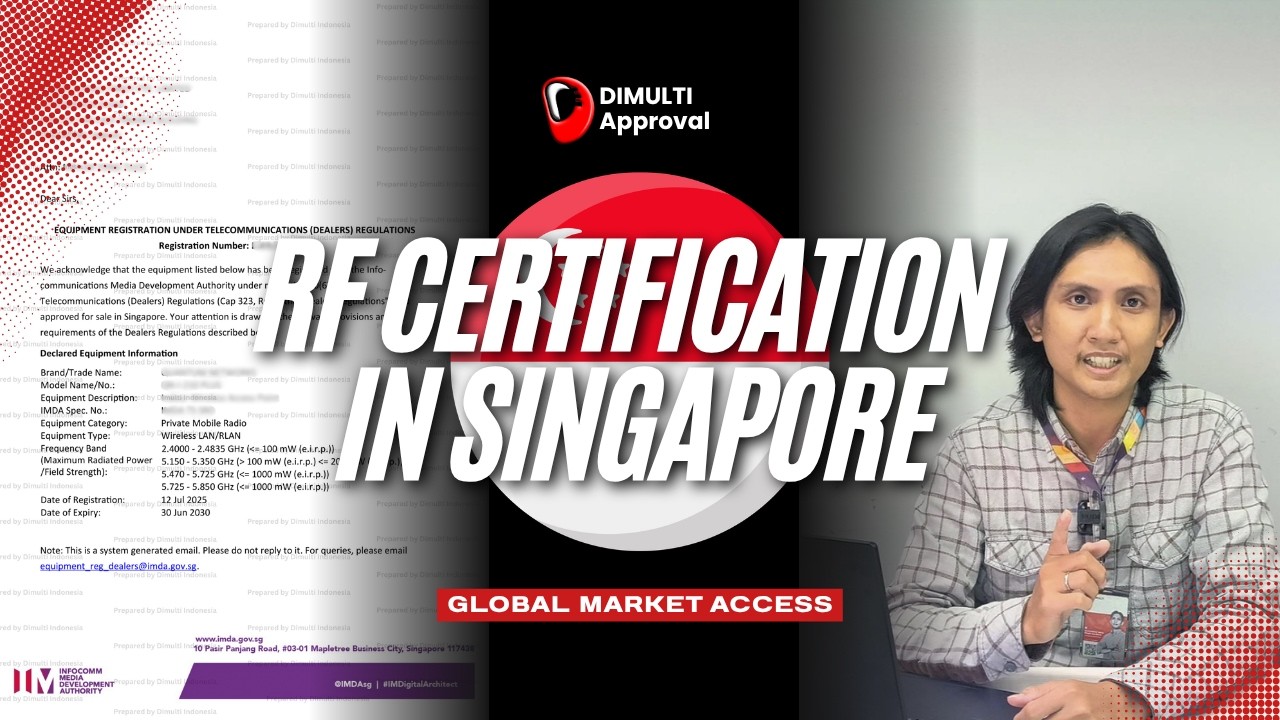
The certification applicant plays a crucial role in the Radio Frequency (RF) certification process, as each country has its own specific requirements in this regard.
The requirements for RF certification applicants in Singapore differ from those in most neighboring countries. Being registered locally is not the only requirement that must be met.
In this article, we’ll discuss who is actually eligible to apply for RF certification in Singapore. You can also watch the full video to learn more about the requirements in detail.
Who can be an Applicant for RF Certification in Singapore?
Who is eligible to apply for RF certification in Singapore is governed by the Telecommunications Traders Regulations, Part II on Trader Licensing and Part V on the Import, Production, and Sale of Telecommunications Equipment.
This regulation stipulates that any company wishing to manufacture, import, or sell telecommunications equipment in Singapore must be registered with the Accounting and Corporate Regulatory Authority (ACRA). Additionally, applicants must also hold a valid telecommunications trader’s license from Infocomm Media Development Authority (IMDA). Without both, an application cannot be submitted.
Local entities
The requirement for local entities to act as applicants for RF certification in Singapore means that foreign manufacturers and brand owners cannot apply directly. Brands must appoint a local representative who also holds a valid IMDA dealer license.
This local entity will serve as the official applicant, certificate holder, and the party responsible for product compliance when the product is marketed in Singapore. Choosing the right local partner is not merely an administrative decision. It is a decision related to compliance.
Dealer license
This is what sets Singapore apart from its neighboring countries. Applicants must obtain a dealer license. There are two types of licenses: the Dealer Class License and the Dealer’s Individual License. Each has a different scope of products and types of activities.
A separate license is required for each location where the devices are stored or sold. Before applying for RF certification in Singapore, you need to determine which license applies to your local partner.
Dealer-Class License
A Dealer-Class License is an automatic authorization that does not require an individual application. This license applies to companies that handle standard registered telecommunications equipment, including:
- Standard, multi-feature, image, data, and switching telephones.
- Telephone line interfaces and ancillaries.
- Autodiallers, auto-answering and recording sets.
- Caller identification equipment.
- Security alarm systems.
- Facsimile transceivers.
- Voiceband modems.
- EFTPOS and CCAT equipment.
- Telex equipment.
- Digital leased circuit equipment.
- Other equipment as determined by IMDA.
Dealer's Individual License
A Dealer’s Individual License is a special permit issued specifically for each company, for specific business activities. This license is required for companies that handle telecommunications equipment not covered by a Class License.
Typically, this equipment includes non-standard, specialized, or equipment intended for re-export.
Why Applicant Status is Checked First
The status of applicants for RF certification in Singapore is verified at the initial stage. This is why it is important. If an applicant does not meet the requirements, the application will be rejected immediately without being processed, even before the type of registration is selected and the document requirements for RF certification in Singapore are evaluated.
Choosing the right local partner (one that is registered and holds a valid license) is the most important first step in the RF certification process in Singapore. Partnering with Narmadi Company relieves you of the concerns associated with finding a trusted local applicant.
With our global network, we are ready to help you navigate the product compliance process effectively and efficiently. We do this from the very beginning, from ensuring applicant status to the certificate being issued.