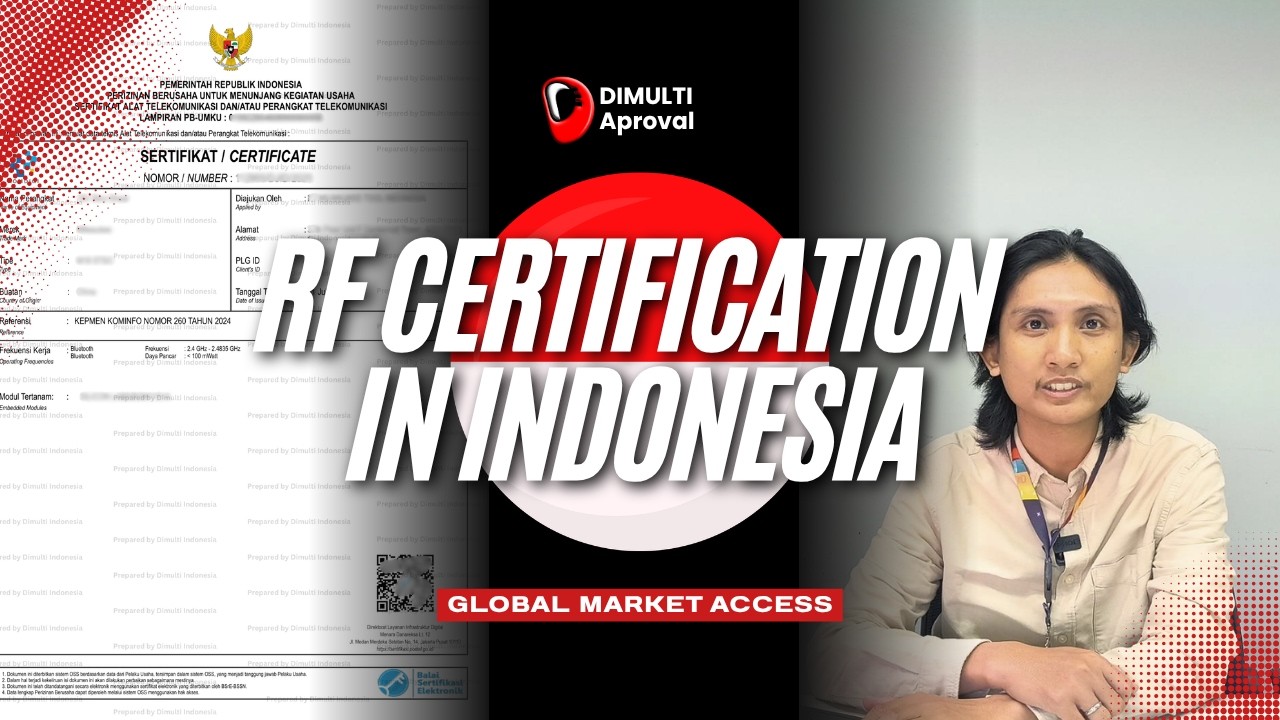
Lead time for RF certification is an important consideration. This is because the process will affect your business planning, market readiness, and budget.
The lead time for RF certification in Indonesia varies depending on the submission route you choose. Your preparation for the certification process will also affect the outcome.
In this article, we’ll cover everything you need to know about the lead time for RF certification in Indonesia. You can also watch the full video to learn the requirements in detail.
Why does Lead Time Matter?
DJID certification is proof that a telecommunications product is legally authorized for sale in Indonesia. Without this certification, your product will remain in storage.
Therefore, you need to understand the lead time for RF certification in Indonesia. This is not a technical matter, but a business decision.
The timeline for your product’s entry into the Indonesian market will depend on when the certificate is issued. Miscalculating this could allow competitors to seize your market opportunities.
Lead Time for RF Certification in Indonesia
When discussing the lead time for RF certification in Indonesia, it is impossible to separate the topic from the available certification pathways. Each application pathway has a different processing time.
As we know, there are four pathways available for applying for DJID certification: local testing, paperwork, document evaluation based on an RF module report, and partial paperwork.
Lead time for local testing
Local testing is the most comprehensive route, making it the longest process. This is because the process involves Radio Frequency (RF), Electromagnetic Compatibility (EMC), and Electrical Safety testing conducted at local laboratories in Indonesia.
The testing process itself can take about four weeks. After that, there is still the document submission and DJID evaluation process. Until the certificate is issued, the entire local testing process can take up to six weeks.
In 2027, local testing is planned to become the only route available for DJID certification. Therefore, you need to be prepared for a lengthy process to obtain this certification.
Lead time for paperwork application
The document evaluation or paperwork application for RF certification in Indonesia is the fastest route available. Choosing this route means you must prepare all required documents from the start and ensure that test results come from the appropriate laboratory.
All documents you submit will be evaluated by DJID within two to three business days, depending on the application queue. A Payment Notice (SP2) will be issued if your application passes the evaluation.
The SP2 must be paid within 14 business days. After that, the certificate will be issued automatically within 24 hours. The total processing time for the paperwork is approximately three to five business days.
Lead time for RF module report
Document evaluation via the RF Module Report pathway is dedicated to products whose RF parameters do not fully meet DJID standards. In this case, test reports from overseas generally only test spurious emission parameters.
Indonesia requires testing to four parameters: frequency range, output power, bandwidth, and spurious emissions. If this is the case, the RF module must be retested at a local laboratory.
The turnaround time for this method is similar to that of local testing, which takes about four to six weeks.
Lead time for partial paperwork
The partial paperwork route applies if you already have some international test reports, but they do not cover all the required tests. For example, you may have RF and EMC test reports from an overseas lab, but no electrical safety test report. The missing electrical safety tests must then be conducted locally.
The lead time for this method will depend on which tests are missing and the local laboratory’s capacity to complete them. Estimate a processing time of two to six weeks.
The Things That Make the Process Slow Down
When applying for RF certification in Indonesia, there are inevitably factors that can delay the process. This is true regardless of which pathway you choose. Even the fastest pathway can be delayed.
Here are some reasons that can slow down the DJID certification process:
- Incomplete documents or samples: Missing documents will result in your application being returned, so you’ll need to correct them and resubmit.
- Failed testing: This occurs when your product does not meet DJID parameters, requiring corrections and retesting.
- Lab queues: The volume of products submitted to accredited laboratories in Indonesia can be high, so your samples may have to wait in line.
To avoid these three issues, you need to make the proper preparations before beginning the application process.